Thursday, November 21, 2013

Clock Fraction Flip Books

You know you have a hit when you demonstrate the new homework assignment and the class collectively says, "Oooooooh, COOL!"

Since we've been using clocks as a model for learning fractions, I thought it might be fun to make Flip Books...in this case, mini books in which fractions appear to move, getting either bigger or smaller (depending upon the order in which you compile the pages.)

The pdf comes with 3 pages of "clock friendly" fractions. (23 fractions with an extra blank one, just in case.) At right, you see several samples of Flip Book cards, colored by a student.  The assignment asks students to:
  1. Color each given fraction. The cards come with numbers and blank clocks.
  2. Cut out the cards.
  3. Sequence the cards. They are purposely printed out of order. The set includes equivalent fractions that must be placed sequentially.
  4. Staple into a Flip Book.
The pdf is FREE in my Teachers Pay Teachers  and Teachers Notebook Stores. The pdf was revised on 11/25 to improve "flip quality." Grab your revision if you downloaded before then! ;) The clocks are now on the right side, so the opposite of what you see in the video below.

One of my students made a little stop action video to demonstrate...AKA, the "Separatists' evil clock plans..."

Wednesday, November 20, 2013

The Power of Picture Books in Teaching Math (angles!)

Tsk, tsk.

Lately, I've been so consumed with curriculum and content that I forgot some of my own advice...

USE PICTURE BOOKS WHEN TEACHING MATH!

The last couple sessions, I've made a concerted effort to include them. I've been reminded of how students new to the books...and the concepts...delight in learning math through stories.

In a specific example, I recently noticed that several students didn't know the meanings of "acute" and "obtuse" angles. I could have had them fill out a worksheet. [Yawn.] Then I remembered Sir Cumference and the Great Knight of Angleland.  In the book, Radius goes on a quest to earn his knighthood. He passes a village with "cute" rooftops, and continues through the "mountains of obtuse." In the end, he gives names to acute/obtuse angles, based on places in his journey.

My fifth graders were captivated.

After the read aloud, students easily wrote their own definitions of acute, obtuse, right, and straight angles on a Math Vocabulary Sheet. As a reader suggested, I'm now copying these with 2 pages on each side, so as to get all four definitions on a single sheet of paper. For a little 3D action I gave them toothpicks to glue on their "example" of the angles.

None of us are likely to forget acute and obtuse after this knightly adventure!

For more book suggestions, visit the Gigantic List of Math-Related Children's Books.

Disclosure: If you order from Amazon, all commissions go toward foster care through Grace and Hope at no additional cost to you. THANK YOU!

Monday, November 18, 2013

Math Monday Blog Hop: Winter & Holiday Math


What ideas would you like to share for teaching math around the winter holidays? Think about Christmas, Hanukkah, Kwanzaa, snowflakes, winter, snowmen, gingerbread and more.

Post your ideas (no ads, please!) in the blog hop below.


**************************************************************************************************************


If you want to share this collection on your blog, just grab this link:

get the InLinkz code


Sunday, November 17, 2013

Dyscalculia - A Math Learning Disability

http://love2learn2day.blogspot.com/2013/11/dyscalculia-math-learning-disability.html
Do you have a student who really struggles with math? Read up on the symptoms of dyscalculia to learn more about this learning disability. Also, read a guest post at Kids Math Teacher where a parent talks about her son's dyscalculia diagnosis.

The following videos describe more:


Saturday, November 16, 2013

Fraction Tracks Online Game

http://www.nctm.org/standards/content.aspx?id=26975
Looking for some online fraction practice? In Fraction Tracks, a 2-player game, students must add, compare, and find equivalent fractions in order to race across a series of 0-1 number lines.
This is a great game to help students increase understanding of fractions.

Friday, November 15, 2013

Fractions on the River Trail - Making Posters

Here are a few photos from class today. In this lesson from 5th grade Bridges Second Edition, students had to locate places on the "river trail," based on fractions in a 30 kilometer stretch. They initially identified fairly easy markings on the trail (1/2, 1/3, etc.) and then used those increments to figure out more challenging fractions (1/12, 1/15, etc.) of the distance, expressing final answers both in fractions and in kilometers. Phenomenal work, all!


Wednesday, November 13, 2013

Clock Fractions with a Paper Plate


In a recent post I mentioned that my students have been using clocks as a model for understanding fractions. Inspired by Pinterest, I thought it might be helpful for students to demonstrate understanding using paper plate clocks. Here's how to prep:

1. Purchase 2 colors of paper plates. I found mine at a $1 store.
2. Find the center of the plate. (There are various techniques to do this...mine was hit/miss!)
3. Cut a straight line from the edge to the center (radius!) of 2 plates--one of each color.
4. Put clock numbers on the lighter colored plate. (Again, various methods. Mine, again...hit/miss.)
5. Slide the darker plate onto the lighter plate/clock face as shown above.

Now make use of it!

What fractions do you see in the photos above?
How many equivalent fractions can you make?
Which photos can model each of the following denominators: 60, 12, 4, 3, 2?

Give students little cards and ask them to record every fraction that can be found in the photos above. Then, using their own clocks, have them model each number.

And that's only a fraction* of the possibilities! Learn how my students learned to add fractions with clocks. And see my Clock Fraction Flip Book freebie here.

Tuesday, November 12, 2013

Fraction Numberline with a Clothesline!


What do Home Depot, fractions, and clotheslines have in common?

My classroom!

Inspired by Jeffrey Frykhom's Book, Learning to Think Mathematically With the Number Line (now FREE!), I purchased a retractable clothesline from Home Depot and installed it in my classroom.


Fraction Warm-Up
Over the last couple weeks, my math class has been looking at how money and clock models can be used to make sense of fractions. In today's warm-up, I wanted to do a quick review of the fractions that we've used in our clock models.

Fraction Number Line Activity
I strung the clothesline across the room and explained the "rules" of the activity:

1. The activity is done in silence. The exception is explained in #3 below.

2. You will receive a fraction. When you get a tap on the shoulder, place the fraction where you think it goes on the number line. If you're really stuck, you can tap another student to come help you. (Still in silence.)

3. When it's your turn, you can move fractions if you think they belong elsewhere. You must justify your answer. (The only time you get to talk!) For example, you might explain where you think the number goes in proximity or sequence with other numbers. Or you might refer to the clock, reflecting on how many minutes would occur in that fraction of an hour.

4. Layer equivalent fractions on top of one another.

Getting started with the number line
Reflections & Differentiation
Students, in rapt attention, worked to figure out their fractions and watched as classmates posted new ones. For some, calculating where to put their fraction proved to be a nice challenge. For others, a higher-level challenge lay in recognizing where the number line wasn't working. I heard comments like:
  • The 1/2 needs to be exactly at the center (and other position comments.)
  • You need to reverse these because... (this is less/more than the one next to it...and then they proved it.)
  • These are equivalent because... (demonstrated proof)
The depth of the activity hugely contributed toward differentiation.
Moving a fraction...then explaining why two fractions are equivalent
Reviewing Fractions of an Hour
After all the cards were posted, I started at zero and picked up one card at a time, asking students to figure out what fraction of an hour the number represented. So, for example, for 1/12, students said 5 minutes. For accountability, I usually had them whisper the answer to their neighbor before I asked for a volunteer to give an answer and justify it. When we reached a stack of fractions on the number line, I asked them to explain why they thought the numbers were equivalent.

Showing a pattern...in this case, noticing that 12ths can be found in order.
Seeing Patterns in the Number Line
As we wrapped up, one student noticed a pattern...that all the 12ths--1/12, 2/12, 3/12, etc...--were in order on the line. Another student lit up, noticing the fourths. Then another saw the thirds.

This clothesline is going to see a lot more laundry fractions!

P.S. For a single student, try Clothespin Fractions.

Monday, November 11, 2013

Math Monday Blog Hop: Measurement


I enjoy teaching measurement, probably because it's such a diverse subject and so easy to apply to real life situations. Some of my favorites have been:

Capacity Scarecrows

How Big is a Giant's Foot?

Measuring Water Temperature and Penguin Height

What ideas would you like to share for teaching measurement? Post your ideas (no ads, please!) in the blog hop below.

P.S. Math Monday will cover time & money in December (a great month to think about both!) so save those measurement concepts for a few more weeks.
**************************************************************************************************************


If you want to share this collection on your blog, just grab this link:

get the InLinkz code


Sunday, November 10, 2013

A Ha! Brainteaser Kit...Problem Solving Perseverance!

It's no secret that I'm a fan of ThinkFun games and activities. So I was pretty excited to receive the A Ha! Brainteaser Kit for review. 

Description
The kit contains 8 colorful, plastic brainteasers designed to exercise problem-solving muscles. Each brainteaser comes with four cards; the first describes the objective and the next three provide clues on how to solve the problem.  

Uses: Individual & Classroom
The kit arrived right before my 11yo son and I left for our weekly allergy shots. We opened it in the office and alternated puzzles. My son started with "Starburst," handing it to me after a ten-minute attempt. I tried. Kept trying. Thought to myself...come on...this is designed for Grades 2-8...YOU...CAN...DO...THIS. Then, seriously, this phrase started going through my head (think Nagini to Harry Potter):
CCSS.Math.Practice.MP1 Make sssssense of problemsssss and persssssevere in ssssssolving them.
And like the little engine that could (or the middle age math teacher putting Ssssstandardsssss into Practiccccce), I DID IT! And, no, I didn't look at all the clues. Well, maybe one clue.

Starburst Puzzle with Cards
See! I did it!
Next, I introduced the kit to my 5th grade math class as a transition activity. The result? Kids frequently pick them up. Since all of our current Math Stations require partners, it's been nice for times when I have an odd number of students. Early finishers also challenge themselves with the kits.

Tips:
I've encouraged students to delay use of the hint cards (especially hints 2 & 3) as long as possible. When students work in pairs, they can discuss their problem solving strategies, thereby providing one another with hints of their own. Although I haven't done this yet, I may put out 2-3 kits on a rotating basis to use for transitions/Math Stations/early finishers and ONLY include the objective card.

Other Thoughts:
While the kit suggests use in Grades 2-8, I think it's most appropriate for gifted students in the lower grades. My 7yo first grader asked to participate along with me and my 11yo son. After about 30 minutes on a single puzzle, I began congratulating myself on my 7yos amazing attention span. Then he burst out crying. He was SO UPSET that he couldn't figure it out. (Bit of a perfectionist?) I put that puzzle away, but he immediately wanted to try another, so I guess it wasn't too traumatizing.

Conclusions:
I love this kit. I will use it with my own kids as well as my students.

Disclaimer: I was provided a free kit by ThinkFun for the purpose of review. This did not influence my opinion. Although I do appreciate the freebie!  If you order from Amazon, all commissions go toward foster care through Grace and Hope at no additional cost to you. THANK YOU!


Monday, November 4, 2013

Math Monday Blog Hop: Thanksgiving Math

http://love2learn2day.blogspot.com/2013/11/math-monday-blog-hop-thanksgiving-math.html


Welcome to Math Monday Blog Hop!!!! In this hop all links will relate to the theme: Thanksgiving Math.

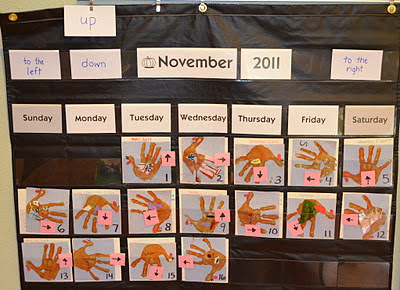
My greatest math/Thanksgiving lesson ever was the one in which we combined handprint turkeys with our math calendar for the month:

http://love2learn2day.blogspot.com/2011/11/turkey-calendar.html


 How do you bring math into your seasonal celebrations? Post your ideas in the blog hop below!
**************************************************************************************************************


If you want to share this collection on your blog, just grab this link:

get the InLinkz code

Saturday, November 2, 2013

Wondering What to Do With All Those SKITTLES? (SALE!)

SALE ALERT!!!   Is your household (or classroom) in a post-Halloween sugar stupor? Got some of these?


Maybe it's time for a little work with Skittles Fractions, Estimation & Graphing! :)

This pack is on sale through this weekend!!!  Make use of those calories! ;)


Skittle Fractions, Estimation & Graphing

Thursday, October 31, 2013

Ghost Blasters Online Game


Happy Halloween! This is a great day to practice multiples with the online (free) game, Ghost Blasters! Choose your multiple (1-20) and then blast ghosts that appear with multiples of that number.

Oh...and don't forget to GRAPH your Halloween candy! :)

Wednesday, October 30, 2013

Math Vocabulary Sheet (freebie!)

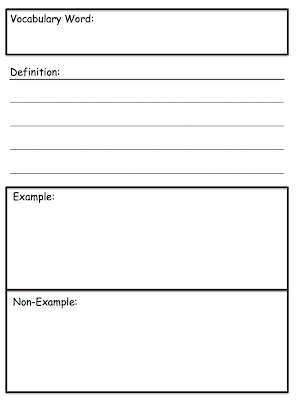
This year, my fifth graders have been recording math vocabulary in their journals. They write the word, their own definition, and an example (in pictures or numbers) as well as a non-example of the term.

The word "quotient" might show a problem with the quotient highlighted for the example and the dividend or divisor highlighted for the non-example. I recently made a little vocab record sheet to help with organization. I uploaded it to Google docs if you want to grab your own freebie.

Thank you for leaving a comment!

Tuesday, October 29, 2013

Free Virtual Math Tools

Don't miss the Edutopia post by Monica Burns highlighting 11 free apps that she uses in her 5th grade math class. She elaborates in a 45 minute webcast. I especially like the Geoboard ideas she shows at 34:00.


Monday, October 28, 2013

Math Monday Blog Hop: Math Vocabulary


Welcome to Math Monday Blog Hop!!!! In this hop all links will relate to the theme: Math Vocabulary.

This week, I'd like you to consider your own school experience. Did you use many mathematical terms? How might your math experience have been richer with more vocabulary inclusion?

Personally, I remember very little terminology. Sure, we had the basics--multiplication, addition, perimeter--but it was pretty limited. When I started teaching and had Word Resource Cards to use in the context of lessons, it brought both inspiration and challenge. I've had to learn vocabulary for the first time...as a teacher. I'm so pleased to support students with vocabulary that helps them to explain their thinking, clarifying both what they know and what they still need to figure out. I turn to resources like:
I ask kids to write their own definitions for terms we're studying, explaining their ideas with pictures, text, and sketches. How do you integrate math vocabulary? Post your ideas in the blog hop below!
**************************************************************************************************************


If you want to share this collection on your blog, just grab this link:

get the InLinkz code

Sunday, October 27, 2013

Flies Make Fabulous Math Manipulatives!

Reposting to enjoy during the Halloween season... Plastic flies are readily available at this time of year!


Since our study this week included insects, I thought it might be fun to do a little math "on the fly." Turns out that plastic flies are the perfect math manipulative. They're quiet. (No buzz. Honest.) Cheap. (Bought mine at the dollar store.) Fit great in a kid's hand. Are big enough to find if they "fly" to the floor. (Although we didn't really have trouble with flying flies...) And the math exploration possibilities are endless. (I saw the idea for counting flies here, but I extended it.) Flies would make great manipulatives for probability or fraction work with older kids. But this week was at the kindergarten level.

1. Practice writing numbers:
I made a sheet with the numbers I wanted my kids to practice. I gave each child 5 flies to spill out of the hand and onto the desktop.  Children then traced the number of "dead flies" (ones that landed on their backs) in one color and number of "live flies" (upright) in another color.

2. Practice addition bonds:
I set a target number and gave the child that number of flies to spill onto a desktop. We started with 5 flies. I made a worksheet to record a fly addition sentence: Dead Flies + Live Flies = How Many Flies Altogether? I put the paper in a page protector so we could change the target number. The picture matches the type of flies I found, but I think you could use it with any plastic fly. As long as kids record the upright flies in one column and the upside down flies in the other column, they're good to go. I mean fly!

On the first day, one little guy looked at the column of sums and remarked, "It always equals FIVE!"

Click on the picture for a free Google Doc download. Since I can't see how many people download, you'd make my day if you'd leave a comment saying you grabbed a copy! :)


This little activity would make a great Math Station or Work Box.

Related Kindergarten Standards:

K.CC.3. Write numbers from 0 to 20. Represent a number of objects with a written numeral 0-20 (with 0 representing a count of no objects).
K.CC.4. Understand the relationship between numbers and quantities; connect counting to cardinality.
K.CC.5. Count to answer “how many?” questions about as many as 20 things arranged in a line, a rectangular array, or a circle, or as many as 10 things in a scattered configuration; given a number from 1–20, count out that many objects.
K.OA.1. Represent addition and subtraction with objects, fingers, mental images, drawings1, sounds (e.g., claps), acting out situations, verbal explanations, expressions, or equations.
K.OA.2. Solve addition and subtraction word problems, and add and subtract within 10, e.g., by using objects or drawings to represent the problem.
K.OA.3. Decompose numbers less than or equal to 10 into pairs in more than one way, e.g., by using objects or drawings, and record each decomposition by a drawing or equation (e.g., 5 = 2 + 3 and 5 = 4 + 1).
K.OA.5. Fluently add and subtract within 5.

Saturday, October 26, 2013

John Boy Walton, Where is MY Room?

If the mere sight of this:


...makes you start to long for calls of "Goodnight John Boy"...I get it.

Yep. I grew up under the illusion that I was half Walton. To this day, I'm pretty sure that MaryEllen is a long-lost sister and that Grandpa's land deed will eventually prove that I'm to inherit a piece of the mountain.

If you need more proof, just look at my childhood lunchbox. It holds a place of honor on my living room shelf.

Last week I visited Virginia for the first time. Along with a trip to Monticello, I couldn't help but visit the next most famous historical site. What else? Walton's Mountain...in non-t.v. land, that would be Schuyler, VA.

So here's my conundrum. I got to see the original "Waltons" (Hamner) house. Based on the television series, I assume that all the kids (7 on t.v., but 8 in real life), parents, and grandparents slept there. Real life = twelve people. Yet here's the real house:

Too cheap and in a hurry to tour the place, I'll take the word of fellow tourists that the place only had 3 bedrooms. So where did all twelve people sleep? As a half sister, I'd love to know!

So that's my math problem for the week:

3 bedrooms
divided by
2 grandparents
2 parents
8 kids

Do the math.
I don't think there's room for any half sisters.
Sigh.

P.S. A reader sent me a message that might explain more:
"My mother grew up in Tennessee/Georgia in the 1940s. They slept 3 to 4 kids per bed; living rooms had beds in them. There wasn't much leisure time, so you didn't need a "living room" or a sofa. She said you were either working at chores or sleeping!"

Monday, October 21, 2013

Math Monday Blog Hop: Fractions

Welcome to Math Monday Blog Hop!!!! In this hop all links will relate to the theme: Fractions


If you want to share this collection on your blog, just grab this link:

get the InLinkz code

Monday, October 14, 2013

Math Monday Blog Hop: Geometry

Welcome to Math Monday Blog Hop!!!! In this hop all links will relate to the theme: Geometry.


If you want to share this collection on your blog, just grab this link:

get the InLinkz code

Related Posts with Thumbnails
Blogging tips