Showing posts with label Visual Models. Show all posts

Wednesday, June 29, 2016

Chalk, Animals, & Tile: Summertime Fun with Area & Perimeter


On my summer reading list: Jo Boaler's Mathematical Mindsets: Unleashing Students' Potential through Creative Math, Inspiring Messages and Innovative Teaching.

Yesterday, I read her challenge to teach math content using a question rather than following a procedure. (p. 78) She offers this suggestion:
"Instead of asking students to find the area of a 12 by 4 rectangle, ask them how many rectangles they can find with an area of 24."
And voila...we have a summer afternoon activity for a slightly bored child whose siblings are all at camp!

I posed the situation this way...

A farmer has pens that each contain an area of 24 square units. The farmer wants to know how many different rectangular pens he can make.

Then we got out the chalk, tile, and animals.  The first pen he built, 4 x 6, was for the cows:
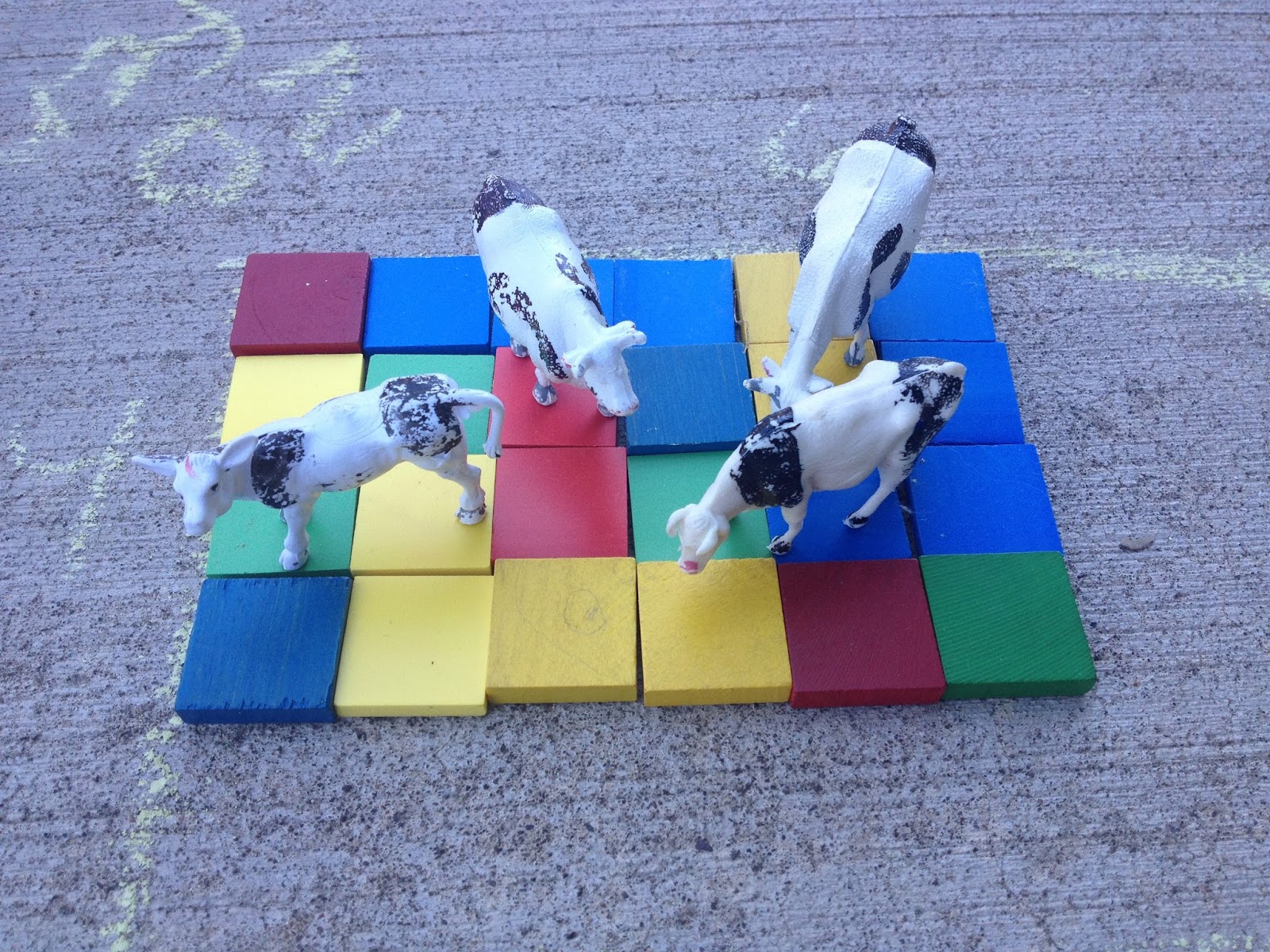

I asked what other pens fit the criteria of 24 square units. He thought for a bit. "6 x 4?" We agreed that since this had the same dimensions, we wouldn't built it. He soon thought of another: 3 x 8.


He asked if this farm could have penguins. Sure, why not? The next pen took a bit more thought, but after some think time he built a 2 x 12 for the pigs.


I asked if this included all the possibilities for pens with an area of 24. He wasn't sure, so we made a list. (Ideally, he would have played around with 24 tile, exploring how many different rectangles could be made, but the farmer was getting tired.)


Although he didn't want to make the 1 x 24, he talked about how LONGGGG that one would be.

Then I asked another question:

The farmer needs to buy fencing for each of the pens. One section of fence covers one side of a tile. Which pen has the cheapest fencing? Which has the most expensive?

At first he predicted that the "biggest" pen would have the most fence. (At this point, in his mind, the 4x6 pen was "biggest." After all, it did contain the cows! Later on, I asked about pen size and he was able to say that they are all the same.)

His findings:
4x6 area = 20 sections of fence
3x8 area = 22 sections of fence
2x12 area = 28 sections of fence
1x24 area = 50 sections of fence

His eyes got really big when he heard it would take 50 sections of fence. He remarked that the chunkier pens have less fence because more of the edges are in the middle. I asked if he knew another name for the "fence" or the distance around. He named it perimeter.

Thanks, Jo, for a great summertime exploration!

p.s. Try making your own farms with pens of 36, 100, or other areas!

Tuesday, June 28, 2016

Student Notebook Strategy Posters


This quick, easy idea is one that works well for student notebooks. When I work with students on strategies, I often create a classroom anchor chart for the wall. I like to record the name of the student who used the strategy, along with a title that clearly describes the strategy. Kids love to see their own names in print and when they're asked to name what happens in the strategy, they often delve into rich mathematical thinking and discussion to define exactly what it is that they've done.


To give students greater ownership in the process, I invite students to make their own posters to go in their math notebooks or journals. I give each child an 11" x 17" paper, folded near (but not on) the halfway mark and 3-hole punched on the left. This way, the poster can be folded and added to their math notebooks as permanent reference.

Today, we made posters for Addition Strategies. If you click on the photos, you can see that we depict and name a variety of strategies. You'll also notice that this exercise is appealing to the artists in the crowd.

Wednesday, June 22, 2016

Multiplication Strategies: x2, x4, x8


Over the past week, my son and I have made tremendous progress with multiplication. (Intro post here.) Each day, we add to his fluency toolbox by looking at specific strategies. The (related) strategies for 2s, 4s, and 8s, have been especially fruitful. Let's look at why...

2s...Dare to DOUBLE!
Twos are easy-peasy. Just a matter of doubling. We can see an example in this array.


If you multiply something by 2, you only need to double. Instead of 1 group of 6, you have 2 groups of 6; you just double 6.


4s...Double-Double
In Bridges in Mathematics, the strategy for multiplying by 4s is called Double-Double. It's easy to see why.

We already doubled when we multiplied by 2. To go from 2x a number to 4x a number, we double. So we double, then double again.

6 is doubled to 12 (x2)
12 is doubled to 24 (x4)

I bet you can guess what's coming next!


8s...Double-Double-Double
We call the strategy for 8s Double-Double-Double.
For 8x, we double 3 times:

6 is doubled to 12 (x2)
12 is doubled to 24 (x4)
24 is doubled to 48 (x8)

Can you see it in the model?

This is not a multiplication "trick" but rather a strategy with meaning behind it. Children need to see the visual model and understand what "Double-Double-Double" means. Once they understand the concept, they can apply it in wonderful ways.

I asked my son (just developing fluency with single digit multiplication) to consider these problems.

8 x 15 = ?

He doubled 15 and got 30. He doubled 30 (60). And doubled once more to get 120. So 8 x 15 = 120.

4 x 13 = ?

Double 13 to get 26. Double 26 to get 52. (Of course he then wanted to keep going and figure out 8 x 13. Double 52 and get 104!)

25 x 8 = ?

50, 100, 200, done! This problem was also a great opportunity to talk about another strategy. Do you know what it is? Leave your ideas in the comments below to start a RICH exchange.

Hope you're having a double dose of summer fun!

Credits:
Little Girl Graphic from: www.mycutegraphics.com
Number Frames (free app) from: http://www.mathlearningcenter.org/web-apps/number-frames/

Friday, June 17, 2016

Multiplication Fluency: Summer Practice


Ready for a start-to-summer quiz?
Question: What happens when the math coach's child begins the summer by taking a multiplication fluency assessment in which he answers 20 problems in 4.5 minutes when the fluency guideline is 20 problems in 1 minute?

Answer: Summer math!  (Don't you wish you lived at my house?)
In case anyone else is in a similar predicament, here are a few resources to get you started...

First, "fluency" does not equate memorization. If you're interested in the difference between "by memory" and "memorization," check out this article. Fluency means accurate, efficient, and flexible mathematical thinking. Think about reading fluency. A fluent reader is not just fast. 120 words-per-mind counts for nothing without comprehension. Fluent readers AND mathematicians are  accurate, efficient, and flexible.

Although every child needs to master all three areas, he may demonstrate challenges in one area over the others. In our case, flexibility is an issue. Although my child knows some strategies for working with multiplication, it doesn't appear to be something that's been emphasized in his education. To that end, we are working to increase his strategy toolbox.

I pulled the Multiplication & Division Discussion Cards from Opening Eyes to Mathematics. (Cards are located on pp. 32-35 in this pdf, free from The Math Learning Center.) We flip through several cards a day and talk about what strategies could be used to solve a problem. For example:

What multiplication expression is represented here? (8 x 8)

How could we look at pieces of this array to help us solve the problem? Maybe we could see it as two parts: 8 x 5 and 8 x 3.

So 8 x 8 = (8 x 5) + (8 x 3) = 40 + 24 = 64

Or maybe you see it as two groups of 4 x 8:


What about this one? Could you use what you already know about 10 x 7 to help you figure out
9 x 7?


Strategies become critical when you get to larger multiplication problems, so this is definitely something we want to work on now.

Although fluency doesn't equate speed, it is generally expected that students be able to complete 20 problems in 1 minute to meet fluency standards. With the strategies in hand, I plan to assess his progress using the free online program, Xtra Math. I would not use this in isolation as I don't want to overemphasize speed, but when combined with visual models and strategies, it's a reasonable way for  both of us to track his progress.

Tuesday, March 15, 2016

Standard Algorithm For Subtraction: Sometimes Yes, Sometimes NO!!!!


Introductory note: For the past year, I've been working as a K-5 Math Coach. Not surprisingly, I have learned a lot. I hope the following blog post expresses just a bit of the wonder of the past year...

I developed a new appreciation for the power of strategies taught in Bridges when a third grader approached me for help on a worksheet he received in his (non-Bridges) classroom. The “Zero-Concept” worksheet included 36 problems with multi-digit subtraction, intended for practice with borrowing across zeros, solely using the standard algorithm.


Although this was the intent (and yes, the way many of us were taught!), it quickly became obvious that several other strategies might produce more efficient results. The third grade standard 3.NBT.2 specifically calls for this:

“Fluently add and subtract within 1000 using strategies and algorithms based on place value, properties of operations, and/or the relationship between addition and subtraction.”

One of the key words, “algorithms” is plural for a reason. We want students to develop fluency defined by accuracy, efficiency, and flexibility. In this standard, students demonstrate fluency using multiple, flexible strategies--strategies selected because of their strength with a particular set of numbers.

The very first problem, 420-115, seemed a good candidate for Partial Place Value Splitting, one of several strategies explored in Bridges.


The student could mentally solve the problem using this strategy; he was surprised by how easy it was to break the subtrahend into manageable pieces and then subtract.

Another problem, 200-189, seemed ideal for Finding the Difference.


Again, once he understood the strategy, the problem was easy to solve mentally. In comparison, the standard algorithm was very complex and inefficient, leaving a lot of room for error.


The Removal Strategy (using a Number Line) worked for 500-333. He also noted that this could be done mentally using Partial Place Value Splitting, taking away 300, then 30, then 3.


Once again, borrowing across multiple zeros seemed unnecessarily complex with a high possibility of error.

A problem like 703-187 became a prime candidate for Constant Difference. Here it's illustrated on a number line:


He agreed that it was far easier to solve 716-200 than 703-187. And it's so simple to get there. Just add 13 to both the minuend and the subtrahend.

Looking over the worksheet we noted that while the standard algorithm might be an efficient method for a handful of problems, for the majority it was not. But perhaps the most surprising to my student: the number of problems that could be completely solved with mental math, using one of the above strategies.

If we think of fluency in terms of accurate, efficient, and flexible thinking, students are best served when they have a variety of strategies from which to choose. By the time we were done, my young friend heartily agreed!


Related Posts with Thumbnails
Blogging tips