Showing posts with label Math Notebooking. Show all posts
Tuesday, June 28, 2016
Student Notebook Strategy Posters
This quick, easy idea is one that works well for student notebooks. When I work with students on strategies, I often create a classroom anchor chart for the wall. I like to record the name of the student who used the strategy, along with a title that clearly describes the strategy. Kids love to see their own names in print and when they're asked to name what happens in the strategy, they often delve into rich mathematical thinking and discussion to define exactly what it is that they've done.
To give students greater ownership in the process, I invite students to make their own posters to go in their math notebooks or journals. I give each child an 11" x 17" paper, folded near (but not on) the halfway mark and 3-hole punched on the left. This way, the poster can be folded and added to their math notebooks as permanent reference.
Today, we made posters for Addition Strategies. If you click on the photos, you can see that we depict and name a variety of strategies. You'll also notice that this exercise is appealing to the artists in the crowd.
Labels:
Addition,
Fact Fluency,
Fluency,
Math Journal,
Math Notebooking,
Visual Models
Saturday, August 29, 2015
Fly on the Math Teacher's Wall: Personalized Math Notebook Covers
Here's an idea for getting your math year off to a great start...
When I posted about Math Journals & Notebooks, I mentioned that I loved the idea of having children make covers relating math to themselves as Courtney shares at A Middle School Survival Guide. Ideally, I'd begin the lesson by reading aloud a book that relates math to everyday life. (I mention several suggestions here.)
- time you wake up/go to sleep
- # of favorite ____________ (sports, colors, hobbies)
- # of years _____________ (teaching, being a student, playing an instrument or sport)
- time each day that you ___________ (exercise, go to school, watch tv, read, play video games)
- # of _____________ that you own (pets, video games, books)
- # of years until you (finish school, turn 21, want to get married or have kids)
- cost of your favorite (restaurant meal, soda, candy bar)
- amount you spent per week on (lunch, snacks, coffee)
These covers then become a fabulous jumping-off point for PROBLEM SOLVING.
After students finish their covers, have them generate several problems on 3x5" notecards that use the information they created. For example, on my cover, I posted the following:
I went ahead and wrote my problem on the cover itself, but would have students write on cards. My question, "How many hours do I sleep each night? Each week?" could then be posed to other students. In the classroom, I could put my cover under the document camera and ask students to answer the question posed on my card(s). They could then share a variety of strategies for solving the problem. In a homeschool setting, children could write problems for siblings or parents to solve. Problems could be written at a wide variety of levels, making them grade and age appropriate.
At the Northwest Math Conference I went to a workshop entitled, "Taking the Numb Out of Numbers" by Don Fraser (Ontario, Canada). He began by telling the group of 30 of us, "Did you know that in a group of 23 or 24 there is a 50% chance that at least two people in the group will have the same birthday?" He then gave us a graph showing us the probability of sharing the same birthday in groups of varying sizes. In a group our size--30 people--the likelihood was 70%. We graphed the days/months for birthdays in the room. Interestingly enough, none of us shared the same birthday...we were in the 30%. After looking at the data, Don asked us to come up with problem solving questions--real life questions--based on the information we'd collected. It was amazing to see how many questions we could generate, at all different levels of mathematical knowledge and proficiency.
Don encouraged us to begin each day by reading a "story" and having kids make up a question/word problem. Going back to the math notebook covers, imagine the possibilities if you put ONE child's notebook cover up each day and asked kids to generate questions from the "stories" found there. The problem solving possibilities are endless!
Do your students make personalized math notebook covers? What interesting stats have they included? Comment below with your stories and then visit Mrs. Balius and read what she has to say about setting up daily math routines!!! :)
Labels:
Math Journal,
Math Notebooking
Thursday, October 9, 2014
Have Multiple & Factor Confusion?
Kids sometimes find it confusing to differentiate between multiples & factors. Here are a few visuals that I've found helpful:Multiple: the product of a given number and another number.
We could show this on a number line:

To find the multiples of 3, we can start with our given number (3) and then multiply it by 2 (6), by 3 (9), by 4 (12), and so on...
We also see multiples represented by tile (Number Pieces):
1 group of 3 tile = 3
2 groups of 3 tile = 6
3 groups of 3 tile = 9
4 groups of 3 tile = 12
We can also use a visual model to investigate factors.
Factors: numbers that, when multiplied together, result in a product.
One of my favorite ways to do this? Lay out the product with tile (Number Pieces). Let's look at 12:
Use the 12 tile to form as many rectangular arrays as possible. The dimensions produce factors of the number. Here we can see arrays with dimensions of:
1 x 12
2 x 6
3 x 4
(Note: When using this visual model, prime numbers are also easy to distinguish: if it's prime, only one rectangular array--a 1 by the number--is possible.)
Why Do We Care?
My son is currently taking AP Calculus. He just popped in my office, saw what I was doing and said, "For us, finding factors is just one tiny step in a huge process. We do it all the time." Factors are a part of higher level math! And, at a slightly lower level, students frequently use factors when working with fractions...not to mention (!) multiplication.
Additional Resources
I just created Fold It!...Factors & Multiples, a new set of flap books (Venn Diagrams & Shutter Folds) for students to compare and contrast factors and multiples. When complete, pages make a nice addition to student math journals. Alternate versions (different number combinations as well as blank copies) are included to allow for many uses: differentiation, exit slips, homework, notebook pages, math stations, etc.
As always, new products (& bundles) are introduced with a sale price.
More Ideas
Looking for more ideas? Here are some of my favorites from around the web:
- Flap Books & Online Games - in this blog entry, I share photos of flap books we made and link to a variety of games on the web
- Factor & Multiple Anchor Charts with Student-Made Posters from Young Teacher Love - both are awesome.
Online Venn Diagram - create your own Venn Diagram to compare factors & multiples (example, right)- Multiple Mummy - kids use adding machine tape to make multiple strips and turn their teacher into a mummy.
Sunday, December 15, 2013
Factors & Multiples: Flap Books & Online Games
Although factors and multiples are a 4th grade focus*, they are definitely something that we fifth grade teachers like LOVE to review.
To keep my students' skills sharp during holiday break, I created factor and multiple flap books. These little "presents" require students to write the definition of "factor" and "multiple" and list 5 multiples for 2-10 and all the factors for 6,7,8,9,10,12,18, 24, 36. Blank versions are also included for teachers or students who want to use their own numbers. When these little homework assignments return from break (!), they will be added to our math notebooks.


You'll find Presenting Multiples & Factors at:
Teachers Notebook
Teachers Pay Teachers
*factors & multiples are in CCSS.Math.Content.4.OA.B.4
Looking for more factor and multiple practice over break? Below, you'll find links to some of my favorite related games:
Table Numbers - Choose a factor from 2-9, then click on one of three numbers that represents a multiple of the chosen factor.
Times Square - find factors as you race to get four products in a row.
Factor Dazzle- Click on the factors of target numbers set by an opponent. Use Guest Pass or register to play against students online.
Factor Game - Click on the factors of target numbers set by an opponent. Play against the computer or a friend.
To keep my students' skills sharp during holiday break, I created factor and multiple flap books. These little "presents" require students to write the definition of "factor" and "multiple" and list 5 multiples for 2-10 and all the factors for 6,7,8,9,10,12,18, 24, 36. Blank versions are also included for teachers or students who want to use their own numbers. When these little homework assignments return from break (!), they will be added to our math notebooks.
You'll find Presenting Multiples & Factors at:
Teachers Notebook
Teachers Pay Teachers
*factors & multiples are in CCSS.Math.Content.4.OA.B.4
Looking for more factor and multiple practice over break? Below, you'll find links to some of my favorite related games:
Table Numbers - Choose a factor from 2-9, then click on one of three numbers that represents a multiple of the chosen factor.
Times Square - find factors as you race to get four products in a row.
Factor Dazzle- Click on the factors of target numbers set by an opponent. Use Guest Pass or register to play against students online.
Factor Game - Click on the factors of target numbers set by an opponent. Play against the computer or a friend.
Wednesday, October 30, 2013
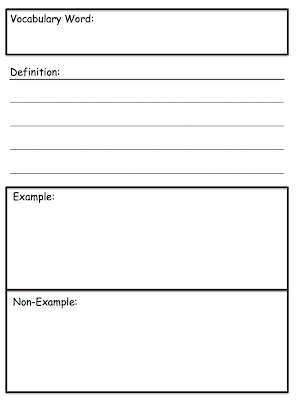
Math Vocabulary Sheet (freebie!)
This year, my fifth graders have been recording math vocabulary in their journals. They write the word, their own definition, and an example (in pictures or numbers) as well as a non-example of the term.
The word "quotient" might show a problem with the quotient highlighted for the example and the dividend or divisor highlighted for the non-example. I recently made a little vocab record sheet to help with organization. I uploaded it to Google docs if you want to grab your own freebie.
Thank you for leaving a comment!
The word "quotient" might show a problem with the quotient highlighted for the example and the dividend or divisor highlighted for the non-example. I recently made a little vocab record sheet to help with organization. I uploaded it to Google docs if you want to grab your own freebie.
Thank you for leaving a comment!
Labels:
Math Notebooking,
Math Vocabulary
Wednesday, August 29, 2012
My Life in Numbers
Here's an idea for getting your math year off to a great start...
When I posted about Math Journals & Notebooks, I mentioned that I loved the idea of having children make covers relating math to themselves as Courtney shares at A Middle School Survival Guide. Ideally, I'd begin the lesson by reading aloud a book that relates math to everyday life. (I mention several suggestions here.)
When I first considered what might go on a cover, I didn't have a lot of ideas. I just thought about # of siblings or children, year of birth or age, height or weight, etc. But the more I considered, the more ideas multiplied! I'd definitely want to do this as a brainstorming activity with students rather than giving them a list. See what your collective brain energy can come up with! How is math related to our daily life? Here are some of the things we thought of:
A follow-up post will show you how to turn this into a problem solving activity!!
When I posted about Math Journals & Notebooks, I mentioned that I loved the idea of having children make covers relating math to themselves as Courtney shares at A Middle School Survival Guide. Ideally, I'd begin the lesson by reading aloud a book that relates math to everyday life. (I mention several suggestions here.)
When I first considered what might go on a cover, I didn't have a lot of ideas. I just thought about # of siblings or children, year of birth or age, height or weight, etc. But the more I considered, the more ideas multiplied! I'd definitely want to do this as a brainstorming activity with students rather than giving them a list. See what your collective brain energy can come up with! How is math related to our daily life? Here are some of the things we thought of:
- time you wake up/go to sleep
- # of favorite ____________ (sports, colors, hobbies)
- # of years _____________ (teaching, being a student, playing an instrument or sport)
- time each day that you ___________ (exercise, go to school, watch tv, read, play video games)
- # of _____________ that you own (pets, video games, books)
- # of years until you (finish school, turn 21, want to get married or have kids)
- cost of your favorite (restaurant meal, soda, candy bar)
- amount you spent per week on (lunch, snacks, coffee)
A follow-up post will show you how to turn this into a problem solving activity!!
Labels:
Math Journal,
Math Notebooking
Sunday, October 30, 2011
My Life in Numbers II...Real Life Problem Solving
Earlier this week, I posted about a fabulous idea Courtney shared at A Middle School Survival Guide having students make Math Journal or Notebook covers telling math ideas about themselves. I've found that these covers become a fabulous jumping-off point for PROBLEM SOLVING.
After students finish their covers, have them generate several problems on 3x5" notecards that use the information they created. For example, on my cover, I posted the following:
I went ahead and wrote my problem on the cover itself, but would have students write on cards. My question, "How many hours do I sleep each night? Each week?" could then be posed to other students. In the classroom, I could put my cover under the document camera and ask students to answer the question posed on my card(s). They could then share a variety of strategies for solving the problem. In a homeschool setting, children could write problems for siblings or parents to solve. Problems could be written at a wide variety of levels, making them grade and age appropriate.
At the Northwest Math Conference I went to a workshop entitled, "Taking the Numb Out of Numbers" by Don Fraser (Ontario, Canada). He began by telling the group of 30 of us, "Did you know that in a group of 23 or 24 there is a 50% chance that at least two people in the group will have the same birthday?" He then gave us a graph showing us the probability of sharing the same birthday in groups of varying sizes. In a group our size--30 people--the likelihood was 70%. We graphed the days/months for birthdays in the room. Interestingly enough, none of us shared the same birthday...we were in the 30%. After looking at the data, Don asked us to come up with problem solving questions--real life questions--based on the information we'd collected. It was amazing to see how many questions we could generate, at all different levels of mathematical knowledge and proficiency.
Don encouraged us to begin each day by reading a "story" and having kids make up a question/word problem. Going back to the math notebook covers, imagine the possibilities if you put ONE child's notebook cover up each day and asked kids to generate questions from the "stories" found there. The problem solving possibilities are endless!
After students finish their covers, have them generate several problems on 3x5" notecards that use the information they created. For example, on my cover, I posted the following:
I went ahead and wrote my problem on the cover itself, but would have students write on cards. My question, "How many hours do I sleep each night? Each week?" could then be posed to other students. In the classroom, I could put my cover under the document camera and ask students to answer the question posed on my card(s). They could then share a variety of strategies for solving the problem. In a homeschool setting, children could write problems for siblings or parents to solve. Problems could be written at a wide variety of levels, making them grade and age appropriate.
At the Northwest Math Conference I went to a workshop entitled, "Taking the Numb Out of Numbers" by Don Fraser (Ontario, Canada). He began by telling the group of 30 of us, "Did you know that in a group of 23 or 24 there is a 50% chance that at least two people in the group will have the same birthday?" He then gave us a graph showing us the probability of sharing the same birthday in groups of varying sizes. In a group our size--30 people--the likelihood was 70%. We graphed the days/months for birthdays in the room. Interestingly enough, none of us shared the same birthday...we were in the 30%. After looking at the data, Don asked us to come up with problem solving questions--real life questions--based on the information we'd collected. It was amazing to see how many questions we could generate, at all different levels of mathematical knowledge and proficiency.
Don encouraged us to begin each day by reading a "story" and having kids make up a question/word problem. Going back to the math notebook covers, imagine the possibilities if you put ONE child's notebook cover up each day and asked kids to generate questions from the "stories" found there. The problem solving possibilities are endless!
Labels:
Math Journal,
Math Notebooking,
Problem Solving
Tuesday, October 25, 2011
Math Journals & Notebooks
This is one of the times I feel very grateful to have connections to both the public school and homeschool community. Excitement bubbles in the homeschool world over lapbooks (we do an "on-steroids" version called Portfolders), closely followed by notebooks, where students demonstrate learning through student-made folders, foldables and creative notebook pages. Some homeschoolers focus specifically on math. Recently, I've seen a lot of fabulous information on teacher blogs about using journals/notebooks in the context of math. Since we are using math notebooks this year, I'm enjoying...
1. Designing our journal covers
I love this idea. This teacher had her students design journal covers using "Math About Me." Students used numbers, pictures, word problems, etc. to represent themselves mathematically. In an upcoming post, I'll share ours...along with some fun extensions.
2. Basic Journal Pages
I'm using blacklines from the Bridges Math Journal as pages. The bulk of the pages are centimeter grid paper which makes it helpful when we're doing math problems, drawing graphs, making diagrams, etc. The back of the journal includes visuals in a blank math glossary (designed for students to fill in) which matches the Word Resource Cards that we use. I'm going to have my student refer to the visual glossary and the Word Resource Cards whenever we add vocabulary to the journal.
3. We'll use flaps, foldables and other interactive models.
In our Portfolders, we use a lot of flips and flaps to demonstrate learning in fun, interactive ways. Dinah Zike is the Queen of Foldables and has many great resources, including Big Book of Math and Notebook Foldables. Some of these are displayed at Simply2ndResources.
So what exactly are math journals/notebooks for? We'll be using them to...
Runde's Room
Jimmie on Math Notebooking
Math Journals Boost Real Learning
I'll be back soon with examples from our notebooks! Would you like to share yours?
1. Designing our journal covers
I love this idea. This teacher had her students design journal covers using "Math About Me." Students used numbers, pictures, word problems, etc. to represent themselves mathematically. In an upcoming post, I'll share ours...along with some fun extensions.
2. Basic Journal Pages
I'm using blacklines from the Bridges Math Journal as pages. The bulk of the pages are centimeter grid paper which makes it helpful when we're doing math problems, drawing graphs, making diagrams, etc. The back of the journal includes visuals in a blank math glossary (designed for students to fill in) which matches the Word Resource Cards that we use. I'm going to have my student refer to the visual glossary and the Word Resource Cards whenever we add vocabulary to the journal.
3. We'll use flaps, foldables and other interactive models.
In our Portfolders, we use a lot of flips and flaps to demonstrate learning in fun, interactive ways. Dinah Zike is the Queen of Foldables and has many great resources, including Big Book of Math and Notebook Foldables. Some of these are displayed at Simply2ndResources.
So what exactly are math journals/notebooks for? We'll be using them to...
- Write our own definitions of math vocabulary used in our daily lessons.
- Demonstrate our understanding of math using pictures, numbers, diagrams, etc...
- Refer back to math concepts that we explored earlier in the year. We'll continue to add to our knowledge by revising and adding to what we've already written.
- Provide ample opportunity to write in the context of math.
- Explore problem solving in creative ways, often using children's books.
- Look at math in many settings: daily life, historical, games & more
Runde's Room
Jimmie on Math Notebooking
Math Journals Boost Real Learning
I'll be back soon with examples from our notebooks! Would you like to share yours?
Labels:
Math Journal,
Math Notebooking,
Math Vocabulary
Subscribe to:
Posts (Atom)