Showing posts with label Multiplication. Show all posts

Wednesday, June 22, 2016

Multiplication Strategies: x2, x4, x8


Over the past week, my son and I have made tremendous progress with multiplication. (Intro post here.) Each day, we add to his fluency toolbox by looking at specific strategies. The (related) strategies for 2s, 4s, and 8s, have been especially fruitful. Let's look at why...

2s...Dare to DOUBLE!
Twos are easy-peasy. Just a matter of doubling. We can see an example in this array.


If you multiply something by 2, you only need to double. Instead of 1 group of 6, you have 2 groups of 6; you just double 6.


4s...Double-Double
In Bridges in Mathematics, the strategy for multiplying by 4s is called Double-Double. It's easy to see why.

We already doubled when we multiplied by 2. To go from 2x a number to 4x a number, we double. So we double, then double again.

6 is doubled to 12 (x2)
12 is doubled to 24 (x4)

I bet you can guess what's coming next!


8s...Double-Double-Double
We call the strategy for 8s Double-Double-Double.
For 8x, we double 3 times:

6 is doubled to 12 (x2)
12 is doubled to 24 (x4)
24 is doubled to 48 (x8)

Can you see it in the model?

This is not a multiplication "trick" but rather a strategy with meaning behind it. Children need to see the visual model and understand what "Double-Double-Double" means. Once they understand the concept, they can apply it in wonderful ways.

I asked my son (just developing fluency with single digit multiplication) to consider these problems.

8 x 15 = ?

He doubled 15 and got 30. He doubled 30 (60). And doubled once more to get 120. So 8 x 15 = 120.

4 x 13 = ?

Double 13 to get 26. Double 26 to get 52. (Of course he then wanted to keep going and figure out 8 x 13. Double 52 and get 104!)

25 x 8 = ?

50, 100, 200, done! This problem was also a great opportunity to talk about another strategy. Do you know what it is? Leave your ideas in the comments below to start a RICH exchange.

Hope you're having a double dose of summer fun!

Credits:
Little Girl Graphic from: www.mycutegraphics.com
Number Frames (free app) from: http://www.mathlearningcenter.org/web-apps/number-frames/

Friday, June 17, 2016

Multiplication Fluency: Summer Practice


Ready for a start-to-summer quiz?
Question: What happens when the math coach's child begins the summer by taking a multiplication fluency assessment in which he answers 20 problems in 4.5 minutes when the fluency guideline is 20 problems in 1 minute?

Answer: Summer math!  (Don't you wish you lived at my house?)
In case anyone else is in a similar predicament, here are a few resources to get you started...

First, "fluency" does not equate memorization. If you're interested in the difference between "by memory" and "memorization," check out this article. Fluency means accurate, efficient, and flexible mathematical thinking. Think about reading fluency. A fluent reader is not just fast. 120 words-per-mind counts for nothing without comprehension. Fluent readers AND mathematicians are  accurate, efficient, and flexible.

Although every child needs to master all three areas, he may demonstrate challenges in one area over the others. In our case, flexibility is an issue. Although my child knows some strategies for working with multiplication, it doesn't appear to be something that's been emphasized in his education. To that end, we are working to increase his strategy toolbox.

I pulled the Multiplication & Division Discussion Cards from Opening Eyes to Mathematics. (Cards are located on pp. 32-35 in this pdf, free from The Math Learning Center.) We flip through several cards a day and talk about what strategies could be used to solve a problem. For example:

What multiplication expression is represented here? (8 x 8)

How could we look at pieces of this array to help us solve the problem? Maybe we could see it as two parts: 8 x 5 and 8 x 3.

So 8 x 8 = (8 x 5) + (8 x 3) = 40 + 24 = 64

Or maybe you see it as two groups of 4 x 8:


What about this one? Could you use what you already know about 10 x 7 to help you figure out
9 x 7?


Strategies become critical when you get to larger multiplication problems, so this is definitely something we want to work on now.

Although fluency doesn't equate speed, it is generally expected that students be able to complete 20 problems in 1 minute to meet fluency standards. With the strategies in hand, I plan to assess his progress using the free online program, Xtra Math. I would not use this in isolation as I don't want to overemphasize speed, but when combined with visual models and strategies, it's a reasonable way for  both of us to track his progress.

Thursday, October 9, 2014

Have Multiple & Factor Confusion?


Kids sometimes find it confusing to differentiate between multiples & factors. Here are a few visuals that I've found helpful:

Multiple: the product of a given number and another number. 

We could show this on a number line:


To find the multiples of 3, we can start with our given number (3) and then multiply it by 2 (6), by 3 (9), by 4 (12), and so on... 

We also see multiples represented by tile (Number Pieces):

1 group of 3 tile = 3
2 groups of 3 tile = 6
3 groups of 3 tile = 9
4 groups of 3 tile = 12


We can also use a visual model to investigate factors.

Factors: numbers that, when multiplied together, result in a product.

One of my favorite ways to do this? Lay out the product with tile (Number Pieces). Let's look at 12:

Use the 12 tile to form as many rectangular arrays as possible. The dimensions produce factors of the number. Here we can see arrays with dimensions of:

1 x 12
2 x 6
3 x 4

(Note: When using this visual model, prime numbers are also easy to distinguish: if it's prime, only one rectangular array--a 1 by the number--is possible.)

Why Do We Care?
My son is currently taking AP Calculus. He just popped in my office, saw what I was doing and said, "For us, finding factors is just one tiny step in a huge process. We do it all the time." Factors are a part of  higher level math! And, at a slightly lower level, students frequently use factors when working with fractions...not to mention (!) multiplication.

Additional Resources
I just created Fold It!...Factors & Multiples, a new set of flap books (Venn Diagrams & Shutter Folds) for students to compare and contrast factors and multiples. When complete, pages make a nice addition to student math journals. Alternate versions (different number combinations as well as blank copies) are included to allow for many uses: differentiation, exit slips, homework, notebook pages, math stations, etc.


The new set is also available as part of a bundled Multiples & Factors Flap Pack that includes the popular Flap Books "Present" Multiples & Factors (pictured right).

As always, new products (& bundles) are introduced with a sale price.

More Ideas
Looking for more ideas? Here are some of my favorites from around the web:
  • Flap Books & Online Games - in this blog entry, I share photos of flap books we made and link to a variety of games on the web
  • Factor & Multiple Anchor Charts with Student-Made Posters from Young Teacher Love - both are awesome.
  • Online Venn Diagram - create your own Venn Diagram to compare factors & multiples (example, right)
  • Multiple Mummy - kids use adding machine tape to make multiple strips and turn their teacher into a mummy.
Tune back for a multiple/factor game that you can play with any size group, 1 to 100!

Tuesday, April 22, 2014

Student Video Tutorials: Multi-Digit Multiplication


We're excited to share student-produced video tutorials on the multi-digit multiplication strategies that we've been learning. The tutorials were recorded using a free app, Educreations.

As we began, I asked if any of them had ever seen a video tutorial. Grinning, they all said that they had. They were thrilled with the idea of making their own!

After randomly selecting a multi-digit multiplication strategy, they planned presentations, including visuals and text/dialog. This organizer helped guide the process. (Click on the sheet for a free copy.)

https://docs.google.com/document/d/16XdATySZUy6L4-cOReIesmTkbXVqmwwGULmp9ut0FYQ/edit?usp=sharing

Take a peek...
Students plan and write the visuals and the dialogue...


...and practice presentations on mini whiteboards...


This was a powerful way for them to demonstrate what they've learned. As students planned, I heard incredible mathematical conversations.  In one example, while working on the ratio table presentation, a student experimented with several sets of numbers--conversing with classmates about choices--before he came up with an example that demonstrated optimal efficiency.

Enjoy their videos. If you'd care to share, they would love to read your comments!


The articles in this 3-part series on Teaching Multi-Digit Multiplication include:
1. Multiple Strategies for Multi-Digit Multiplication (introduction)
2. Choosing the BEST Strategy
3. Student Video Tutorials


Tuesday, April 15, 2014

Multi-Digit Multiplication: Choosing the BEST Strategy

Warning: this is a ginormous post, filled with student work. I am feeling just math-teacher-pride-nerdy enough to post it. You've been warned.

I mentioned how my students have learned many strategies for multi-digit multiplication this year. That, in itself, is terrific. But even better? They understand what types of numbers work best with certain strategies. This ability--to determine which strategy is most efficient in a given situation--shows that have an incredible array of mathematical knowledge in their tool boxes.

In the first several examples, students could choose from 20 multiplication expressions, selecting the problem that they thought was a good match for each of the strategies they've learned. They had to:
  1. choose an appropriate problem for the strategy
  2. solve the problem using that strategy
  3. explain why that strategy fit the problem
  4. double check their answer using a second strategy. 
It's important to note that when the year began, some students had zero strategies for multi-digit multiplication. We've come a LOOONNNGGGG way!!

I've added captions to a few examples near the end...stuff you mustn't miss. And then read on...there's more below!
    Strategy: Doubling & Halving
     Strategy: Over Strategy
     Strategy: Using Quarters


    Strategy: Four Partial Products
    Strategy: Ratio Table

    Strategy: Standard Algorithm
    Notice that this student deliberately chose more challenging numbers to use on this strategy.
    Cracks me up...I told them that the standard algorithm is the only strategy I was taught. Notice what this kiddo wrote in his explanation...

    After completing the strategy sheets, I compiled a list of the strategies and the problems chosen by students for each one. Students selected the identical expression on some problems (like 99x73 for the over strategy) and had different expressions for others. This led to a great discussion about which strategy was chosen for each, and why.
    Tips for Multi-Digit Multiplication Strategies
    After my students finished the strategy sheets, they made posters--TIPS--for using each strategy...


    I wish you could have heard the discussions that went with both the development and the presentation of these tip sheets. I couldn't believe the amount of higher-level thinking involved.

    Do these students "get" multi-digit multiplication, or what??? A parent told me that her student was about ready to bust a button when he proudly said, "I know TEN ways to solve problems."

    Awesome, awesome work!!!!!! (And thank you to Math Learning Center, Bridges Second Edition, Grade 5, for the strategies and core lessons.)


    The articles in this 3-part series on Teaching Multi-Digit Multiplication include:
    1. Multiple Strategies for Multi-Digit Multiplication (introduction)
    2. Choosing the BEST Strategy
    3. Student Video Tutorials

    Friday, April 11, 2014

    Multiple Strategies for Multi-Digit Multiplication

    For the record, I was cheated. As a child, I learned ONE WAY to calculate multi-digit multiplication: the "standard" or "traditional" algorithm. As an adult, I was shocked to learn that the "standard" method is NOT standard in all parts the world, and neither is it always the easiest or most efficient way to solve a problem.

    This past school year, my students have learned many strategies for multi-digit multiplication. I am astounded by their ability to think flexibly and find the best strategy to fit a particular problem. They can compute so much faster and with greater ease and efficiency than I was ever able to do with only one multi-digit multiplication tool. Many times, they can compute mentally because the right strategy makes multiplication easy. This week, we reviewed using 25 x 96. Take a look.

    (The sheet below comes from Bridges Grade 5 Second Edition and is used by permission.)

    Doubling & Halving

    Ratio Table
     Over Strategy

    Using Quarters

    Partial Products


    Standard Algorithm

    After the review, I gave them a sheet of multi-digit multiplication expressions and let them choose a different problem to illustrate each of the six strategies. They organized their work on these Strategy Support Sheets (questions/ideas modified from Bridges Second Edition) where they had to:

    1. show their work using the strategy
    2. explain why that strategy was well-suited for that particular problem
    3. prove their answer correct by solving with a second strategy.

    I heard kids exclaim, "this is FUN!" and saw example after example of high-level mathematical thinking. They GET which strategies are the most efficient for different types of problems. The sheets will be used as reference pages in their math notebooks.

    I can't begin to describe how proud I am!

    The articles in this 3-part series on Teaching Multi-Digit Multiplication include:
    1. Multiple Strategies for Multi-Digit Multiplication (introduction)
    2. Choosing the BEST Strategy
    3. Student Video Tutorials


    Sunday, January 26, 2014

    Scoot: Multiply & Divide Decimals & Whole Numbers by Powers of 10

    Have you played Scoot with your students? I love the game! Basically, you spread task cards around the room and each child moves from problem to problem when you call "Scoot," and enters answers on a record sheet.

    I LOVE anything that involves getting up and moving! So I created a new Scoot game for my students to practice multiplying and dividing decimals and whole numbers by 10 and 100. The cards can also be used in math centers or as task cards for early finishers. Perfect for classrooms and homeschoolers!

    I've designed the cards so that students must closely evaluate different combinations with similar numbers in every set of four cards. For example, cards #1-4 are as follows:

    135 x 10
    1.35 x 10
    1.35 ÷ 10
    13.5 x 10


    All cards show some form of a whole number or decimal multiplied or divided by either 10 or 100. Exponents are NOT included.

    32 cards, record sheet, and answer key are included.

    This game was designed to support the following Common Core Standards:
    • CCSS.Math.Content.5.NBT.A.1 Recognize that in a multi-digit number, a digit in one place represents 10 times as much as it represents in the place to its right and 1/10 of what it represents in the place to its left.
    • CCSS.Math.Content.5.NBT.A.2 Explain patterns in the number of zeros of the product when multiplying a number by powers of 10, and explain patterns in the placement of the decimal point when a decimal is multiplied or divided by a power of 10.
    You'll find the game on Teachers Pay Teachers and Teachers Notebook!

    Credits:
    Cover Background, MyCuteGraphics
    Frames & Bubble Border: Mr. Magician
    Cartoon Characters: Monster Wrangler Mike

    Friday, January 24, 2014

    Powers of Ten: Powerful Teaching Resources

    News Alert!
    Check out my just-released SCOOT game that supports students as they practice multiplying and dividing fractions and decimals by 10 and 100. You'll find it on Teachers Pay Teachers and Teachers Notebook!

    To commence our decimal unit, we looked at the powers of ten and more specifically:
    • CCSS.Math.Content.5.NBT.A.1 Recognize that in a multi-digit number, a digit in one place represents 10 times as much as it represents in the place to its right and 1/10 of what it represents in the place to its left.
    • CCSS.Math.Content.5.NBT.A.2 Explain patterns in the number of zeros of the product when multiplying a number by powers of 10, and explain patterns in the placement of the decimal point when a decimal is multiplied or divided by a power of 10. Use whole-number exponents to denote powers of 10.
    Early on, we examined The Great Wall of Base Ten (from a lesson in The Math Learning Center's Bridges Curriculum):


    On the far right of the picture, you see a unit (1cm x 1cm). What you can't see (and what the kids had to envision and then make) is what happens to the right of the unit. They cut out a tenth and a hundredth and discussed what happens to the number when you move each direction across The Great Wall of Base Ten.

    Whenever possible, I like to share books and videos that reinforce or expound on our studies. Here are several favorites. (If you're in my class, watch the videos below!!) :)

    Books: Powers of Ten

     http://www.amazon.com/exec/obidos/ASIN/076145070X/ref%3Dnosim/candle-20/
    Ten Times Better by Richard Michelson - an excellent introduction to the topic, this book illustrates 10 times the numbers 1-10.


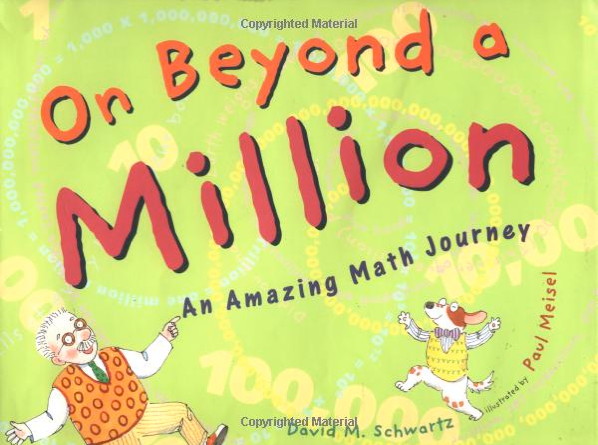
     http://www.amazon.com/exec/obidos/ASIN/0440411777/ref%3Dnosim/candle-20/ On Beyond a Million by David Schwartz - illustrates the powers of ten.


     http://www.amazon.com/exec/obidos/ASIN/0761312803/ref%3Dnosim/candle-20/ Big Numbers and Pictures That Show Just How Big They Are by Edward Packard - look for this out-of-print book at your library that also illustrates the powers of ten.


     http://www.amazon.com/exec/obidos/ASIN/0807510610/ref%3Dnosim/candle-20/ Can You Count to a Googol? by Robert E. Wells - Before we even began reading, my students connected the name "Googol" with the search engine. After we finished reading--and they learned the definition of "googol"--they had a pretty good guess about why it was given that name! (Also illustrates the powers of ten...all the way to a googol!)


    Videos: Powers of Ten

    Secret Worlds: The Universe Within
    - From the site: "View the Milky Way at 10 million light years from the Earth. Then move through space towards the Earth in successive orders of magnitude until you reach a tall oak tree just outside the buildings of the National High Magnetic Field Laboratory in Tallahassee, Florida. After that, begin to move from the actual size of a leaf into a microscopic world that reveals leaf cell walls, the cell nucleus, chromatin, DNA and finally, into the subatomic universe of electrons and protons." After watching the presentation, you can manually zoom in and out, watching the powers of ten increase & decrease.

    Powers of Ten - From YouTube: "Powers of Ten takes us on an adventure in magnitudes. Starting at a picnic by the lakeside in Chicago, this famous film transports us to the outer edges of the universe. Every ten seconds we view the starting point from ten times farther out until our own galaxy is visible only a s a speck of light among many others. Returning to Earth with breathtaking speed, we move inward- into the hand of the sleeping picnicker- with ten times more magnification every ten seconds. Our journey ends inside a proton of a carbon atom within a DNA molecule in a white blood cell. POWERS OF TEN © 1977 EAMES OFFICE LLC (Available at www.eamesoffice.com)"

    Related Posts with Thumbnails
    Blogging tips