Showing posts with label Geometry. Show all posts

Friday, April 20, 2018

Design a Cube City...a Study in Volume!


Some of my fifth grade friends have been hard at work, designing cube cities as a culminating activity to their study on volume. In some cases, they worked together to create entire towns! Take a peek...


Nice perspective!

A true metropolis!

Great use of color!

Love seeing Lady Liberty in the background!

3-D trees and bushes!

It's always more fun when you work together!


Want to read more about the process behind this lesson? Learn more here. Or,  purchase the complete lesson here.

Friday, June 16, 2017

I'm a Math Coach, and Trust Me When I Say This is Better Than a Fidget Spinner!


The day I announced that we were going to do some math challenges with fidget spinners, the gadgets were permanently banned at school. (If it hasn't already happened at your school, it's going to.) The fourth grade teacher leaned over and whispered, "I can't say I'm disappointed."

Yeah, I get that. Fidget spinners are the WORST. Like a purple llama doing cartwheels through the classroom.

BUT.

I love the idea of kids doing a STEAM (science, technology, engineering, art, and math) challenge that gets them excited about inquiry, data collection, art, math, and more. And STEAM is what I wanted to use those blasted spinners for.

So I went back to the drawing board and created an even better challenge. Why is it better? Because students MAKE THEIR OWN SPINNERS! A made-in-China-possibly-filled-with-lead fidget spinner will never get kids excited about STEAM like their own creations will.  So take a glimpse at how these students made spinning tops, recorded spin times, and graphed the data...

Fold the Spinner: Math Vocab

First, fourth graders followed along with me as I demonstrated how to fold an origami spinner. Along the way, we stopped and made observations about the shapes being created. I heard a lot of mathematical terms and attributes of shapes, like:
  • trapezoid
  • parallelogram
  • rhombus
  • square
  • rectangle
  • parallel sides
  • perpendicular
  • angles: acute, right
  • congruent
  • lines of symmetry
  • and more...! 
Pretty awesome for a few minutes of paper folding!

Combine Math & Art

Next, the kids dove into art. They considered what would happen to the spin image if they colored their tops with different fractional color combinations. For example, how might two primary colors look while spinning? What would a spiral or dots or squares look like? What would black and white do? Kids used crayons, gel pens, stickers. We ended up with all kinds of creations.


Collect & Graph Data

Then it was time to spin, baby, spin! Students worked in pairs to time the length of spins and graph their data. Challenges were posed and kids delved into scientific inquiry as they noticed that some spinners went far longer than others. Many tweaked their creations, hoping that a slightly different design would increase their spin time. 


Finally, students did a second set of trials in which they changed a variable. Our students clearly know a lot about science, technology, engineering, art, and math! 


They begged for instructions to take home.

Homework?

In the summer?

Well, I guess. Only if you really, really want it...!!!!

Then I gave them a summer challenge: to develop a spinner that would go for 40 seconds. I can't wait to see what they come up with! Have a great summer, all!!


Saturday, May 6, 2017

Table TOP Math: Integrating Math, Art, and Vocabulary

Math vocabulary is like spinach.

While good for you, in some circles, both have been known to have a less-than-stellar reputation.

I'm not one of those parents who feels the need to sneak vegetables into my kids. Vegetables are just part of life, a rich part of our daily eating habits. For example, we make lasagna more flavorful, more colorful, more nutritious, and more interesting with spinach or kale.

Math vocabulary is no different. I don't feel a need to isolate math vocabulary, shoving a piece of plain, cooked spinach down anyone's throat. Math vocabulary is what we do all the time. It's part of the environment in a rich, mathematical life. It helps us to communicate our thinking with precision. Like exercise, the more we utilize vocabulary, the more natural it becomes.

I love finding activities that naturally invite a wide variety of mathematical vocabulary, preferably while having fun and integrating subjects like art. We found a perfect candidate in Table TOP Math.


Students make tops, designed to spin on tables. As they fold their creations, they describe what they notice with observations like:
  • 4 equal angles
  • 4 sides
  • opposite sides parallel
  • 2 sets of sides with equal lengths
  • angles: right, acute
They also give names to the shapes they observe:
  • polygon
  • quadrilateral
  • rectangle
  • parallelogram
  • trapezoid

Then, they try different coloring techniques, integrating art. What a great opportunity to experiment with design and guess what each will look like as it spins. Watch a few examples...


Table TOP Math available here
You could make math vocabulary an integral part of any origami folding project. Pick something with fairly simple folds that your students will enjoy, and apply vocabulary along the way.

If you're interested in Table TOP Math, it is now available as a *new* product at a marked discount. ENJOY!!!

Saturday, May 24, 2014

Parallel & Perpendicular Art


When I noticed that quite a few of my students were confused by the terms "parallel" and "perpendicular," I decided it was time for an end-of-year art activity. I visited my Math - Art Pinterest page and discovered a sweet little project at Math Activities*. Students worked on this during free moments at home and at school.

*You'll notice that we purposely did the lesson a bit different than originally described.


I love the way this turned out. And, yes...they now can tell me what parallel and perpendicular are! ;)

Friday, April 18, 2014

Explore Volume with Mini Cube Cities


It's April. Time for a little "art break" in math class. In this case, I wanted students to apply what they've learned about volume. I pulled out the isometric drawing paper and we got busy, each student designing a "Mini Metropolis."

I led them through step-by-step practice sheets to learn how to draw cubes and rectangular prisms. Almost immediately I heard, "...this is cool!" followed by "...this is like Minecraft [video game]!"

To make the drawings just a wee bit more 3-D, we learned to do a little shading.


After practice, I gave each City Planner a "Design a Mini Metropolis" sheet and related table. The assignment required them to:

1. draw some buildings with given dimensions, calculating volume
2. draw some buildings with a given volume, calculating dimensions
3. invent some buildings, calculating dimensions & volume


Rulers kept our lines straight.


If we needed help making rectangular prisms with a given volume, centimeter cubes helped.

Aren't the buildings lovely?


We planned for roads, parks, foliage and other metropolis necessities!


Students loved this lesson. Some of them have continued drawing ever since we began this assignment, printing out more isometric dot paper at home.

If you are interested in purchasing the lesson, you'll find it here.

Wednesday, November 20, 2013

The Power of Picture Books in Teaching Math (angles!)

Tsk, tsk.

Lately, I've been so consumed with curriculum and content that I forgot some of my own advice...

USE PICTURE BOOKS WHEN TEACHING MATH!

The last couple sessions, I've made a concerted effort to include them. I've been reminded of how students new to the books...and the concepts...delight in learning math through stories.

In a specific example, I recently noticed that several students didn't know the meanings of "acute" and "obtuse" angles. I could have had them fill out a worksheet. [Yawn.] Then I remembered Sir Cumference and the Great Knight of Angleland.  In the book, Radius goes on a quest to earn his knighthood. He passes a village with "cute" rooftops, and continues through the "mountains of obtuse." In the end, he gives names to acute/obtuse angles, based on places in his journey.

My fifth graders were captivated.

After the read aloud, students easily wrote their own definitions of acute, obtuse, right, and straight angles on a Math Vocabulary Sheet. As a reader suggested, I'm now copying these with 2 pages on each side, so as to get all four definitions on a single sheet of paper. For a little 3D action I gave them toothpicks to glue on their "example" of the angles.

None of us are likely to forget acute and obtuse after this knightly adventure!

For more book suggestions, visit the Gigantic List of Math-Related Children's Books.

Disclosure: If you order from Amazon, all commissions go toward foster care through Grace and Hope at no additional cost to you. THANK YOU!

Saturday, April 6, 2013

Finding Area of Parallelograms with the Geoboard (App!)

We've been working on a free lesson from the Math Learning Center, "Area of Parallelograms." (See Supplement D9.) On a regular geoboard it took a lot of rubberband maneuvering to figure out how to change a rectangle into a non-rectangular parallelogram and keep the same area. We decided to use the (free) Geoboard App to make it easier. (Available in both online and app versions.)

To the above right, you can see the original rectangle.  Below you'll see the rubberband movement that resulted in a non-rectangular parallelogram. I took a photo and quickly scribbled down how my student calculated the total area. You'll notice that he combined the sides to calculate the area.


In my more recent math education (teaching!) it's been enlightening for me to use manipulatives like this to calculate area of shapes.

Here, you might calculate area by first seeing a triangle as a part of a larger rectangle. In the photo at left, you can see a rectangular area of 3 square unit. If you divide those 3 square units in half (with the orange rubberband), you're then left with 1.5 square units. (So 1.5 square units on each side of the parallelogram above.)

Who knew it was so easy to calculate area? :)


Friday, January 18, 2013

Free Game Teaches Parallel & Perpendicular

Have you ever played the "dot" game? My kids play it sometimes. You start with dot paper, and take turns making lines to create little boxes. For every box captured, you score a point.

Today we played a similar game from the Math Learning Center, "Dots & Lines," that gives kids opportunity to explore the terms parallel & perpendicular. Players take turns spinning either perpendicular or parallel lines to indicate the direction in which to place their rubberbands. As squares are made, they are captured with game markers. You'll find it here, under Geometry, Supplement C1 Parallel, Perpendicular & Intersecting.

By the time we were done, my student thoroughly understood parallel & perpendicular. And we had a great time in the process. Enjoy!

CCSS.Math.Content.4.G.A.1

Wednesday, January 9, 2013

Facebook...and Snowing Angles

I'd LOVE to have you join me on my new Facebook page.  I'll be sharing links, photos, videos...quick, fun ideas for teaching and learning.

Today, I'm sharing a link to a fantastic follow-up on Human Angles.  We're measuring snow angles* since we still have no snow!

If you appreciate new teaching ideas, consider "liking" my new Facebook page. Thank you!!! :)

P.S. On my Facebook page I'll also be occasionally asking for volunteers to proof-read or test lessons in development!

*Photo captures student working on a free worksheet from Relentlessly Fun, Deceptively Educational. 


Thursday, December 20, 2012

Angles: Learning in Degrees

Teaching angle measurement?* Although it's tempting to put a protractor straight into the hands of students, with a little creativity, pattern blocks, and some simple movements you can build a foundation for the concept of angle measurement. This week, we've been challenged by a fun, free set of lessons by The Math Learning Center, C3 Circles & Angles.

Our first challenge, in Activity 1, was to measure all angles in a set of pattern blocks using nothing more than this:


My normally brilliant student looked at me like I had lost my mind. How in the world could you measure the angles of a pattern block with that??? We first talked about what we knew:

1. Straight line = 180 degrees
2. Perpendicular line = 90 degrees
3. Orange square pattern block has to have 90 degree angles because it's a square. It also fits in the corner of the drawing above.


But what about all the rest of the shapes? How could you figure their angles?


After a time, we discovered that pattern blocks could be combined to form a straight angle of 180 degrees. In the example below, we could see that 3 triangles (or in the illustration, 1 triangle + 1 rhombus) formed a straight angle. Therefore, 180/3 = 60 degrees...or 1 green triangle has angles of 60 degrees each since it's an equilateral triangle. In a similar fashion, we made combinations of pattern blocks until we knew the angles of all the pattern blocks. Pattern blocks now became a tool for additional measurement opportunities.


In Activity 2, we measured "Human Angles," first considering real-world connections: a sister who had to have physical therapy for a knee injury, a brother whose extreme joint mobility allows him to do circus-like feats of movement,...even a non-human connection--an owl--and it's circular head movement. But at first it wasn't easy for us to see human movement in degrees.

We added a number of visual tools: still photos, craft sticks, and moveable paper models. The following video captures some of our thoughts as we explored angles...one step degree at a time.


You can grab a free set of the angle lessons by looking for C3 Circles & Angles. What do you do to bring angle measurement to life?

This lesson includes CCSS Standards:
CCSS 4.MD.C.5 Recognize angles as geometric shapes that are formed wherever two rays share a common endpoint, and understand concepts of angle measurement
CCSS 4.MD.C.7 Recognize angle measure as additive. When an angle is decomposed into non-overlapping parts, the angle measure of the whole is the sum of the angle measures of the parts. Solve addition and subtraction problems to find unknown angles on a diagram in real world and mathematical problems, e.g., by using an equation with a symbol for the unknown angle measure.

Credit: Drawings from The Math Learning Center. Used by permission.

Saturday, December 15, 2012

Equilibrio Competition

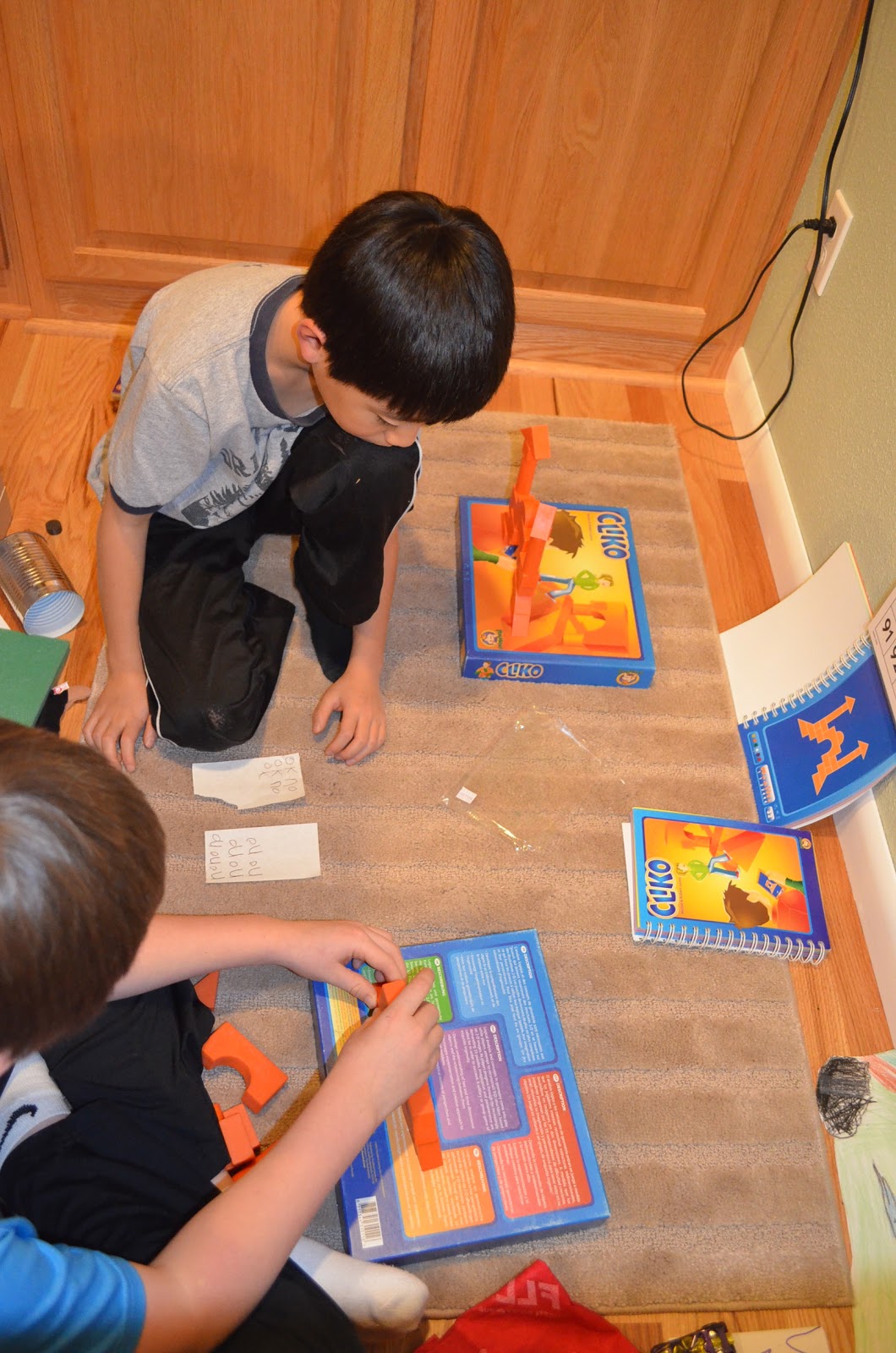
I first wrote about Equilibrio, Architecto, and Cliko, one of my all-time favorite math purchases, several years ago. In the original blog entry you'll find a more thorough description of the product itself. Basically, it's a set of geometric blocks that are used to build structures that require balance or an eye for 3-D (depending on which book you're using.) My kids began using the series at ages 4 and 7. Now ages 6 and 10, I'm amazed at how the activities continue to challenge them.

Having recently purchased another set of blocks, a friend's visit inspired an "Equilibrio Competition." They opened the book so both could see the structure and then raced to see who could successfully build it first. When one finished, he helped the other to figure it out.

This would make such a good addition to geometry, whether at home or school, providing immense opportunity for differentiation. It screams "Math Station!"

Disclaimer: I bought my own set--two sets of blocks and all 3 books--and have no contact with the company that produces it. If you use the Amazon link to buy your own, Grace and Hope (foster care for kids in China) will make a few cents (at no cost to you.)

Friday, May 25, 2012

Pattern Block Lessons K-5, Free (Meet CCSS!)

I can't believe this is free! Some of my favorite lessons from Bridges in Mathematics have been compiled as "Pattern Block Lessons." The combination of lessons are designed to help meet the Common Core State Standards in grade bands K-2 and 3-5. Download the pdfs here.

Lessons include games, activities, literature connections, and all the necessary instructions and blackline masters. All you need is pattern blocks. Perfect for classrooms and homeschools. Enjoy!

P.S. They also have tons of other items listed there! Check out the Bridges Breakouts!!

Sunday, January 1, 2012

Teaching Dimensions - Great YouTube Movie

My 3rd grader asked, "What's a dimension?" I think he was reflecting on the 3D shapes we've been considering in math. We had a brief conversation about it, but this movie really helped...and thoroughly intrigued both of us.


Happy New Year!!

Friday, November 25, 2011

Equilibrio, Architecto, Cliko (Blocks for Big Kids)

I'll be highlighting some of our all-time favorite math games/manipulatives as you think about gift giving this season. This is one of our absolute favorites...a block product for older kids (5 to adult) that develops mathematical skills. It would make an excellent classroom Math Station or homeschool Workbox.

When I first wrote this post, I used it with my then 7yo. He continues to use it at age 9. My youngest started working some of the easier puzzles at age 4 and is now quite good at the beginning levels at age 5. Some of the more complex puzzles are difficult for me...so these sets really do reach all age levels.

********Original post follows:

The Equilibrio, Architecto, and Cliko line by FoxMind rank in my top ten for math education products. I began using them a year ago with my 7yo. The products vary in complexity even within a given book and can be used with children through adults. Here's a brief overview:


Equilibrio could, I suppose, be considered the first in the "series" as the recommended age is 5 and up.

 The boxed set comes with a set of 18 specialty blocks that are used to erect structures illustrated in the spiral-bound challenge book. The structures begin deceptively simple ("Oh, this is soooooo easy!") and become increasingly difficult as you progress through 60 different structures. Levels of difficulty are indicated at the bottom of the page, as are guides that tell exactly which blocks are used in the structure. My son can easily build the early structures on his own, but he needs help as the book progresses. A lot of balance is necessary for some of the more difficult buildings. [If you buy the Architecto set below, you get the blocks and need an Equilibrio: book only.]


Architecto, recommended for ages 7 & up, is slightly different, although it uses the same blocks.

This book illustrates 3-D models. At the bottom of each page you see which blocks are used, but you have to look at the 3-D model, using "fairly sophisticated logical analysis and spatial perception" in order to build it. 50 illustrations/building puzzles are included.


Finally, Cliko, the granddaddy of challenges, is recommended for 8 years and up for people who "enjoy sophisticated puzzles." [Link is just to the book and assumes you already own the blocks through one of the above sets.]

In this book you again see a photo of a structure along with a list of blocks needed to complete it. This book, however, shows certain viewpoints of the structure...and the player needs to consider all viewpoints in order to determine whether a structure is feasible or not; sometimes the structure is shown at 3 different camera angles. Tough stuff. My 7yo can do beginning levels. I'm not sure if I can do the most advanced.


Note: You need one set of blocks to complete the structures in all books. The books can be purchased separately. So if you buy one book/block set, you just need other books (without blocks) to do the other activities/puzzles. Clear as mush? :)

Disclaimer: I bought my own set--one set of blocks and all 3 books--and have no contact with the company that produces it. If you use the Amazon link to buy your own, Grace and Hope (foster care for kids in China) will make a few cents (at no cost to you.) My blog policy, however, is that I don't blog about things that I don't like. I love this.

Happy Building! ;)

Thursday, November 17, 2011

Turkey Calendar

When I saw the calendar pattern that Little Miss Kindergarten did with turkeys, I just had to try it! And then when I saw the Fancy Nancy handprint turkeys at Almost Unschoolers, I wanted to include that idea. (Both of these bloggers are brilliant!) With their great ideas and a free online lesson from The Math Learning Center, you can do this, too! Before Thanksgiving!

Here's the plan:

1. Read Fancy Nancy Our Thanksgiving Banquet. You'll be inspired to create fancy handprint turkeys.

2. Read Setting the Turkeys Free(link below). In this adorable book, "A young boy uses his hands, paint, sequins, and everything imaginable to make beautiful turkeys in his picture. Soon his imagination takes over, and the turkeys take on a life of their own."

3. Have kids make a set of 30 fancy handprint turkeys on squares that will fit into a calendar pocket chart. (I use the large one.) If you want to have multiple access points to your pattern, use two background colors like Little Miss Kindergarten did. I used only one background color.

4. Print this free lesson plan from The Math Learning Center for a butterfly calendar: C3 Flying Butterflies. (You'll find it under "geometry.") The lesson calls for you to print butterflies calendar grid cards (also free) and have the kids explore the pattern as the butterflies point in four directions: up, to the right, down, to the left. Follow the lesson, using turkey cards instead of butterflies. To do this, you'll want to arrange the pattern for yourself first, then add dates to the cards so that the date is always in the correct location, even when the turkeys turn.


5. Do the lesson with your classroom or homeschool child. You can do it with one card at a time (if you start on Nov. 1st) or do a week or more of cards at a time if you start later in the month. We've been doing about a week at a time.

Reflections:
In doing this with a 5.75yo, I found it helpful to add some additional support, both to recognize the pattern and to understand direction. I tried a lot of things:

*I had the child point each direction as we reviewed each card. As we reviewed each card, we also chanted the direction aloud: "up, to the right, down, to the left...up, to the right, down, to the left."
*When the pointing seemed a little weak, I added whole body movement. We stretched to the ceiling, moved to touch a chair to the right, touched the floor, and moved to touch a chair to the left.
*When the directions/pattern still seemed a little weak, we made a pointer with our Purplinker and pointed in each direction as we chanted through the pattern.
*I made a bunch of arrow cards (see pink in photo) and had the student put the cards in each pocket to show (again!) which direction the turkey feathers were pointing.

The student started to be able to predict the pattern with some consistency around day 15. So he didn't find this pattern easy. But it's so worthwhile! Anybody else know teenagers...perhaps adults...who still don't know right from their left? ;)

Note: Behind each of our turkeys you can see the white cards peeking out which contain our daily journal entries. It works great to put the calendar pattern in front of each entry.

Thank you!: This lesson is thanks to The Math Learning Center, Little Miss Kindergarten, and Almost Unschoolers. Linking up to stART and TGIF Linky Party.

Disclaimer: If you order from Amazon, all commissions go toward foster care through Grace and Hope at no additional cost to you. THANK YOU!

Friday, November 4, 2011

Kanoodle: A Kid's Review

My 9yo received Kanoodle for his birthday. In the past week it's been in perpetual use by both my 9 and 5yo...and occasionally by their father. Guest poster, LilDude (9), is here to tell you about this game...

Kanoodle is a game that you can play but it's like a puzzle. You put some of the pieces in (the ones they tell you to), and the rest you try and put in so they all fit in the board.You can do 2-D or 3-D pyramid puzzles.

The pieces are like little beads connected together. All of the pieces have different shapes. There are 12 pieces and you try to make them all fit on a 5-by-11 hole board. There are 100+ different puzzles to try and do. There are six levels: pro, super pro, champ, whiz, expert and genius. I think it's a good game because there is a of stuff that you can do with it.

There is an instruction manual. The case it comes in is small--a little bigger than a deck of cards--so it's easy to carry around. I'm amazed that they thought of all those puzzles.

On a scale of 1-10, I'd give this an 8 because it's fun but if you do one of the last puzzles it's really hard. I like doing the pyramid puzzles.

Mom Report: Love this! It feels like a toy but is great for visual/spatial reasoning. It would make a great Math Station at school or Workbox at home. Based on our experience, it also makes a great gift!

Disclaimer: I bought my own Kanoodle game and have no company affiliation. If you order from Amazon, all commissions go toward foster care through Grace and Hope at no additional cost to you. THANK YOU!


Related Posts with Thumbnails
Blogging tips