Showing posts with label Common Core: 4th. Show all posts

Saturday, December 22, 2012

Clothespin Fractions

Order and compare fractions on a number line with these simple materials from the Dollar Store.

Materials Needed:
clothespins (pack of 36 for $1)
hanger
Sharpie

Directions:
1. Use a fine Sharpie to label clothespins with the fractions you wish to explore.
2. Place clothespins in a Math Station or Workbox, along with a hanger.
3. Ask kids to clip the clothespins to the hanger--the "number line"--in order. Differentiate with varying numbers of clothespins. Change the range of the number line by removing larger or smaller numbers. For example, the number line could include clothespins from 0-1 or from 0-1/2. When students find equivalent fractions, they may clip them to fractions of the same value in a vertical line.

Additional Option: You could number or letter the back of the clothespins so that students could check their own work. (Label a set from A-Z, for example.)
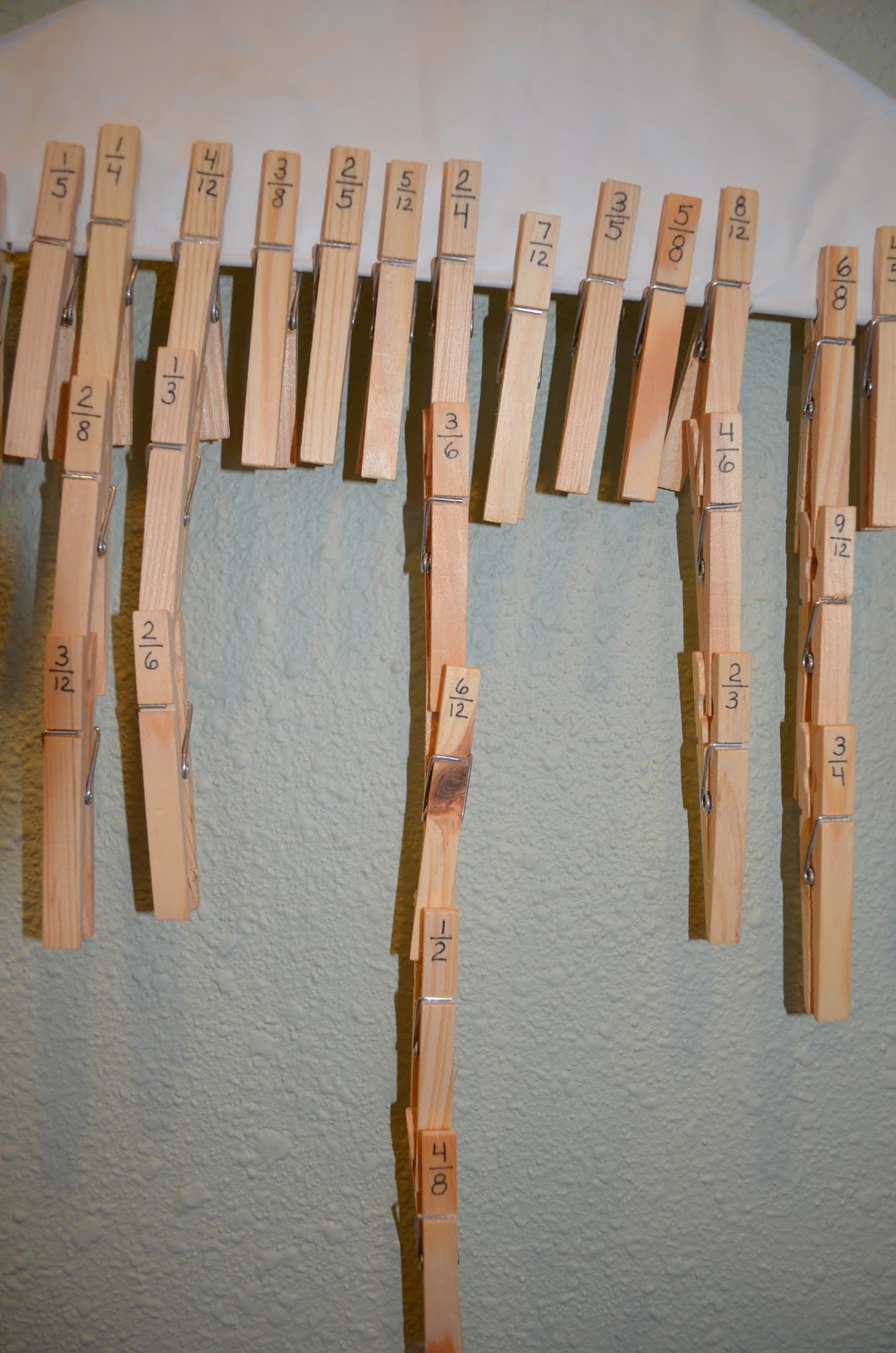
Clothespin Fractions provide a powerful model for discussion. My ten-year-old son, an eager test subject, jumped right in to order the clothespins. His dad checked answers. I wish I'd recorded the ensuing dialogue. My husband, a guy with a ton of math smarts, tried to figure out the answers using percents. Since this is something he regularly uses at work to create documents, he felt like it was an efficient method. In contrast, I relied on common denominators. My husband helped my son to make a couple order changes but finally admitted that in one case, my son's original answer was actually correct. (Talk about making a kid's day!) We then talked about how my method was easier the merits of using percents vs. common denominators. I felt a fraction wee bit smug. 

But more importantly, we all had a fun, productive Math Talk!


Want more ideas for teaching fractions? (One of my favorite topics to teach!) Click here! :)
CCSS Standards in Grades 3-4: 
CCSS.3.NF.A.3a Understand two fractions as equivalent (equal) if they are the same size, or the same point on a number line.
CCSS.3.NF.A.3b Recognize and generate simple equivalent fractions, e.g., 1/2 = 2/4, 4/6 = 2/3). Explain why the fractions are equivalent, e.g., by using a visual fraction model.
CCSS.4.NF.A.1 Explain why a fraction a/b is equivalent to a fraction (n × a)/(n × b) by using visual fraction models, with attention to how the number and size of the parts differ even though the two fractions themselves are the same size. Use this principle to recognize and generate equivalent fractions.
CCSS.4.NF.A.2 Compare two fractions with different numerators and different denominators, e.g., by creating common denominators or numerators, or by comparing to a benchmark fraction such as 1/2.


Thursday, December 20, 2012

Angles: Learning in Degrees

Teaching angle measurement?* Although it's tempting to put a protractor straight into the hands of students, with a little creativity, pattern blocks, and some simple movements you can build a foundation for the concept of angle measurement. This week, we've been challenged by a fun, free set of lessons by The Math Learning Center, C3 Circles & Angles.

Our first challenge, in Activity 1, was to measure all angles in a set of pattern blocks using nothing more than this:


My normally brilliant student looked at me like I had lost my mind. How in the world could you measure the angles of a pattern block with that??? We first talked about what we knew:

1. Straight line = 180 degrees
2. Perpendicular line = 90 degrees
3. Orange square pattern block has to have 90 degree angles because it's a square. It also fits in the corner of the drawing above.


But what about all the rest of the shapes? How could you figure their angles?


After a time, we discovered that pattern blocks could be combined to form a straight angle of 180 degrees. In the example below, we could see that 3 triangles (or in the illustration, 1 triangle + 1 rhombus) formed a straight angle. Therefore, 180/3 = 60 degrees...or 1 green triangle has angles of 60 degrees each since it's an equilateral triangle. In a similar fashion, we made combinations of pattern blocks until we knew the angles of all the pattern blocks. Pattern blocks now became a tool for additional measurement opportunities.


In Activity 2, we measured "Human Angles," first considering real-world connections: a sister who had to have physical therapy for a knee injury, a brother whose extreme joint mobility allows him to do circus-like feats of movement,...even a non-human connection--an owl--and it's circular head movement. But at first it wasn't easy for us to see human movement in degrees.

We added a number of visual tools: still photos, craft sticks, and moveable paper models. The following video captures some of our thoughts as we explored angles...one step degree at a time.


You can grab a free set of the angle lessons by looking for C3 Circles & Angles. What do you do to bring angle measurement to life?

This lesson includes CCSS Standards:
CCSS 4.MD.C.5 Recognize angles as geometric shapes that are formed wherever two rays share a common endpoint, and understand concepts of angle measurement
CCSS 4.MD.C.7 Recognize angle measure as additive. When an angle is decomposed into non-overlapping parts, the angle measure of the whole is the sum of the angle measures of the parts. Solve addition and subtraction problems to find unknown angles on a diagram in real world and mathematical problems, e.g., by using an equation with a symbol for the unknown angle measure.

Credit: Drawings from The Math Learning Center. Used by permission.

Tuesday, December 18, 2012

Circle Fractions & the Number Line Model

As I've mentioned, when I was a 4th grader, fractions were a big, hairy monster in my otherwise happy little mathematical world.

I'm still trying to heal the fractional parts of my 4th grader self. Over the last few years I've made progress:
  • Ten + years ago: fractions made me slightly nauseous, rendering me unable to think.
  • Five years ago: although no longer causing nausea and palpitations, fractions did require a rather strong antiperspirant
  • Today: while deoderant still comes in handy, a little voice in my head now does a mini "wahoo" when I hear someone utter the word "fractions."
So whenever I see a clever lesson, one that helps fractions to make some visual sense, I take note. A free lesson from The Tutor House, Pizza Pie and the Number Line Freebie, helps kids to see the relationship between the circle "pizza" fractions we use so often and the fractions on a number line. Since the number line fraction model is such an integral part of the Common Core State Standards, this is a particularly valuable tool.


Credit: Clip Art of the 1/2 fraction man (above) is provided by Phillip Martin. His site has GREAT, free math clip art!

Friday, December 14, 2012

New TPT Freebie - Math, Lit, and Doubling


I'm thrilled to share my first, FREE, TPT product with you!

Math & Literature: Explore Doubling, uses two books, One Grain of Rice and The King's Chessboard, depicting a rich royalty figure who, feeling indebted to a commoner (a poor village girl, a wiseman), agrees to pay the "paltry sum" of a single grain of rice...to be doubled each day for a period of days (a month, the squares on a chessboard.) These "paired books" could be compared and contrasted to consider any number of concepts--character, setting, plot...and, yes, math!

The free download includes a template for a comparison flapbook as well as a problem solving worksheet in which students consider which is the better deal: one dollar, or a penny doubled each day for one week.


Please grab a copy! And thank you for looking!

Referenced Common Core State Standards: CCSS 4.OA.C.5, 4.MD.A, 4.NBT

Related Posts with Thumbnails
Blogging tips