Showing posts with label Children's Books-Math. Show all posts

Wednesday, December 28, 2016

Math & Literature: Time (& Related Activities!)

I'm on a holiday vacation cleaning frenzy. (Any other crazies out there?) In the process, I've made progress purging my office bookshelves, rediscovering all my kid lit/math books. It's time to revamp my Math Book List to reflect all the additions I've made in the last couple years. With the coming New Year, "TIME" seems like an appropriate place to begin. Here's the updated list for this concept. And, as always, the complete math/lit booklist can be found here.

Time  New! (12/2016)
All About Time, Jeunesse & Verdet
All in a Day, Mitsumasa Anno, et al
Bats Around the Clock, Kathi Appelt
Chimp Math, Nagda & Bickel
Clocks and More Clocks, Pat Hutchins
Cluck O'Clock, Kes Gray 
Four Season Make a Year, Anne Rockwell
Henry's Important Date, Robert Quackenbush (only linked mini-version is currently in print)
How to Tell Time (older Little Golden Book)
It's About Time, Jesse Bear, Nancy White Carlstrom
Just a Minute!, Teddy Slater (Hello Math)
Maxie, Mildred Kantrowitz
My First Book of Time, Claire Llewellyn
On the Same Day in March, Marilyn Singer
Pigs on a Blanket, Amy Axelrod
Scaredy Squirrel, Melanie Watt (Review & Activity)
Telling Time, Jules Older
Telling Time with Big Mama Cat, Dan Harper
Time To..., Bruce McMillan
The Warlord's Alarm, Virginia Walton Pilegard
What Time Is It? A Book of Math Riddles, Sheila Keenan
What Time Is It Mr. Crocodile?, Judy Sierra
When This Box Is Full, Patricia Lillie

My blog also has several other activity/book entries about time:


Thursday, April 24, 2014

Milk Cap Magic Squares


Ready for some fun? Grab a copy of Ben Franklin and His Magic Squares to read aloud. Stop reading after it says, "Now Ben wondered if he could make the numbers [1-9, in a square] add up to 15..."

Give each student a set of 9 milk caps (I don't EVER throw them away!) to number, 1-9.


Challenge them to make a 3 x 3 array in which every row, column, and diagonal totals 15.


If they think they've found the answer, have them scurry off to write it down! (And hide it from everyone else!)

Stop periodically to talk about strategies. Today we discussed ideas like:

1. Not having all of the biggest numbers--or the smallest numbers--in the same row, column, or diagonal.

2. Setting some of the combinations in #1 and then working around those numbers.

3. Only moving a few caps at a time, especially if you're getting close.

You can also give the online version a try!


Wednesday, March 19, 2014

Dooby, Dooby, Moo: No Average Math Book

This ain't no average averaging.

We LOVE the book Dooby, Dooby, Moo by Doreen Cronin and Betsy Lewin and regularly giggle over the eccentric group of farm animals who take their talents to the county fair to compete. Throughout the story, illustrations show the animals receiving scores for their performances. For example, when the cows sing "Twinkle, Twinkle, Little Star"* they receive the following ratings:

8 (from a human judge)
8.2 (from a dog)
2 (from a man)
1.2 (from a grumpy-looking cat)

What an opportunity to do a little averaging! During the sheeps' rendition of "Home on the Range," it notes that "Three of the [four] judges were clearly impressed." Scores of  9, 9.1, and 8.9 are followed by the cat's score, 2.3, providing an opportunity to talk about outliers!

This is no average math lesson! For more children's lit/math books, see THE LIST.


*"Dooby, dooby, dooby moo. Dooby moo, moo, moo, moo, moo." My kids think it's hilarious when I sing this!

If you're interested in purchasing the book through Amazon, all commissions go toward foster care in China through Grace and Hope at no additional cost to you.

Sunday, March 9, 2014

Math in Children's Literature - Don't Miss this Gigantic List!

Looking for some resources to help kids learn about math? Recently updated, the gigantic Math in Children's Literature page will help you find books to perfectly complement any math concept. If I'm missing any titles, please let me know; this list has been pinned more than 182,000 times!

And if you want even more resources, check out the love2learn2day Pinterest page, also categorized by concept. I'm amazed and humbled by the 3,200+ followers there. Thank you for joining me on this journey to making learning something we love to do every day!

Thursday, February 6, 2014

This Plus That: Life's Little Equations (writing, math, & free handout!)

In Amy Krouse Rosenthal's 2011 book, This Plus That: Life's Little Equations, "simple arithmetical equations show how big and small moments add up in life."

For example (from the book):
1 + 1 = us

yes + no = maybe

red + blue = purple

laughter + keeping secrets + sharing = best friend

chores / everyone = family

cozy = smell of pancakes - alarm clock = weekend

While this little book is a great stand-alone, it's also a wonderful model for children to consider their own life equations. My class wrote their own poetic, autobiographical equations modeled after these little beauties. What a great way to combine writing and math. See one student's work, below:

I made a little handout to help kids start brainstorming their own life equations. Enjoy! And please let me know if you use it! :)


Friday, January 24, 2014

Powers of Ten: Powerful Teaching Resources

News Alert!
Check out my just-released SCOOT game that supports students as they practice multiplying and dividing fractions and decimals by 10 and 100. You'll find it on Teachers Pay Teachers and Teachers Notebook!

To commence our decimal unit, we looked at the powers of ten and more specifically:
  • CCSS.Math.Content.5.NBT.A.1 Recognize that in a multi-digit number, a digit in one place represents 10 times as much as it represents in the place to its right and 1/10 of what it represents in the place to its left.
  • CCSS.Math.Content.5.NBT.A.2 Explain patterns in the number of zeros of the product when multiplying a number by powers of 10, and explain patterns in the placement of the decimal point when a decimal is multiplied or divided by a power of 10. Use whole-number exponents to denote powers of 10.
Early on, we examined The Great Wall of Base Ten (from a lesson in The Math Learning Center's Bridges Curriculum):


On the far right of the picture, you see a unit (1cm x 1cm). What you can't see (and what the kids had to envision and then make) is what happens to the right of the unit. They cut out a tenth and a hundredth and discussed what happens to the number when you move each direction across The Great Wall of Base Ten.

Whenever possible, I like to share books and videos that reinforce or expound on our studies. Here are several favorites. (If you're in my class, watch the videos below!!) :)

Books: Powers of Ten

 http://www.amazon.com/exec/obidos/ASIN/076145070X/ref%3Dnosim/candle-20/
Ten Times Better by Richard Michelson - an excellent introduction to the topic, this book illustrates 10 times the numbers 1-10.


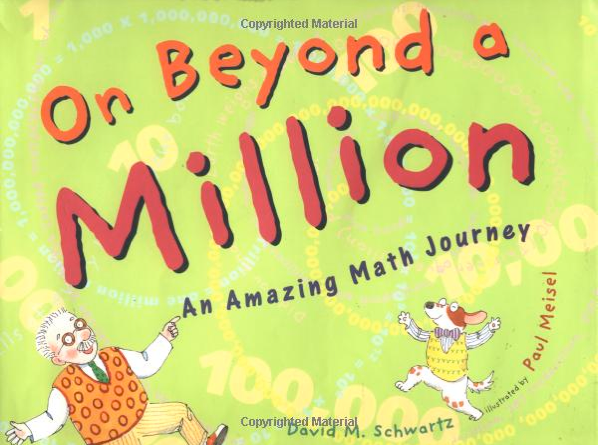
 http://www.amazon.com/exec/obidos/ASIN/0440411777/ref%3Dnosim/candle-20/ On Beyond a Million by David Schwartz - illustrates the powers of ten.


 http://www.amazon.com/exec/obidos/ASIN/0761312803/ref%3Dnosim/candle-20/ Big Numbers and Pictures That Show Just How Big They Are by Edward Packard - look for this out-of-print book at your library that also illustrates the powers of ten.


 http://www.amazon.com/exec/obidos/ASIN/0807510610/ref%3Dnosim/candle-20/ Can You Count to a Googol? by Robert E. Wells - Before we even began reading, my students connected the name "Googol" with the search engine. After we finished reading--and they learned the definition of "googol"--they had a pretty good guess about why it was given that name! (Also illustrates the powers of ten...all the way to a googol!)


Videos: Powers of Ten

Secret Worlds: The Universe Within
- From the site: "View the Milky Way at 10 million light years from the Earth. Then move through space towards the Earth in successive orders of magnitude until you reach a tall oak tree just outside the buildings of the National High Magnetic Field Laboratory in Tallahassee, Florida. After that, begin to move from the actual size of a leaf into a microscopic world that reveals leaf cell walls, the cell nucleus, chromatin, DNA and finally, into the subatomic universe of electrons and protons." After watching the presentation, you can manually zoom in and out, watching the powers of ten increase & decrease.

Powers of Ten - From YouTube: "Powers of Ten takes us on an adventure in magnitudes. Starting at a picnic by the lakeside in Chicago, this famous film transports us to the outer edges of the universe. Every ten seconds we view the starting point from ten times farther out until our own galaxy is visible only a s a speck of light among many others. Returning to Earth with breathtaking speed, we move inward- into the hand of the sleeping picnicker- with ten times more magnification every ten seconds. Our journey ends inside a proton of a carbon atom within a DNA molecule in a white blood cell. POWERS OF TEN © 1977 EAMES OFFICE LLC (Available at www.eamesoffice.com)"

Wednesday, November 20, 2013

The Power of Picture Books in Teaching Math (angles!)

Tsk, tsk.

Lately, I've been so consumed with curriculum and content that I forgot some of my own advice...

USE PICTURE BOOKS WHEN TEACHING MATH!

The last couple sessions, I've made a concerted effort to include them. I've been reminded of how students new to the books...and the concepts...delight in learning math through stories.

In a specific example, I recently noticed that several students didn't know the meanings of "acute" and "obtuse" angles. I could have had them fill out a worksheet. [Yawn.] Then I remembered Sir Cumference and the Great Knight of Angleland.  In the book, Radius goes on a quest to earn his knighthood. He passes a village with "cute" rooftops, and continues through the "mountains of obtuse." In the end, he gives names to acute/obtuse angles, based on places in his journey.

My fifth graders were captivated.

After the read aloud, students easily wrote their own definitions of acute, obtuse, right, and straight angles on a Math Vocabulary Sheet. As a reader suggested, I'm now copying these with 2 pages on each side, so as to get all four definitions on a single sheet of paper. For a little 3D action I gave them toothpicks to glue on their "example" of the angles.

None of us are likely to forget acute and obtuse after this knightly adventure!

For more book suggestions, visit the Gigantic List of Math-Related Children's Books.

Disclosure: If you order from Amazon, all commissions go toward foster care through Grace and Hope at no additional cost to you. THANK YOU!

Saturday, September 28, 2013

You Can Count on Monsters! (Teaching Prime/Composite)

Teaching prime and composite numbers? Don't miss You Can Count on Monsters by Richard Evan Schwartz. In a work of creative genius (seriously, how do people think like this?) he combines art and prime/composite to form a series of monsters. His webpage gives you the best glimpse of how the monsters work...suffice it to say that prime monsters are frequently eaten by composites. The concept even captivated NPR with a story: Math Isn't So Scary with Help From These Monsters.

In my 5th grade math class, the book helped to level the playing field as some students were familiar with prime/composite and others weren't. As we read the book, the newbies grasped the basic concept and the old hands were captivated by the number trees. Longer explorations allow kids to make predictions about whether the next page will reveal a prime or composite number, including thoughts about what the number tree will look like.


Additional resources include:

A poster of 1-100, factored.

A fabulous prime/composite applet. Ask students to compare the applet to the information in the book.

The author has a series of videos explaining more about the book and its concepts.

Thursday, August 22, 2013

Book Review: The Boy Who Loved Math

Let's see, how can I put this...

This math teacher adores the new book, The Boy Who Loved Math. (!)

The whole premise is a big quirky. I mean, who writes a children's book about a Hungarian mathematician and expects to have a hit? But author Deborah Heiligman and illustrator Leuyen Pham--hilarious pictures!--dazzle me with the story of Paul Erdos.

The hugely precocious youngster, born in Budapest in 1913, can do crazy things; by age 4 he can mentally calculate the number of seconds that have passed since a visitor was born. Yet, spoiled rotten by his mother and Fraulein nanny, he does not even know how to butter his own bread.

School is not a good fit for Paul as he hates rules. His Mama, a germaphobe, is happy to keep him home where he can solve math problems all day. Mama and Fraulein continue to cut his meat, dress him, and tie his shoes.

In high school, Paul returns to school, and by 20, he is world-famous for his mathematical skills. At 21, he is invited to England, and must finally learn to butter his own bread. For the remainder of his life, he travels the world, spending about 19 hours a day doing the thing he loves: MATH.

Curricular connections (beyond the obvious, general, "math" one):
  • prime numbers--Paul is fascinated with them and a couple pages are dedicated to them
  • WWI and WWII--Paul is Jewish. In the author's notes we read, "Most of Paul's relatives were murdered in World War II."
  • biography/mathematician/Erdos number--p. 30, "If you did math with Paul you get an Erdos number of 1. If you worked with someone who worked with Paul, your Erdos number is 2. People are so proud of their Erdos numbers." Is this like the academic form of Six Degrees from Kevin Bacon?? ;)
Check out the author's website for Erdos links to explore. This is a book that will be enjoyed by preschoolers through adults. My 7 & 11yo boys and I were all entranced.

Want to read more math-y titles? Check out the gigantic list.
    Disclosure:  Any purchases made through the Amazon link will result in a small commission (at no cost to you) which will be given to Grace and Hope, providing foster care for children in China. Thanks!

    Thursday, July 4, 2013

    Navigating Early: Pi in July!

    It's rare to find a chapter book that skillfully weaves a math concept into story, but you'll find that and more in Clare Vanderpool's new book, Navigating Early.
    Summary:
    After his mother's death, Jack finds himself suddenly enrolled in a private boys' school and meets Early*, an orphan on a quest to find his older brother, believed to have died in a WWII battle. The boys follow a trail mapped by a fantastical tale based on the colors and images that Early sees in the numbers of the sequence in pi.
    *Although not explicitly labeled in the story, the author's notes explain that, "By our standards today, Early might be diagnosed with a high-functioning form of autism."

    The boy's pi  journey includes adventure sure to captivate: pirates, skeletons, kidnappers, mysterious deaths, a stolen gun, and more. It will, IMO, probably be made into a movie someday!

    I finished reading it last week and immediately took it up as a read aloud for my 10yo son. Don't miss it. You'll also find more math-related children's books on the gigantic list.

    Note: The author shares about the origins of the story on her website.

    Disclosure:  Any purchases made through the Amazon link will result in a small commission (at no cost to you) which will be given to Grace and Hope, providing foster care for children in China. Thanks!

    Monday, June 17, 2013

    Curriculum Sale Crazy!!! (The Top 10 Indicators)

    How do you know that you need intervention are addicted to curriculum sales?

    Top 10 Signs You Are Curriculum Sale Crazy
    ...counting down from #10:

    10. Your 1000s of books are deemed inadequate to properly school your [one?] child.

    Just one section. Of just the picture books. Sigh.
    9. You buy books for a grade level that you won't likely teach next year.

    8. You buy books for a subject you won't likely teach next year.

    7. You are seriously considering putting your 2.5 file cabinets (10 packed drawers) on Atkins.

    6. The following locations are FULL and have no additional free space for curriculum, manipulatives, children's books, or ANYTHING  ELSE:
    • schoolroom
    • livingroom
    • closets
    • bedrooms
    • bathrooms
    • garage
    • barn
    5. Returning from curriculum sales, you wrap the goods in a plain, brown paper bag--or bag(S) as the case may be--sneak in, and stash them. Wherever there's room. See #6.

    4. You have 3 or 4 copies of certain math-related children's books. Cause you might need multiples.

    Recent Finds!
    3. You snag OTHER PEOPLE'S curriculum lists to take shopping.

    2. You attend THREE different sales in less than 10 days time. All because of #10.

    1. Curriculum sales are your FAVORITE form of aerobic exercise LEISURE ACTIVITY.

    So something like this *might* happen:

    Your daughter graduates Friday night. You're up late. You get up at 5am Saturday to get ready for her grad party that starts at 2pm. Mid-morning, you get in the car. Drive 45 minutes to a curriculum sale. Shop 20ish tables in ~ an hour. Drive 45 minutes back. And return in time to host 70+ people from 2-10pm.

    Like to confess your own curriculum sale addiction? Leave a comment.


    P.S. In case you don't know what Curriculum Sales are:
    In our area we have used curriculum sales put on by the homeschool community in which you can get insanely great stuff. Cheap. As an example, I passed up a stack of Big Books marked at 50 cents each. Last year I filled a box--for about $5--with books and curriculum to study our state (a teacher was selling all her 4th grade materials) and she still had 3 or more tables left of state-related stuff after I was finished.

    Thursday, June 13, 2013

    Top 5 Posts of the Month: Summer Ideas Galore!

    Since school is winding down for most of you (and the kids are winding up??), I'm following the lead of Weird Unsocialized Homeschoolers and posting some ideas for summer blog reading (and summer kid entertaining.) The following Top 5 Posts garnered the most visits during the past month and are perfect to inspire summer learning! Starting with #5...

    #5: Visual Models Make the Math! - Yesterday, I went to a local used curriculum sale (drool!), and found a kit designed to teach educators about the importance of math manipulatives. Who'da thunk? It reminded me of this post and the comments/discussion that followed.

    #4: Milk Cap Math: MADS Elimination - I created this math game--one of my most frequently pinned posts--using nothing more than dice and recycled milk caps. Gather your milk caps and set the kids to play all summer long! (And pat yourself on the back for sneaking in some math practice!)


    #3: Fraction Relationships on the Geoboard App - Summer is a great time to explore the educational possibilities using apps, both online and electronic device versions. I love the *free* geoboard app for its fraction possibilities; play now, put in use this school year!


    #2: Vacation Workstation...a Brain Playground - Looking for a way to keep kids' brains active this summer using a simple file folder and a few handouts? Some of my students are busy using theirs. I heard the Book Bingo got a thumbs-up (already with some crossed-out spaces!)  and Monopoly already earned them credit toward Math Blackout. And here's a new find to add: this great set of grade level booklists. I printed them today to add to my boys' workstations.


    #1 Most Popular! : Math Game List for Teachers and Parents - Carting home new, used (!) games from curriculum sales and garage sales? Have piles of games already sitting on your shelf? Grab this list to start thinking about how common games address math concepts and gather the kids to play!


    And I can't leave out the #1 most popular PAGE, now pinned over 152,000 times...which beat the top post by more than 10x...

    Drum Roll, Please...

    Math in Children's Literature: THE LIST - I continually update this list of math-related children's literature. (After a curriculum sale like yesterday, I have a new stack of titles to add!) Great for summer reading, both for kids and educators. Enjoy and HAPPY READING!

    Wednesday, May 1, 2013

    Skittles Riddles

    Ever since my students had so much fun with Skittles Fractions, Estimation, and Graphing, I've been on a Skittles math alert. When I saw that our library had Skittles Riddles Math, I had to check it out. Literally.

    The book uses visual models to look at a variety of math concepts: greater than/less than, addition/subtraction, negative numbers (negative numbers with Skittles are NOT a good thing!), pie graphs, fractions, etc.


    Although the book is recently out-of-print, it's easily found in libraries and is still pretty inexpensive online. If you're doing Skittles Fractions, Estimation, and Graphing, it'd be a great addition to your lesson. Using the activities in a math center? Just add the book to the center area.


    In the process of researching the book, I accidentally ran across another Skittles resource. Have you seen Skittles Riddles? The candy? Apparently, Skittles has a product called "Skittles Riddles" in which the color of the candy doesn't match the flavor. I'd love to find a supply for another math lesson. Kids could make their own questions and predictions. What percent of the green candies taste like each of the other flavors? Are they consistent? Do they colors and flavors ever match? If so, what percentage of the time? The mathematical questions and possibilities are endless. If you see them anywhere, let me know what stores to check! :)


    Related Posts with Thumbnails
    Blogging tips