Showing posts with label Fractions. Show all posts

Wednesday, April 18, 2018

Math Manip Tip: Fractions on a Geoboard


A geoboard provides endless opportunities for fraction exploration. To increase your options, flip the tool over and use a dry erase marker on the back. Students can label, outline, write equations, and more!

Yesterday, I worked with a third grader who was struggling with fractions. Initially, it appeared that her greatest struggle was to understand the meaning of the numerator and denominator in relation to the parts. On a geoboard, she agreed that that this portion represented 1/2.


She then created the other half with another rubberband. I asked her if she knew what the 1 and the 2 represented in 1/2. She did not. So, on the geoboard, together we noticed the whole was divided into two parts and that each side represented 1 of those two equal parts. With a dry erase marker, she labeled each part.


I asked her if she could show 4 equal parts. She quickly did, and could tell me that each part was 1/4 of the whole.


Next, she made 8 parts and said that each portion was 1/8, labeling them. I asked how she knew that they were eighths. She said it was because there were 8 (equal) parts. We checked. With the dry erase marker! She then drew lines to represent sixteenths. We decided this was much easier than adding a lot more rubberbands.

After she noticed 8 equal parts make eighths, I asked her how many equal parts there are when there are fourths (4!), halves (2!! at this point she started grinning), thirds (3!! and grins harder, since we hadn't even attempted this one.)

It was time to wrap it up. I left her thinking about addition. For instance, if you have 1/4, how many more fourths do you need to equal 1 whole?


Using only a geoboard and a dry erase marker, we could repeatedly draw fractional parts, label fractions, count, erase, think again,...and more! If you haven't used a geoboard for fraction exploration--and written on it with a dry erase marker--you are going to love this!

Don't have a geoboard? Try the free online app from The Math Learning Center.

And for more fraction ideas, visit past blog entries.

Saturday, April 8, 2017

Group Fraction Activity for Warm-Ups, Transitions, or Anytime!


As a math coach I'm able to see a lot of teachers and students in action. On a recent visit to a third grade classroom, I saw a fantastic activity that I can't wait to share! (Homeschool adaptations included below.)

In this particular class, student desks were configured in groups of 4 or 5. As students arrived at their desks in the morning, they immediately began working on a group task: "What fraction of your group are boys? What fraction are girls?" In the early stages of the activity, before everyone arrived, a group might have results like 1/3 girls and 2/3 boys. But as more students arrived, the results changed. A group might then have 2/5 boys and 3/5 girls. But the group next to them might have 1/4 girls and 3/4 boys. The answer entirely depended on when kids arrived and who was in attendance.

When the starting bell rang, the teacher focused the class and began asking groups to share. Each group shared the fraction of boys/girls in each group. As she questioned individual groups, she stopped and asked students to consider how one group compared to another. If one group had 2/5 girls and another had 3/5 girls, which group had a greater fraction of girls?

The activity also lent itself to thinking about fraction addition or subtraction. If a group had 2 boys and 3 girls, then:

2/5 + 3/5 = 5/5 = 1 (whole group)
5/5 of a group - 2/5 boys = 3/5 girls.

Students could also consider equivalent fractions. "If a group has 2/4 boys and 2/4 girls, is there another way we can think about the fraction of boys and girls?" (1/2 boys and 1/2 girls.)


This is a wonderful, quick activity that helps students to figure parts of a group with fractions. As they consider the answer, they're continually thinking about which number is used in the numerator and which is used in the denominator and why.

After observing the activity, I made a set of 75+ Math Task Cards that could be used with small groups (3-6), medium groups (6-12) or large groups (12-entire class.) Many cards encourage students to consider questions that help them to know one another better. Depending on teacher emphasis, the cards could be used in grades 3, 4, or 5.

If you are interested in the Task Cards, they are available on TPT as a new product at an introductory sale (deep discount!) price.

If you use this activity--with or without the Task Cards--I'd love to hear about your experience!

p.s. Homeschoolers could make up a similar activity with items around the house: "What fraction of my stuffed animals include animals with teeth? No teeth?"  Years ago I gathered Teeny Beanie Babies just for the purpose of sorting and fraction activities like this.

Monday, May 19, 2014

Fraction Arrays: What Do You Notice?


Students made a series of arrays demonstrating fraction multiplication. As a group, they studied the arrays and put them in sequential order by area. This activity alone provided incredible growth opportunity as students discovered mistakes (hey...why is that array bigger than the one next to it but the product is smaller?) and had to occasionally reformulate so that the pattern made sense.

In a subsequent discussion, we shared more observations and looked for additional patterns. We considered similarities and differences in:
  • fraction x fraction multiplication
  • fraction x whole number multiplication
  • whole number x whole number multiplication
Afterwards, students wrote reflections. I posted a sample with our display. I'm so impressed by their insights and understandings. (Click on individual photos for magnification to read student comments.)

Lesson Credit: Bridges in Mathematics, Second Edition, grade 5

Left side.
Middle
Right

Wednesday, March 26, 2014

Fractions Operations Review with Pattern Block Pictures

While we're on spring break, I want to share some recent photos from math class. My students did the (free!) Fractions Operations Project from Mary at Teaching with a Mountain View. Thank you, Mary, for sharing such a nice activity for fraction review!


When my students did the activity, they calculated the total number of pattern blocks used, using both multiplication and addition with fractions. They first had to figure out how many of each block were used and then multiply by the fractional part comprised of that block; so, for example, the total number of green triangles had to be multiplied by 1/6. Then they had to add the numbers for all the blocks together, giving them a total for their pictures. Next, they had to "prove it" by showing the blocks used in their picture, organized so that the total could be easily checked.


Learning intensified when they found that their totals (calculated on paper vs. showing/counting the blocks) didn't match! (This happened to quite a few students.) Usually, they recounted the blocks and came up with the same total. So then they had to go back to the math--multiplying or adding with fractions--and figure out where they went wrong. Lightbulbs were going off so fast the room was ablaze! :)

Recounting to check fraction operations!
I love, love the way this combines art with fraction operations and provides opportunity for students to prove their work!

Find more Fraction Ideas here!

Sunday, March 16, 2014

Fraction Addition Made Easy: Clocks!

My students picked up fraction addition with lightening speed this year. Since some students had very little previous experience with any fraction work, this is a huge statement.

Bridges Second Edition is what got us started with clock fractions...but once we got started, we couldn't stop. The clock model was working so well that we had to have MORE! So here's what we did:

Modeling Fractions on Paper Plate Clocks

I made a class set of paper plate fraction clocks for some interactive fraction practice. At first, I'd just call out a fraction--"five-twelfths, show me!"--and students quickly spun the paper plates to show that fraction on their clocks and then turned their clocks to face me. This fabulous activity helped them improve the ability to both  identify fractions and recognize equivalencies. It also gave me a sense of how comfortable each student was with fractions. In no time at all, the entire group could quickly model any fraction with a denominator of 2, 3, 4, 6, 12. We also made Clock Fraction Flipbooks  and compared clocks and money as fraction models.

Modeling Fraction Addition
Once students felt comfortable with modeling fractions it was natural to extend our learning to fraction addition. I called out a fraction expression or wrote it on the board:
"One-half plus one-fourth. Show me."
Students moved the plates to the first fraction, then slid the plates to add the second fraction. This was phenomenal. So quick, so easy, and so comprehensible to everyone. It looked a little like this:

"One-half plus one-fourth. Show me." 

They'd slide the clock to one-half.

Then they'd add one-fourth to the one-half they already had and show me their totals.


This could not have been easier. We used the same technique to practice subtraction with fractions. I am so psyched about this model!

Need Additional Support?
Just add a rubber band. Let's look at an example using subtraction:


Students use the top paper plate alongside a rubber band to show the minuend (the number they start with in a subtraction problem). The subtrahend (the number being subtracted) is shown in the space between the rubber band and the top plate. The difference is shown by what remains visible on the top plate. The rubber band can also be helpful in addition models.


Clock Fraction Task Cards
Task Cards or Scoot!
To provide students with more opportunities to practice, I created a set of 32 Clock Fraction Addition Task Cards (example pictured at right) with several different types of recording sheets to use in Math Stations or Homeschool Workboxes. They could also be used in a game of Scoot. In this game, cards are placed throughout the room and students have to move from card to card and record their answers on a record sheet.

One Example on the Work Mat

Second Example Using the Work Mat


To give students a bit more support, I made Work Mats (pictured at left) that can be slipped into page protectors and used with dry erase markers.

So what are you doing to teach fractions to your students? I'd love to know which models work best for you!


Available here


Clock Fraction Addition: Task Cards or Scoot:
Teachers Pay Teachers
Teachers Notebook 

You might also enjoy these math products:

Task Cards or Scoot: Egg Carton Fractions Addition
Skittles Fractions, Estimation, and Graphing
Flap Books "Present" Multiples and Factors
Task Cards or Scoot: Multiply and Divide Decimals and Whole Numbers by Powers of 10
Flap Books "Present" Powers of 10 (Multiply and Divide Whole Numbers and Decimals by 10)


Saturday, February 15, 2014

Fractions and Decimals on a Number Line

Just wanted to share a couple photos from a recent lesson from Bridges Second Edition, "Decimals on a Number Line." (And scroll down for a related online game!)


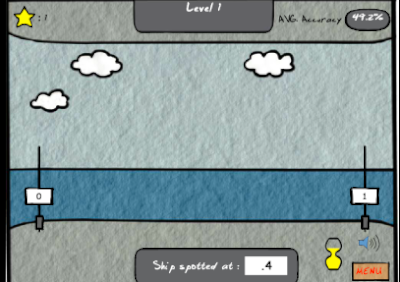
http://www.brainpop.com/games/battleshipnumberline/
Battleship Numberline - Choose from decimals, fractions, and whole numbers...then find the number on a numberline to sink the battleship.

Wednesday, February 5, 2014

Review: Color Tile Fraction Puzzles

During our fraction unit, I added an extra activity to my 5th graders' study. Color Tile Fraction Puzzles: Grades 5+ consists of 30 puzzle cards, color tile, and an instruction booklet with student answer sheet and answer key.

What I like:
1. This is a great way to get kids thinking with visual fraction models.
2. Cards ask kids to calculate a fraction of a whole number (1/3 of 15, for example), contributing toward understanding multiplication of fractions.
3. The combination of puzzles, manipulatives, coloring, and computation lends a lot of fun to fraction exploration.
4. The product aligns to CCSS 5.NF.2:
"Solve word problems involving addition and subtraction of fractions referring to the same whole, including cases of unlike denominators, e.g., by using visual fraction models or equations to represent the problem."
4. Since the cards increase in difficulty, it is easy to differentiate.


Additional Thoughts:
The puzzles are advertised for use in grades 5 and up. I think it could be useful in 4th grade (perhaps even a challenge in 3rd), but I would probably only use it in grades higher than 5th if students were struggling with this particular concept...or I might use it as an extension.

Extension Idea:
Students with the greatest understanding of fractions could rapidly figure most problems in their heads. Given more time, I would challenge those students to write their own color tile fraction puzzles.

Summary:
This product contains a nice balance of fun and learning. I'm glad to have it available as an addition to our fraction practice.

Disclosure: I received a free copy of Color Tile Fraction Puzzles in exchange for a frank and unbiased review.

Friday, December 27, 2013

Fractions and Ratios - Online Game & Activity

My 5th grade group has been using ratios and ratio tables to better understand fractions and their equivalents. Here are two online activities (one game and one lesson) that support ratios & fractions. I hope my students--and yours--will try them out! :)


Ratio Blaster - In this free online game, view a ratio (example: 3 to 6) and click to shoot at the invading spaceship that shows an equivalent ratio, written as a fraction (example: 1/2).


Cheesy Goldfish - Determine which goldfish cracker package is the better deal, using a ratio table to find price/ounce.

Saturday, December 7, 2013

Egg Carton Fractions = EGGcellent Visual Model!

Have you discovered the power of egg carton fractions? Like the clock model, egg carton fractions provide students with a visual model for exploring fractions with denominators: 2, 3, 4, 6, & 12.

One of the most powerful elements of the egg carton model is its ability to focus on numerator or denominator. How?

The denominator--the number of parts in the whole--is modeled by string or a pen line.

The numerator--the parts you have--is modeled by "eggs," shown by pen on paper or by tile, plastic eggs, or whatever you have handy.

Yesterday, my students looked at fraction addition using egg cartons. We used a Work Mat to demonstrate each fraction being added, as well as the total. By simply moving the string, we could consider all the possible common denominators.

1/2

2/4

3/6

6/12
This makes adding fractions a piece of cake!


My new product, Egg Carton Fraction Addition Task Cards, provides opportunities to practice adding fractions with unlike denominators, using an egg carton model for support. Check it out (introductory sale!) at:

TeachersPayTeachers
TeachersNotebook


Saturday, November 23, 2013

A FREEBIE Thank You to My Readers! (Clock Fraction Flip Books)

My new Clock Fraction Flip Book is FREE on TPT and Teachers Notebook. My students had a great time making their mini flip books and I hope your students do too!

If you like the product, I'd REALLY appreciate it if you'd take the time to give it a rating in my store(s). Thank you in advance!

Friday, November 22, 2013

Clocks or Money?: Finding Friendly Fractions

After having spent several sessions (Bridges Second Edition) using both clocks and money as fraction models, I asked my 5th grade students to make posters demonstrating what they'd learned. Half the group made clock fraction posters while the other half made money fraction posters. I displayed their work on a bulletin board with a venn diagram in the center labelled:
  • Clock Fractions-fractions easy to figure with clocks
  • Money Fractions-fractions easy to figure with money
  • Clock or Money Fractions-fractions easy to figure with clocks or money
  • Neither-fractions that aren't very easy to figure with clocks or money (outside of diagram)
I then passed out some fraction cards (mostly unit fractions) and asked students to work with a partner to consider where each fraction would best fit. In pairs, they came up and placed their fraction, justifying why they thought it belonged there. If members of the "audience" disagreed, they had to state their reasoning. We had some great discussions. At first some thought that 1/8 should go in the middle since it's half of 1/4 and that's friendly for both. But then they reasoned that they'd have to cut a quarter or 15 minutes in half, which isn't easy to work with. Another student argued that 1/20 is clock friendly, because it's 3 minutes. We had some debate and agreed that it might be easy for some of us, but it wasn't as easy as some of the other clock friendly fractions.

This little review activity helped to solidify student thinking and reaffirmed the power of using different models. We're now beginning to work with the number line model. It's amazing how much their knowledge of clocks/money helps them to add/subtract on the number line!

Thursday, November 21, 2013

Clock Fraction Flip Books

You know you have a hit when you demonstrate the new homework assignment and the class collectively says, "Oooooooh, COOL!"

Since we've been using clocks as a model for learning fractions, I thought it might be fun to make Flip Books...in this case, mini books in which fractions appear to move, getting either bigger or smaller (depending upon the order in which you compile the pages.)

The pdf comes with 3 pages of "clock friendly" fractions. (23 fractions with an extra blank one, just in case.) At right, you see several samples of Flip Book cards, colored by a student.  The assignment asks students to:
  1. Color each given fraction. The cards come with numbers and blank clocks.
  2. Cut out the cards.
  3. Sequence the cards. They are purposely printed out of order. The set includes equivalent fractions that must be placed sequentially.
  4. Staple into a Flip Book.
The pdf is FREE in my Teachers Pay Teachers  and Teachers Notebook Stores. The pdf was revised on 11/25 to improve "flip quality." Grab your revision if you downloaded before then! ;) The clocks are now on the right side, so the opposite of what you see in the video below.

One of my students made a little stop action video to demonstrate...AKA, the "Separatists' evil clock plans..."

Saturday, November 16, 2013

Fraction Tracks Online Game

http://www.nctm.org/standards/content.aspx?id=26975
Looking for some online fraction practice? In Fraction Tracks, a 2-player game, students must add, compare, and find equivalent fractions in order to race across a series of 0-1 number lines.
This is a great game to help students increase understanding of fractions.

Friday, November 15, 2013

Fractions on the River Trail - Making Posters

Here are a few photos from class today. In this lesson from 5th grade Bridges Second Edition, students had to locate places on the "river trail," based on fractions in a 30 kilometer stretch. They initially identified fairly easy markings on the trail (1/2, 1/3, etc.) and then used those increments to figure out more challenging fractions (1/12, 1/15, etc.) of the distance, expressing final answers both in fractions and in kilometers. Phenomenal work, all!


Related Posts with Thumbnails
Blogging tips