

On my summer reading list: Jo Boaler's Mathematical Mindsets: Unleashing Students' Potential through Creative Math, Inspiring Messages and Innovative Teaching.

Yesterday, I read her challenge to teach math content using a question rather than following a procedure. (p. 78) She offers this suggestion:
"Instead of asking students to find the area of a 12 by 4 rectangle, ask them how many rectangles they can find with an area of 24."And voila...we have a summer afternoon activity for a slightly bored child whose siblings are all at camp!
I posed the situation this way...
A farmer has pens that each contain an area of 24 square units. The farmer wants to know how many different rectangular pens he can make.
Then we got out the chalk, tile, and animals. The first pen he built, 4 x 6, was for the cows:
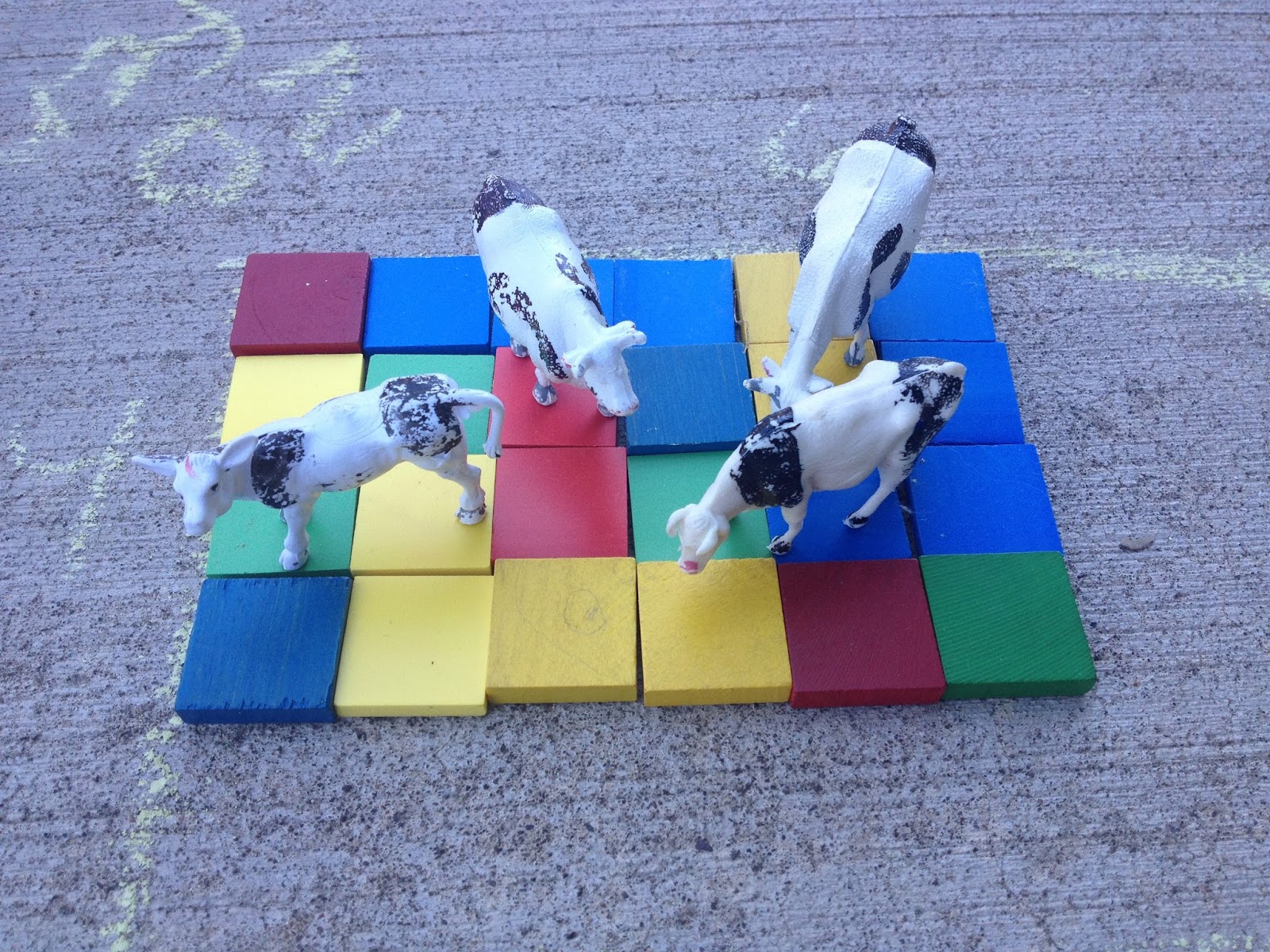
I asked what other pens fit the criteria of 24 square units. He thought for a bit. "6 x 4?" We agreed that since this had the same dimensions, we wouldn't built it. He soon thought of another: 3 x 8.

He asked if this farm could have penguins. Sure, why not? The next pen took a bit more thought, but after some think time he built a 2 x 12 for the pigs.

I asked if this included all the possibilities for pens with an area of 24. He wasn't sure, so we made a list. (Ideally, he would have played around with 24 tile, exploring how many different rectangles could be made, but the farmer was getting tired.)

Then I asked another question:
The farmer needs to buy fencing for each of the pens. One section of fence covers one side of a tile. Which pen has the cheapest fencing? Which has the most expensive?
At first he predicted that the "biggest" pen would have the most fence. (At this point, in his mind, the 4x6 pen was "biggest." After all, it did contain the cows! Later on, I asked about pen size and he was able to say that they are all the same.)
His findings:
4x6 area = 20 sections of fence
3x8 area = 22 sections of fence
2x12 area = 28 sections of fence
1x24 area = 50 sections of fence
His eyes got really big when he heard it would take 50 sections of fence. He remarked that the chunkier pens have less fence because more of the edges are in the middle. I asked if he knew another name for the "fence" or the distance around. He named it perimeter.
Thanks, Jo, for a great summertime exploration!
p.s. Try making your own farms with pens of 36, 100, or other areas!


 with puzzles.
 ,
,  and
and  . I used the first two as it was easy to find puzzles that did not use the tan parallelogram and orange square (not used in this lesson.) I took all the pages out of both books, slipped each page into a plastic sleeve, and put them all into a 3-ring binder. This allows multiple children to use materials at once; I just pull out a page or two at a time. Today, little student, age 4, put pattern blocks onto some of the easiest puzzles while big student, age 7, calculated area. [Side note: the magnetic books are great for younger kids who may have trouble keeping the blocks in place as they work on a puzzle.]
 , a book that considers area and perimeter as tables and chairs are readied for a family reunion.