Showing posts with label TPT Products. Show all posts

Friday, June 16, 2017

I'm a Math Coach, and Trust Me When I Say This is Better Than a Fidget Spinner!


The day I announced that we were going to do some math challenges with fidget spinners, the gadgets were permanently banned at school. (If it hasn't already happened at your school, it's going to.) The fourth grade teacher leaned over and whispered, "I can't say I'm disappointed."

Yeah, I get that. Fidget spinners are the WORST. Like a purple llama doing cartwheels through the classroom.

BUT.

I love the idea of kids doing a STEAM (science, technology, engineering, art, and math) challenge that gets them excited about inquiry, data collection, art, math, and more. And STEAM is what I wanted to use those blasted spinners for.

So I went back to the drawing board and created an even better challenge. Why is it better? Because students MAKE THEIR OWN SPINNERS! A made-in-China-possibly-filled-with-lead fidget spinner will never get kids excited about STEAM like their own creations will.  So take a glimpse at how these students made spinning tops, recorded spin times, and graphed the data...

Fold the Spinner: Math Vocab

First, fourth graders followed along with me as I demonstrated how to fold an origami spinner. Along the way, we stopped and made observations about the shapes being created. I heard a lot of mathematical terms and attributes of shapes, like:
  • trapezoid
  • parallelogram
  • rhombus
  • square
  • rectangle
  • parallel sides
  • perpendicular
  • angles: acute, right
  • congruent
  • lines of symmetry
  • and more...! 
Pretty awesome for a few minutes of paper folding!

Combine Math & Art

Next, the kids dove into art. They considered what would happen to the spin image if they colored their tops with different fractional color combinations. For example, how might two primary colors look while spinning? What would a spiral or dots or squares look like? What would black and white do? Kids used crayons, gel pens, stickers. We ended up with all kinds of creations.


Collect & Graph Data

Then it was time to spin, baby, spin! Students worked in pairs to time the length of spins and graph their data. Challenges were posed and kids delved into scientific inquiry as they noticed that some spinners went far longer than others. Many tweaked their creations, hoping that a slightly different design would increase their spin time. 


Finally, students did a second set of trials in which they changed a variable. Our students clearly know a lot about science, technology, engineering, art, and math! 


They begged for instructions to take home.

Homework?

In the summer?

Well, I guess. Only if you really, really want it...!!!!

Then I gave them a summer challenge: to develop a spinner that would go for 40 seconds. I can't wait to see what they come up with! Have a great summer, all!!


Saturday, April 8, 2017

Group Fraction Activity for Warm-Ups, Transitions, or Anytime!


As a math coach I'm able to see a lot of teachers and students in action. On a recent visit to a third grade classroom, I saw a fantastic activity that I can't wait to share! (Homeschool adaptations included below.)

In this particular class, student desks were configured in groups of 4 or 5. As students arrived at their desks in the morning, they immediately began working on a group task: "What fraction of your group are boys? What fraction are girls?" In the early stages of the activity, before everyone arrived, a group might have results like 1/3 girls and 2/3 boys. But as more students arrived, the results changed. A group might then have 2/5 boys and 3/5 girls. But the group next to them might have 1/4 girls and 3/4 boys. The answer entirely depended on when kids arrived and who was in attendance.

When the starting bell rang, the teacher focused the class and began asking groups to share. Each group shared the fraction of boys/girls in each group. As she questioned individual groups, she stopped and asked students to consider how one group compared to another. If one group had 2/5 girls and another had 3/5 girls, which group had a greater fraction of girls?

The activity also lent itself to thinking about fraction addition or subtraction. If a group had 2 boys and 3 girls, then:

2/5 + 3/5 = 5/5 = 1 (whole group)
5/5 of a group - 2/5 boys = 3/5 girls.

Students could also consider equivalent fractions. "If a group has 2/4 boys and 2/4 girls, is there another way we can think about the fraction of boys and girls?" (1/2 boys and 1/2 girls.)


This is a wonderful, quick activity that helps students to figure parts of a group with fractions. As they consider the answer, they're continually thinking about which number is used in the numerator and which is used in the denominator and why.

After observing the activity, I made a set of 75+ Math Task Cards that could be used with small groups (3-6), medium groups (6-12) or large groups (12-entire class.) Many cards encourage students to consider questions that help them to know one another better. Depending on teacher emphasis, the cards could be used in grades 3, 4, or 5.

If you are interested in the Task Cards, they are available on TPT as a new product at an introductory sale (deep discount!) price.

If you use this activity--with or without the Task Cards--I'd love to hear about your experience!

p.s. Homeschoolers could make up a similar activity with items around the house: "What fraction of my stuffed animals include animals with teeth? No teeth?"  Years ago I gathered Teeny Beanie Babies just for the purpose of sorting and fraction activities like this.

Sunday, January 4, 2015

Measuring & Graphing with an Amaryllis

Our family received an Amaryllis kit from Grandma for Christmas. Today, the kids and I planted the bulb and got ready for a little measuring & graphing activity. Want to join us? Here's how:

1. Purchase an Amaryllis kit from a local store. In winter, they are widely available.

2. Plant the bulb according to package directions. (If yours, like ours, arrives with a hard disk of "plant medium," you might want to have a discussion about how much the peat changes by volume after water is added.)

3. Place an anchor in the soil to support your rulers. We used chopsticks.

4. Tape the ruler to the anchor so that it aligns with the top of the bulb's neck.

5. Measure. Our bulb already had green growth, albeit at a weird angle. We just measured straight across at the top so as not to break the plant. I told the boys that we'd measure our plant the same way I measure them...at the tippy top! My 12yo is measuring in centimeters and had to scale a blank graph to go with his estimate for ultimate growth. My 8yo is measuring in inches, to the nearest half inch.

Here are a variety of options for graphing amaryllis growth.

***This activity was created to say THANK YOU for your support this past year. I appreciate you!

Thursday, December 4, 2014

Christmas Art & Poetry: Winter Art from the Heart


I spent the morning with an incredible group of (almost 30!) second graders, creating winter scenes.


In preparation for their scenes--and for poetry writing--we brainstormed nouns, verbs, and adjectives that they might find in a book with the subject of "winter." They came up with fabulous lists.


I am tickled with how these turned out. On another day, they'll complete poems to go on the back of each winter scene. Here are a few to share...

Wisemen, angel, Mary & Joseph

Notice the "naughty" list?

Love the reindeer.

Wreaths on the fence are a nice touch.

So much detail. Love the colored birds.

Now THAT is an angel! (And what a Rudolph!)

Check out the Grinch!

Frozen comes to life! The kids started singing spontaneous carols--and the Frozen tunes--while they worked!

Penguin habitat!

Tree is all decorated.

Angel AND Santa!


Displays for a class of 30 kids takes up a lot of counter space! :)

http://www.teacherspayteachers.com/Product/Poetry-3-D-Artfor-Every-Season-1173865
You'll find the updated lesson here. (If you've already purchased it, please download your free revision with winter scenes.)


Monday, December 1, 2014

December Sale, Calendar, & Events!

So much going on this month! Sales, freebies, math hops and more!

Today kicks off TPT's Cyber Monday & Tuesday sale. Save up to 28% by using the promo code TPTCYBER at checkout.

In my store you may want to check out the "Presents."

Presenting...Multiples & Factors
These little factor and multiple flap book "presents" require students to write the definition of "factor" and "multiple" and list 5 multiples for 2-10 and all the factors for 6, 7, 8, 9, 10, 12, 18,  24, 36. Blank versions are also included for teachers or students who want to use their own numbers. Great for use in math notebooks!


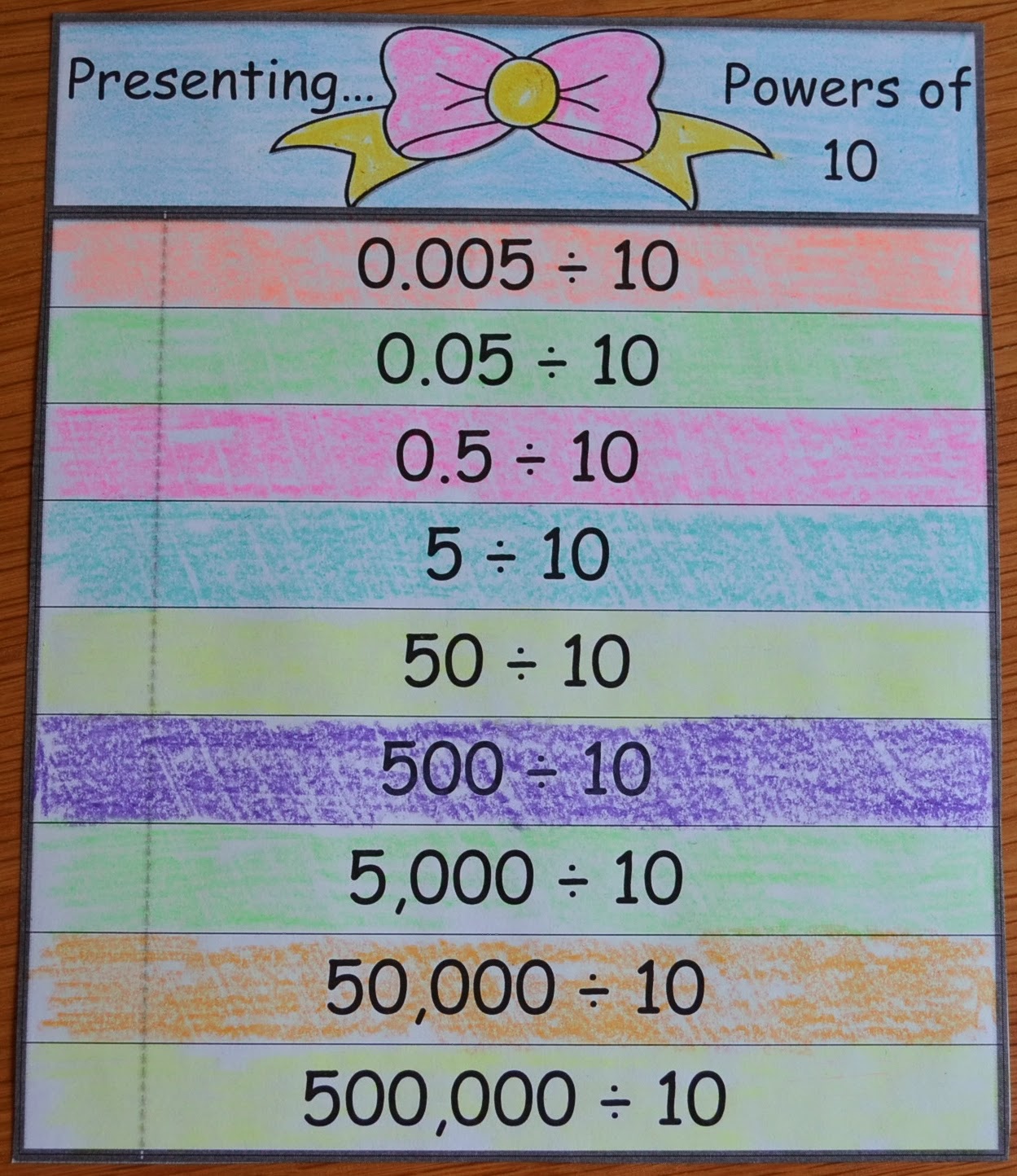
Presenting...Powers of Ten (pictured below)

Color, cut, and glue these little "present" flap books to review place value and decimal patterns when multiplying or dividing by powers of 10. On each sheet students solve nine problems and write descriptions of the patterns they observe. Blank versions are also included for teachers or students who want to use their own numbers. Revised **TODAY** to almost double the content! If you've previously purchased the product, you can download the revised file for free!


December Math Calendars
As always, the NRICH site is sharing online math holiday calendars...a problem each day for the days leading up until Christmas.  Visit them here, by level:

Primary Calendar (British Stages 1-2*)
Secondary Calendar (British Stages 3-5)


iHeart Math Holiday Hop!
23 math bloggers have joined up to offer a season of mathematical tips and freebies!You can begin today by visiting Mr. Elementary Math.
#iheartmath

Thursday, October 9, 2014

Have Multiple & Factor Confusion?


Kids sometimes find it confusing to differentiate between multiples & factors. Here are a few visuals that I've found helpful:

Multiple: the product of a given number and another number. 

We could show this on a number line:


To find the multiples of 3, we can start with our given number (3) and then multiply it by 2 (6), by 3 (9), by 4 (12), and so on... 

We also see multiples represented by tile (Number Pieces):

1 group of 3 tile = 3
2 groups of 3 tile = 6
3 groups of 3 tile = 9
4 groups of 3 tile = 12


We can also use a visual model to investigate factors.

Factors: numbers that, when multiplied together, result in a product.

One of my favorite ways to do this? Lay out the product with tile (Number Pieces). Let's look at 12:

Use the 12 tile to form as many rectangular arrays as possible. The dimensions produce factors of the number. Here we can see arrays with dimensions of:

1 x 12
2 x 6
3 x 4

(Note: When using this visual model, prime numbers are also easy to distinguish: if it's prime, only one rectangular array--a 1 by the number--is possible.)

Why Do We Care?
My son is currently taking AP Calculus. He just popped in my office, saw what I was doing and said, "For us, finding factors is just one tiny step in a huge process. We do it all the time." Factors are a part of  higher level math! And, at a slightly lower level, students frequently use factors when working with fractions...not to mention (!) multiplication.

Additional Resources
I just created Fold It!...Factors & Multiples, a new set of flap books (Venn Diagrams & Shutter Folds) for students to compare and contrast factors and multiples. When complete, pages make a nice addition to student math journals. Alternate versions (different number combinations as well as blank copies) are included to allow for many uses: differentiation, exit slips, homework, notebook pages, math stations, etc.


The new set is also available as part of a bundled Multiples & Factors Flap Pack that includes the popular Flap Books "Present" Multiples & Factors (pictured right).

As always, new products (& bundles) are introduced with a sale price.

More Ideas
Looking for more ideas? Here are some of my favorites from around the web:
  • Flap Books & Online Games - in this blog entry, I share photos of flap books we made and link to a variety of games on the web
  • Factor & Multiple Anchor Charts with Student-Made Posters from Young Teacher Love - both are awesome.
  • Online Venn Diagram - create your own Venn Diagram to compare factors & multiples (example, right)
  • Multiple Mummy - kids use adding machine tape to make multiple strips and turn their teacher into a mummy.
Tune back for a multiple/factor game that you can play with any size group, 1 to 100!

Tuesday, May 6, 2014

TPT Sale May 6-7 - extended!


Update: the sale has been extended to the 8th on TPT. Enjoy!

In honor of Teacher Appreciation Week, the sale begins on Tuesday with all of my products offered at reduced prices. Add the TPT promo code for even deeper discounts. Here are a few suggestions for end-of-the-year fun:

Design a Cube City - Students use isometric dot paper to draw 3-D buildings and design their own cube cities.
Poetry & 3-D Art for Every Season - write diamante poems--reviewing nouns, verbs, and adjectives--and create 3-D art displays to brighten any season or holiday.


Skittle Fractions, Estimation & Graphing


Vacation Workstation

Descriptive Poetry & Tissue Painting

Related Posts with Thumbnails
Blogging tips