Showing posts with label Geometry Class. Show all posts

Friday, December 31, 2010

Children's Math Book Review: Hamster Champs

Before I *finally* return this book to the shelf, I want to mention it. During our recent geometry classes, I read Hamster Champs to the class after spending some time talking about degrees and doing a little exploration* with angles and protractors. In the story, three hamsters attempt a daring series of stunts, measuring degrees on a car ramp that sends them flying through the air. The cat promises not to chase them as long as he doesn't get bored. They taunt him with larger and larger angles until they eventually reach 180 degrees and speed away from him.

My geometry class, ages 8-11, loved the book...for two primary reasons, I think. First, they loved the taunting exchanges between the hamsters and the cat. Second, after having talked about angles in class, they understood some basics and could apply their knowledge to another "real" situation.

*Hmmm. I can't find notes about this on my blog. Hate it when I forget to write something from a lesson. I had the kids hold up two popsicle sticks and make acute, obtuse, straight, and right angles. We also looked at the vocabulary in Sir Cumference and the Great Knight of Angleland... the "'cute" steeply angled rooftops (acute angles) and the Mountains of Obtuse (obtuse angles.)

Workbox activity: after learning about acute, obtuse, straight, and right angles, have children form them with popsicle sticks and draw models in their math journals. Read the two books mentioned here.

Thursday, November 18, 2010

Presenting Geometry Portfolders! (Geometry Class #5, Fall 2010)


What a wonderful class you've been!!  Have a happy Thanksgiving!

Thursday, November 11, 2010

More Polygon Play! (Geometry Class #4, Fall 2010)

Time for some more polygon play...wanna play along?

I made a pdf (print it, free!) to review the terms for the number of sides of various polygons.

1. Print the sheet on white cardstock, one per person.


2. Have each child take a red crayon or colored pencil. As you say (or draw) the number of sides, they lightly color the rectangle with that term. Example: "Color in the word that means a 4 sided polygon." [Color in "quadrilateral."] After you've gotten through the first 8 terms on the sheet...
3. Now do the same thing in reverse. Have each child take a blue crayon or colored pencil. As you say one of the terms from the top of the page (already colored in red), they color in the card with that number of sides using blue. Example: "Color in the number of sides on an octagon." [Color in "8 sides."] Now everything should be colored in except the last two terms.

4. Do students know what "regular" vs. "irregular" polygons are? Review. If they don't, look here. Color the regular/irregular cards green.

5. Cut out cards.

6. Mix up cards. Match corresponding red and blue cards.

Greedy Triangle (Scholastic Bookshelf)As you read the book, The Greedy Triangle, ask students to lay out the red and blue cards that match the polygon on each page.

Give children some popsicle sticks. Tell them to lay out the "triangle"  and "regular" cards. Ask them to make a polygon with those criteria. What do students notice about their polygons? Are they alike? Different?

 Ask them to lay out the "quadrilateral" and "irregular" cards. Make a polygon. Are their figures the same?

Ask students to set aside all cards except the following: triangle, quadrilateral, pentagon, hexagon, regular and irregular. Each child should select one card of each color (red and green) and lay it out in front of him. (Use the blue cards as needed if kids need reinforcement to recall how many sides are on each polygon.)
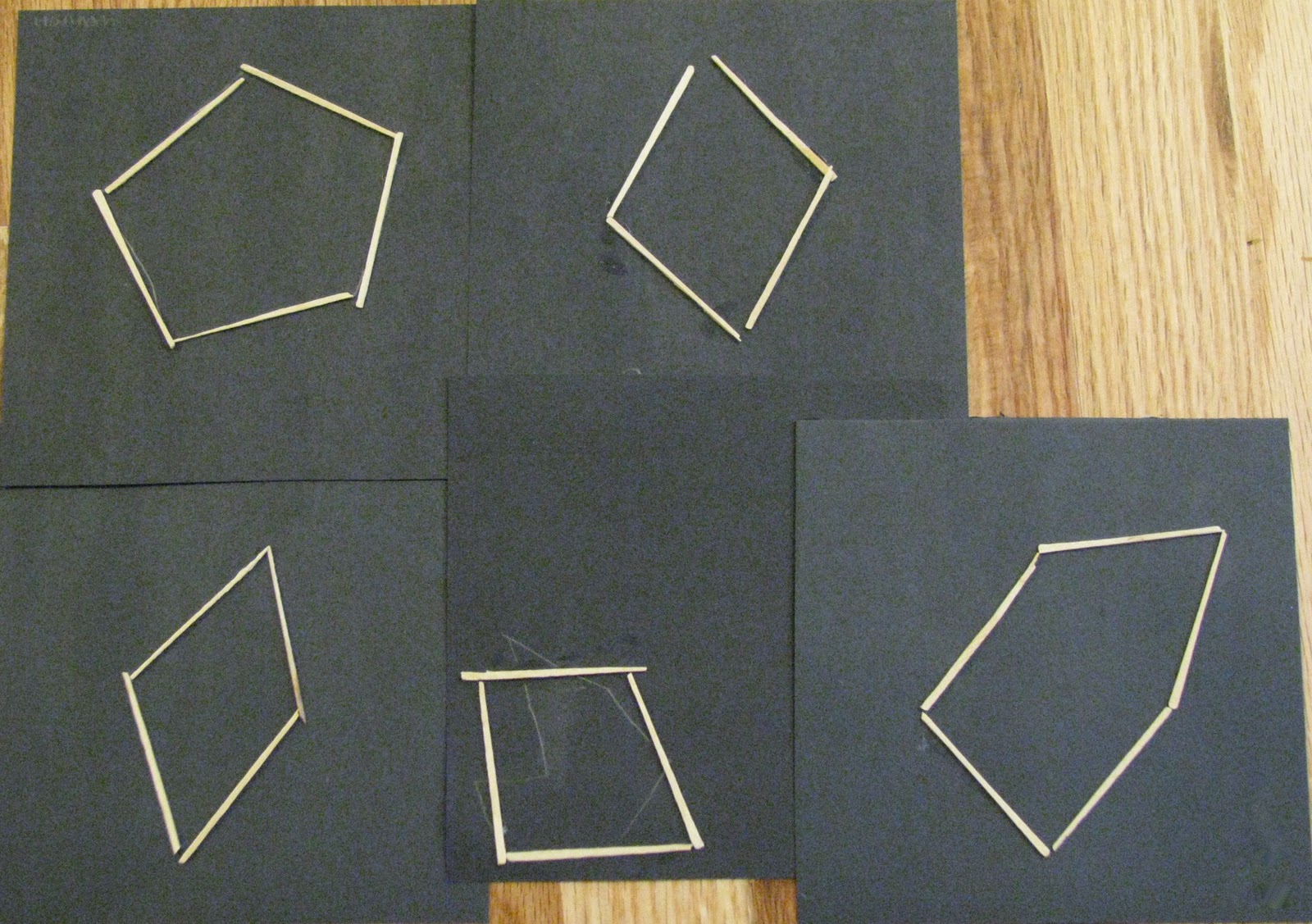
This is one awesome irregular pentagon. Dude!


Now, have kids switch places and build a polygon based on the cards at his new spot. Rotate around the table, placing cards, building, and checking polygons.

See our first Polygon Play session here
Look, Ma! Another irregular pentagon!

Captain, we are ready for irregular triangle takeoff!
Whoa. Irregular quadrilaterals are too cool for words.
P.S. The content in this post has been heavily influenced by Bridges lessons. Love them! :)

Tuesday, November 2, 2010

Reflective & Rotational Symmetry & More (Geometry Class #3, Fall 2010)

Another busy day with geometry! Here's what we did:

*read "A Square Puzzle" from Mathemagic. (This book, published in 1978, as part of the Childcraft series, has many interesting stories, puzzles, and activities. You can often find it cheap!)

*added to our "What Do You Know About Geometry?" flap books.

*shared symmetrical masks from last week, reviewed our understanding of "line of symmetry," and wrote definitions in a flap book.

*checked to see how many letters in our names are symmetrical.

*continued with lessons from Bridges, using an index card to investigate both reflective and rotational symmetry. We then explored symmetry with a variety of pattern blocks. I put a magnetic pattern block on the magnetic board, traced it, rotated, and asked the kids to stop me each time the block fit into the frame. They became very good at identifying the order of rotation and the number of lines of symmetry!

*read A Cloak for the Dreamer.

*used more Bridges lessons, building regular and irregular pentagons with toothpicks. Students followed up by drawing the shapes they made; this wasn't easy. (You try trying a regular pentagon!) We also built and drew regular and irregular hexagons.

    *finished by building toothpick polygons. We'll use these next week.

    Another great day! Thanks so much for all your hard work! :) If you'd like to do some "homework," check out the links below.


    Great Resources for Further Study:

    Monday, October 25, 2010

    Polygon Play (Geometry Class #2 Part I, Fall 2010)

    Math class today. We did so many things that I'm going to break it into a series of posts. :)

    Started with a brief review of tangrams by reading Grandfather Tang's Story. I provided tangrams so the kids could construct the animals as the story went along, but the story became too captivating...they slowly abandoned the pieces to fully concentrate on what was happening. Great book!

    We continued with a review of polygons. Last week we discussed the characteristics of a polygon. I drew a variety of figures on the board and they told me which were polygons and which were not. Since we'd read The Greedy Triangle last week, we quickly flipped through the book to see the polygons used there.

    We then made a flapbook...the word "polygon" on the outside of the flap and the characteristics listed inside. (This is not pictured.)

    And now...to make a quiz for their parents...to see if they know about polygons. They LOVED that idea! We made a series of 6 flaps (see right photo...one flap is open.) I had them cut off the top flap to make a "title" area..."Is this a polygon?" They then drew 5 figures of their choice on top of the 5 remaining flaps. Under each, they wrote "yes" or "no" to indicate whether the figure is a polygon. They used rulers to make sure the straight lines were actually straight.

    In the process of assessing their parents, this became a quick assessment to see if they had a solid understanding of polygons. With fun in the process!

    Nice addition to polygon lessons:


    Geometric Stick Lessons

    Tuesday, October 19, 2010

    Tangrams (Geometry Class #1, Fall 2010)

    [Note: Most of what we did today comes from Bridges materials.]

    We began by reading a Marilyn Burns book, The Greedy Triangle, in which a shape takes on one additional side after another, transforming from a triangle to a quadrilateral to a pentagon, etc.  I then asked the kids to consider what they already knew about geometry. They recorded their thoughts (words and/or pictures) in a 2-flap book. (We made our own flap books--photo left--but you can see a template under "Flip Flap with 2 flaps.") They wrote what they knew under the left flap and questions or things they wonder about under the right flap.

    We then compiled our information on a class chart.  It was exciting to see lightbulbs begin to go on; several kids had little to nothing on their individual flaps as they thought "geometry" was something totally new. As they heard ideas from other kids, our list became longer and longer as they began to make connections.

    We began thinking about Tangrams by reading Three Pigs, One Wolf, and Seven Magic Shapes. After the book, I slowly took them through the process of cutting their own Tangrams from 6x6" pieces of wallpaper. Here are instructions if you'd like to make your own. As they worked, we used a lot of mathematical vocabulary in context. Two words we especially highlighted: congruent and similar. A debate arose as to whether all triangles are "right triangles" or not. Some children were certain that they are; others were positive that there are exceptions. I told them to think about that for a time.

    When the Tangrams were complete, we used them to create a variety of shapes using just 2 pieces: square, rectangle, parallelogram, trapezoid, etc. They were then challenged to create the same shapes with 3 pieces. They have homework (optional) in which they'll try to construct shapes out of 4 or 5 pieces.

    Another challenge? To put the seven pieces back into their original square. This will be made easier by the fact that we used wallpaper with a pattern on one side. We finished with a reading of Agatha's Feather Bed.

    During the week, students may try Tangram puzzles on an iPad/Touch/Phone or select from the following:

    Tangram Puzzles

    Cyberchase Tangram Game

    Sagwa Tangrams

    NCTM Tangram Puzzles

    NCTM Illuminations Tangram Lesson

    Tangram Puzzles to Print

    Online Tangram Puzzles

    We also have several tangram puzzle kits and a game called Classic Tangoes. Manipulating the puzzles by hand definitely uses a different set of skills than doing them on the computer. If you'd like to read some more books with Tangrams, pick up Grandfather Tang's Story or The Tangram Magician.

    What an enjoyable class you are! See you next week! :)

    P.S. We talked quite a bit about the properties of a trapezoid. Please have them look at this site.  It allows you to manipulate a figure so that it remains a trapezoid but allows you to see the wide range of possible figures.

    Saturday, October 9, 2010

    New Class: Two and Three Dimensional Geometry

    Class: Two and Three Dimensional Geometry

    Age/Grade: appropriate for grades 3-6, ages 8-11(approximately).

    Course Description: Students will "develop more precise ways to describe, classify, and make generalizations about 2- and 3-dimensional shapes. They'll identify properties of shapes and then link those properties to specialized geometric vocabulary like angles, sides, faces, edges, and so on. They will construct and sketch shapes, compare and discuss their attributes, classify them, and develop definitions for these new ideas.

    Students will communicate their geometric conjectures and arguments in the context of problem solving. They'll fold and cut a square piece of paper to make a set of tangrams and then use spatial reasoning to investigate the relationships among the tangram shapes, using combinations of pieces to create familiar polygons.

    [As time allows] students will use also use geoboards, geoblocks, and polygons formed with toothpicks to build understanding of congruence, similarity, and symmetry." (The curriculum and course description are taken from Bridges in Mathematics.)

    Here are class examples from last year. (This is not the same content as the geometry class I taught last year.)

    When:
    5 sessions, 2 hrs. each
    October 18, 25, November 1, 8, 15
    10am - noon
    Oregon's Willamette Valley area

    If you have interest in participating, please drop me an email for more information. :)
    love 2 teach 2 day @ gmail dot com
    Related Posts with Thumbnails
    Blogging tips