Showing posts with label Symmetry. Show all posts

Friday, May 25, 2012

Pattern Block Lessons K-5, Free (Meet CCSS!)

I can't believe this is free! Some of my favorite lessons from Bridges in Mathematics have been compiled as "Pattern Block Lessons." The combination of lessons are designed to help meet the Common Core State Standards in grade bands K-2 and 3-5. Download the pdfs here.

Lessons include games, activities, literature connections, and all the necessary instructions and blackline masters. All you need is pattern blocks. Perfect for classrooms and homeschools. Enjoy!

P.S. They also have tons of other items listed there! Check out the Bridges Breakouts!!

Thursday, April 28, 2011

Magic Mirror Tricks: Exploring Symmetry

Two oldie-but-goodie books give children some fun exposure to symmetry. The Magic Mirror Book and Magic Mirror Tricks show incomplete illustrations--sometimes halves of objects, especially in the tricks book, hence the link to symmetry--that children can complete by holding a small mirror up next to the picture. The books, though out-of-print, can be found very cheaply.

To continue the symmetry lesson, I drew a light pencil line down the center of a piece of paper and asked my son to make a pattern block pattern on one side of the line only. He traced the blocks to make a new symmetry puzzle which he then completed by finishing the design on the other side of the line. He quickly discovered it was easier to trace blocks if he used the magnetic blocks on our new cookie sheet math board so the pieces didn't move.

I then asked him to make a riddle to give a hint as to the picture he'd made. He wrote one about a lion, the second about a hyena.


It would be fun to further extend the lesson by making his own Magic Mirror book. Sounds like a good summer project!

Tuesday, April 26, 2011

Magnet Board Math: Pattern Block Puzzles

I'm beginning to doubt my intelligence.

For years I have put pattern blocks in front of my kids only to have them slide all over the place on the block puzzle sheets. I had a DUH moment and finally gave them a magnet board (this could be a cookie sheet) to STICK the puzzle on while they used MAGNETIC pattern blocks to complete the puzzle.

My son explored symmetry in the process. One page asked him to complete patterns "so that the dotted line becomes a Line of Symmetry." You'll see (right) that he made a lovely pattern WITH symmetry, but didn't pay attention to the dotted line/line of symmetry. We had a good discussion about "line of symmetry" and used a ruler to help (below.) This was a nice extension to our symmetry lessons with Magic Mirrors that I'll show you later this week.


Note on materials: I own several different pattern block books: Pattern Block Problems for Primary People, Patternables and Magnetic Pattern Blocks. (That last one should have given me a clue!) I took all the pages out of the first two books, slipped each page into a plastic sleeve, and put them all into a 3-ring binder. This allows multiple children to use materials at once; I just pull out a page or two at a time.


Thursday, April 14, 2011

Easter Egg Symmetry (+ Bunny Tangrams??)

Last fall, we made symmetrical masks, modeled after some found on Mathwire. I thought it would be fun to do something similar with Easter eggs this week. We began by reading Magic Mirror Tricks, looking at the symmetry in the pictures.

My 8yo enjoyed using punches to decorate his egg. He worked really hard to make it symmetrical, agonizing over the fact that "it might be 100th of a millimeter off, Mom!"


At first, I gave my newly 5yo some cutouts and helped him with the symmetry. In time, however, I faced up to the inevitable. He was having entirely too much fun with DECORATING and could have cared less about the symmetry involved. That's okay. We're all about fun here, too! :)

Check out a few more of our symmetry lessons!

Or try making some Easter bunny tangrams. (What will people think of next???)


We're linked up over at A Mommy's Adventures: stART. And don't forget to check out all the posts linked to Math Monday! What a lot of great ideas to explore.

Tuesday, December 7, 2010

More Snowflake Symmetry (3D paper!)

You'll recall that we did some snowflake symmetry earlier this fall. If you want to extend the lessons a bit, consider making a 3D paper snowflake. Does your snowflake have rotational symmetry? Line symmetry?

And before you leave the topic of snow, read Robert Frost's Stopping By Woods on a Snowy Evening. My older kids memorized this poem when they were little. Now I'm working on it with my younger two. The book itself is gorgeous and one that we pull out and read several times each winter.

Monday, November 22, 2010

Lego Math: Symmetry

After studying line of symmetry and rotational symmetry I thought it'd be fun to do a little hands-on practice. With LEGOS!

Challenge:

1. Create a Lego masterpiece with line symmetry.
  • Basic level: build a Lego creation with at least one line of symmetry. When you're done, show the lines of symmetry.
  • Advanced: decide on how many lines of symmetry the creation will have. One? Two? More? Build a structure to those specifications.
Give kids a building plate and tell them to begin with a relatively flat structure...more picture-like than building-like.

[Teacher note: visit this site for more information on reflective symmetry.]

2. Create a Lego masterpiece with rotational symmetry.
  • Basic: build a Lego creation with rotational symmetry. You choose the order of rotation.
  • Advanced: decide on an order of rotation and build a project to match. 
[Teacher note: learn more about rotational symmetry and order of rotation. It's probably worth mentioning that while I don't remember being taught this in elementary school it's now a standard part of elementary math. I'm thrilled that my son will enter high school geometry at a higher level of understanding than I did! I knew squat.]
    See the video for our examples. I had my 8yo demonstrate the position of his lines of symmetry with yarn. As you'll see, it's difficult to keep the yarn straight to perfectly identify the lines, but it works. It'd be best to use some sort of frame to make it easier for kids to see the order of rotation. I'll work on that for my next rendition. ;)

    I didn't see this idea anywhere else and can't find it on the internet. Perhaps an original idea strikes once a decade. If so, I'm happy to share mine with you!!


    Please visit our other lessons on symmetry. Also, check out these art lessons using symmetry.

    And take a little peek at this "Symmetry Song." Love the way she filmed it in a mirror!


    Doing workboxes? Pop a handful of Legos in the box and challenge your kiddos!

    Friday, November 5, 2010

    Fabulous Math Website

    I accidentally found Links Learning when I was searching for a math site. It's phenomenal. The "Illustrated Lessons" are short movies that explain math concepts and then allow students to follow-up with interactive quizzes. From the site:

    In this section, you will find some fun ways to learn about math. You can start out with Estimation of Length, Place Value, Weight and Capacity. If you want something more challenging, take a look at Line Symmetry, Patterns and Tangrams. Try some of these at home with your family!

    On the Tangram movie, it gives you step by step instructions on making your own tangram. You push the button when you're ready for the next step. The lessons are great for introducing or reinforcing a concept.

    Tuesday, November 2, 2010

    Reflective & Rotational Symmetry & More (Geometry Class #3, Fall 2010)

    Another busy day with geometry! Here's what we did:

    *read "A Square Puzzle" from Mathemagic. (This book, published in 1978, as part of the Childcraft series, has many interesting stories, puzzles, and activities. You can often find it cheap!)

    *added to our "What Do You Know About Geometry?" flap books.

    *shared symmetrical masks from last week, reviewed our understanding of "line of symmetry," and wrote definitions in a flap book.

    *checked to see how many letters in our names are symmetrical.

    *continued with lessons from Bridges, using an index card to investigate both reflective and rotational symmetry. We then explored symmetry with a variety of pattern blocks. I put a magnetic pattern block on the magnetic board, traced it, rotated, and asked the kids to stop me each time the block fit into the frame. They became very good at identifying the order of rotation and the number of lines of symmetry!

    *read A Cloak for the Dreamer.

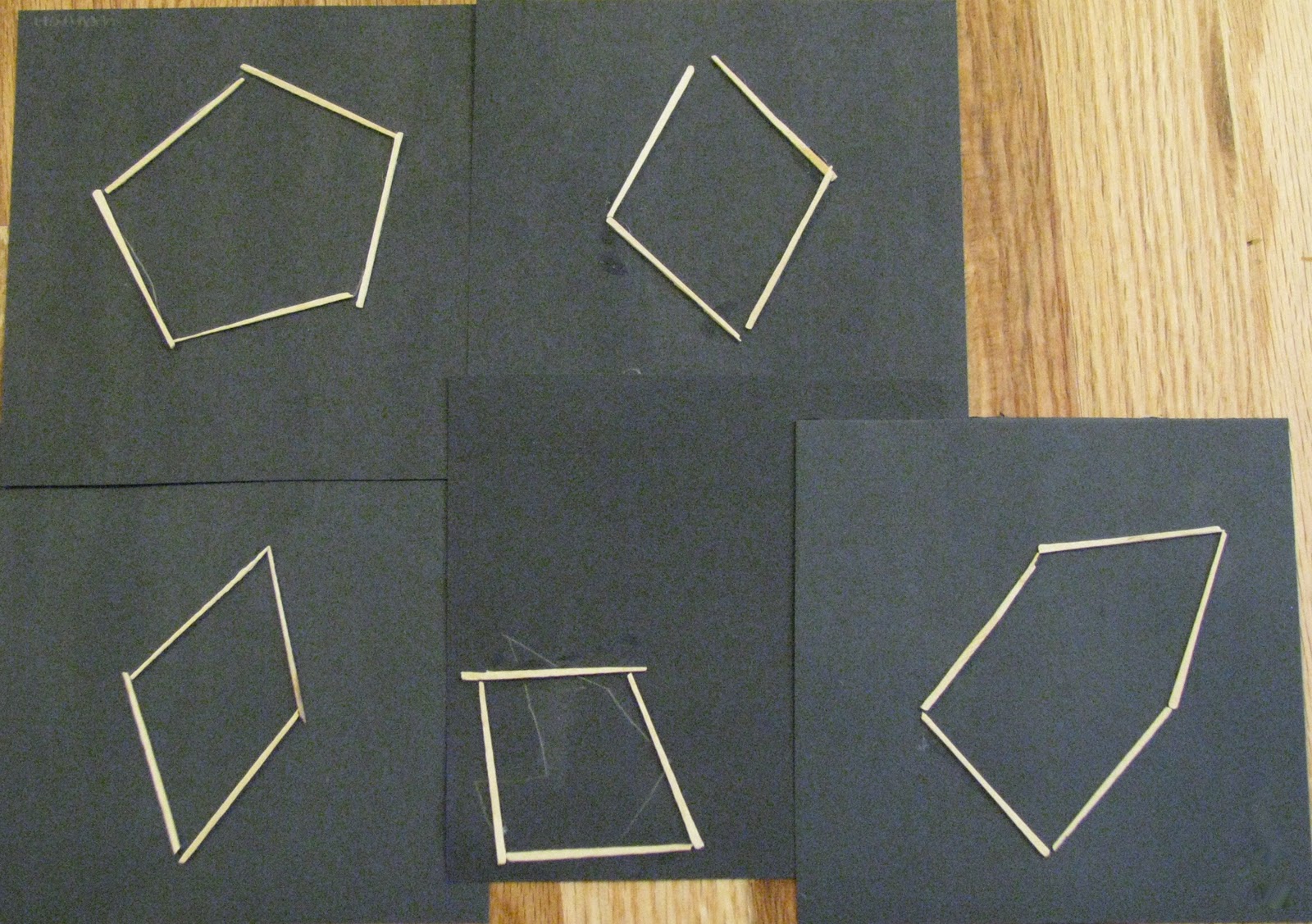
    *used more Bridges lessons, building regular and irregular pentagons with toothpicks. Students followed up by drawing the shapes they made; this wasn't easy. (You try trying a regular pentagon!) We also built and drew regular and irregular hexagons.

      *finished by building toothpick polygons. We'll use these next week.

      Another great day! Thanks so much for all your hard work! :) If you'd like to do some "homework," check out the links below.


      Great Resources for Further Study:

      Tuesday, October 26, 2010

      Snowflake Symmetry (Geometry Class #2 Part 2, Fall 2010)

      This week's math class continued with symmetry...

      We read Snowflake Bentley, a Caldecott winning book, that tells the true story of Wilson Bentley, who first captured individual snowflakes on film. We noted that Willie was homeschooled until age 14. Some speculate that Bentley may have been autistic.

      Bentley said, "I found that snowflakes were masterpieces of design. No one design was ever repeated. When a snowflake melted...just that much beauty was gone, without leaving any record behind."

      Two years ago my husband and I were in Vermont. Driving through Jericho, I noticed a snowflake sign on the "Old Red Mill." We inadvertently discovered the Snowflake Bentley Exhibit with a tiny museum housing Bentley's cameras as well as some of his photos. If you're ever in Jericho, Vermont, be sure to visit! (pictured, left)


      Using Bridges materials, my students made their own snowflakes using paper pattern blocks.


      After thinking about the meaning of "line of symmetry," we sorted our snowflakes. It took a lot of work to figure out how many lines of symmetry in each! We held a ruler in front of each image so we could imagine where the line(s) might be. One snowflake had rotational symmetry; we will explore that in more depth next week.


      As a last, optional, activity, students could make a symmetrical mask. I saw this posted on Mathwire and wanted to use it as an extension of our lesson on "line of symmetry."

      If you'd like, try some symmetry activities on-line:

      Symmetry Game

      Learn About Symmetry

      Symmetry Pattern

      Cyberchase Symmetry

      Symmetry Shape Games

      Finish the Symmetry Picture

      List of Kids' Symmetry Links

      Also, check out this snowflake set. What a fun way to explore tessellations!
      Related Posts with Thumbnails
      Blogging tips