Showing posts with label Writing. Show all posts

Saturday, April 29, 2017

Fractured Fairy Tales...my Favorite Unit EVER!!


**UPDATE: I'm working hard to make more pieces of this unit available. In the meantime, enjoy my favorite unit and one of love2learn2day's most popular posts!

Over the next 3 months, I will be teaching my FAVORITE UNIT EVER!!!  I first wrote and taught this unit back in the days before internet...before Common Core...before man discovered fire...

Just kidding. About the discovery of fire. But close.

Anyway, I'd like to share the unit as it unfolds.  I am teaching a group of 4th-6th graders in a 3 hour block, once a week. I originally taught the unit in 6th-8th grade language arts. The unit can be comfortably modified up or down to fit grades 3-8 in a classroom or homeschool setting.


Session 1
Focus: What Every Good Story Must Include/Parts of a Story

Opener
As students enter, I ask them to list every fairy tale title they can name.

Getting to Know You: Fairy Tales
We begin with a quick introduction in which students say their name, followed by their favorite fairy tale. They then repeat all the previous names/favorite tales in the class. This becomes a quick assessment tool as students offer up titles that are not actually fairy tales. In my class, one child named a book and said that the title is a fairy tale because it is fiction. I do not correct students as we will be learning more about what makes a fairy tale in the coming weeks.

Round Robin Fairy Telling
As a class, we retell the story of the Three Little Pigs, popcorn-style. I start the story and keep it going, randomly pointing to a student to have him/her fill in parts. I want them to recognize how much they DO already know. Later in the morning I can use this as an example for certain words/topics..."do you remember the DIALOGUE in the Three Little Pigs," etc.

http://www.amazon.com/exec/obidos/ASIN/1404853421/ref%3Dnosim/candle-20/
What Makes a Good Story?
Next, a read aloud: Show Me a Story: Writing Your Own Picture Book. Here, we talk about the tools that authors use to create good stories.

Fairy Tale Bibliography
I hand out a blank bibliography so students can add each book that we read. We will be doing a LOT of fairy tale reading, and I want them to use this as a reference.


This sheet is now available here!
Parts of a Story
I read aloud a traditional Red Riding Hood tale. Then, together, we list fairy tale events and plot them on an excitement scale to show rising action, climax/turning point, and falling action. We talk about how these elements are in every good story...and how the stories that they write will also include these elements. I follow with a reading of  Ruby by Michael Emberley. This is a "fractured" version of Red Riding Hood. We track events and plot an excitement scale again, showing that even as the story changes, the general shape of the excitement scale remains the same.
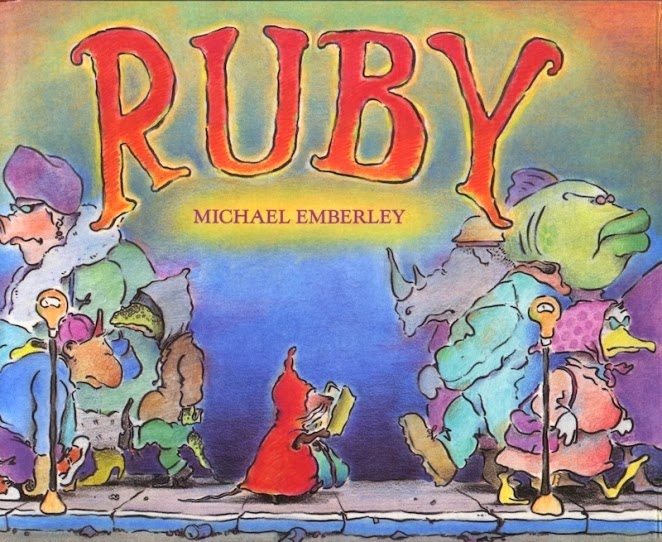
http://www.amazon.com/exec/obidos/ASIN/0316236608/ref%3Dnosim/candle-20/

http://www.amazon.com/exec/obidos/ASIN/0916260313/ref%3Dnosim/candle-20/
Drama
A big portion of this unit includes drama. Today we did an introductory pantomime activity from Theatre Games for Young Performers.

Comparison/Contrast
First, I read a traditional Cinderella Story. Together, we build a chart to look at various elements of the story. I record on the bulletin board as students record on their own individual charts. Then, I give each student a "fractured" version or a version from another culture to read. They each add this book to their own charts, then present what they discover so that we can add to the class chart (and individual charts.)


It is eye opening to discover just how many versions of Cinderella there are...and how the elements stay consistent throughout the tales. It's those consistent elements that make fairy tales what they are...so we're beginning to uncover how fairy tales differ from other types of fiction.

Think Sheets are now available here!
Writing Assignment: Fractured Fairy Tales

We'll be doing a lot of writing this term. To kick off the year, I read the traditional Three Little Pigs, then ask each student to use a  "Fractured Fairy Tale Think Sheet" to brainstorm how they might fracture the story. I suggest that they change one or two elements of the story--perhaps the setting, character, point-of-view of the story, etc...  But not all elements. Just a few changes allow students to start experimenting with fairy tale writing. I also mention a few additional guidelines. Their stories will likely include:
  • 3 little somethings
  • a "big bad" something
  • 3 "houses" of some type
  • dialogue between little somethings and big bad somethings
  • the phrase, "Once Upon a Time"
Before class begins next week, students will complete their own fractured fairy tales. Next week, we'll meet in authors' circles to revise our writing.

For additional support, students might also use this site from ReadWriteThink.

Fairy Tale Notebooks
We're compiling all our work into 3-ring binders with page protectors. At the conclusion of the unit, the page protectors will be taken out of the binders and made into permanent reference books.

Once Upon a Time there was a teacher who LOVED teaching fractured fairy tales...

Read more about our adventures here and here. And now you can also read about writing and producing the play portion, here.

**Update**

I am gradually adding items from this fairytale unit to TPT. Currently available:

Fairy Tale, Folktale Characteristics Poster

Short Story: Plot Diagram for Fairy Tales and More!

Character Studies: Folk, Fairy Tale, and Short Stories

Fairy Tale Think Sheets: Story Analysis & Pre-Writing Organizer (New! 4/29/17)

Fairy Tale Maps: Exploring Setting(New! 5/5/17)

Fairy Tale Bibliography Record Sheets(New! 5/12/17)

Fairy Tale Character Wanted Posters(New! 5/17/17)

Folk & Fairy Tale Compare & Contrast Story Chart(New! 5/19/17)

The entire collection is also available in a bundle:
Folk, Fairy Tale, & Short Story Series Bundle (Now complete! Over 100 pages!)


Sunday, March 23, 2014

Fractured Fairy Tales...Photos & Video!

Want to hook students on writing and performing? Fractured fairy tales are just the ticket. Here are some of my students, sharing photos & videos from our unit:

Fairy Tale Notebooks


A Few Fairy Tale Notebook Contents:


Little Billy


The Three Little Cats and the Big Bad Dog

Sunday, February 9, 2014

Getting Kids Excited About GRAMMAR?! (free, too!)

Over at Growing By Degrees, my brilliant-English-teacher-friend, Sherri, wrote a series of grammar lessons that begin with the book, Woe Is I, Jr., and extend to related online games and creative writing assignments. My fifth grader has been working his way through the series, mostly independently. It could be used as a source of grammar teaching ideas or as an independent study.

Here's a link to the final page (for Lesson 12), which contains an index for all 12 lessons. The introduction begins here.

This is a fantastic resource for grammar teaching and learning! Woe is...anyone who doesn't give it a try. 'Cause this grammar really will make you GRIN!

Wednesday, January 29, 2014

Journaling with Top 10 Lists


I've always enjoyed Dave Letterman's Top 10 Lists. Recently, we've had a bit of a slump in journal writing. With foggy, dreary days, periodic bouts of illness, and nothing much new on the horizon, it's been hard to come up with much to record. So I decided it was time for a change...

Journaling with Top 10 Lists

I made a whole series of journal pages (20) in which students can record ten items on a topic and then choose one (or more) of the topics to write about in a paragraph below:


Head on over to:

Teachers Pay Teachers

or

Teachers
Notebook

to get your copy.

Thursday, January 23, 2014

Fractured Fairy Tales: Character

Poster now available here.
Our fairy tale exploration continues...

We began our Fractured Fairy Tale study with a focus on plot. After writing our own variations of The Three Little Pigs, we read Once Upon a Time: Writing Your Own Fairy Tale, talked about the elements that make up a fairy tale, and considered the techniques we used in our own writing. We met in author's circles, revised, edited, and completed final copies of our stories.

The handout (shown right) helped us to distinguish fairy tales as just one kind of story that appear under the broader definition of "folk tale." To be a fairy tale, stories often include magic elements, fantasy characters, etc. (We are actually studying both folk and fairy tales.)

http://www.amazon.com/exec/obidos/ASIN/1404853367/ref%3Dnosim/candle-20/
Character
This week we continued by looking at character. We read fairy tales of our choice (traditional or fractured--with the only stipulation being that students had to know the traditional tale before reading the fractured version) and wrote report cards on characters' behaviors. Some characters didn't get very good grades! A Character Adjective Analysis (looking at adjectives that describe characters) and a Character Casting Call (who would portray your character in a movie?) helped to round out a character study.

http://www.amazon.com/exec/obidos/ASIN/0140544518/ref%3Dnosim/candle-20/
Character: Point-of-View
Popcorn-style (everyone participated!), we retold the story of the Three Little Pigs, this time from the wolf's point-of-view. It's not easy to see things from one character's point-of-view. We then read The True Story of the Three Little Pigs, where the wolf shares his (twisted!) perspective on the story.

Think Sheets are now available here!
We analyzed the wolf's point-of-view using a Character Think Sheet. Then each student chose another story to analyze, specifically looking at how a minor character might view the story's problem. Student choices included the troll in the Three Billy Goats Gruff, one of the lazy animals in The Little Red Hen, and the stepsisters in Cinderella. Each student made some notes on a Think Sheet and then wrote one page from that character's point-of-view. Diary entries and letters (Dear Mom, ...Love, Wolfie), helped to organize thoughts.


Next week we'll finish up the character study and begin thinking about setting.

Follow our Fractured Fairy Tale journey:

Part I: Plot
Part II: Character
Part III: Character with Art & Poetry


I am gradually adding items from this fairytale unit to TPT. Now available are:

**new!**Fairy Tale Bundle (all fairy tale products available)

**new!**Fairy Tale Bibliography Record Sheets, free!

**new!** Fairy Tale Maps: Exploring Setting

**new!** Fairy Tale Think Sheets

Character Studies: Folk, Fairy Tale and Short Stories

Fairy Tale Plot Sheet

Fairy Tale, Folktale Characteristics Poster

Disclaimer: if you're interested in purchasing any of these books through Amazon, all commissions go toward foster care in China through Grace and Hope (who sponsored my child) at no additional cost to you.

Sunday, December 29, 2013

Kids Learn to Type Before They Drive These Days??!

I remember learning to type. Because my daytime course schedule was packed, my parents drove me to a nearby high school to take evening classes. On an electric typewriter...

FFF (space) JJJ (space)

I learned to type about the same time I learned to drive. Driving and typing. Doorways to adulthood.

Not so today.

At least with typing.

I've been perusing the Common Core Standards for Writing and noticed something interesting:

Grade 3 (my bold)
CCSS.ELA-Literacy.W.3.6 With guidance and support from adults, use technology to produce and publish writing (using keyboarding skills) as well as to interact and collaborate with others.

Grade 4 (my bold)
CCSS.ELA-Literacy.W.4.6 With some guidance and support from adults, use technology, including the Internet, to produce and publish writing as well as to interact and collaborate with others; demonstrate sufficient command of keyboarding skills to type a minimum of one page in a single sitting.

Grade 5 (my bold)
CCSS.ELA-Literacy.W.5.6 With some guidance and support from adults, use technology, including the Internet, to produce and publish writing as well as to interact and collaborate with others; demonstrate sufficient command of keyboarding skills to type a minimum of two pages in a single sitting.

Grade 6 (my bold)
CCSS.ELA-Literacy.W.6.6 Use technology, including the Internet, to produce and publish writing as well as to interact and collaborate with others; demonstrate sufficient command of keyboarding skills to type a minimum of three pages in a single sitting.

When I read that 5th graders are supposed to type two pages in one sitting, I distinctly heard a character speaking from the movie, The Princess Bride. "INCONCEIVABLE!!!!!!"

Soooooo,..... methinks my 5th grader might do a bit more typing in the new year. We'll return to a favorite standby, Dance Mat Typing (free), from the BBC. Maybe we'll see you on the dance floor??

And not on the freeway! ;)

Thursday, December 26, 2013

Celebrating Our "Me Books!" (autobiographies)

First, Merry Christmas and Happy Holidays! I haven't been posting in the last week...  Too busy with a daughter home from college and all 5 kids (ages 7-23!), plus relatives, gathered here yesterday.

But I want to take time to share photos from the final project we completed before the holidays. This fall, my class studied biographies and autobiographies and wrote their own "Me Books." Here are photos from their hard work!

The lesson for the cover art came from Create Art with Me.

Some cover shots...

More cover shots...

Photos from some of the inside pages. Poetry, biographical sketches, artwork, and more...

Monday, June 3, 2013

Vacation Workstation...a Brain Playground


Was on my "To-Do" List:

1. Create something for my 7 & 10yo boys to do for a bit of "summer school."
2. Make a parting gift for my 3rd-5th grade class. (Shhhh...don't tell!)

Now on my "Done!" list! :)

Introducing the Vacation Workstation...a Brain Playground!

Left section
Right section


Using these adorable workstations--made from simple file folders--students keep their brains active with:
  • Nature Journal Mini Books - children go outside and use words and pictures to record things in the natural environment.
  • Math Blackout - using household games (suggested Math Game List is included, though individual users will need to take inventory of the games they have available), students play one game each day, focusing on different math concepts. I'm excited to make use of the games that we have available, encouraging my kiddos to try out a variety of the games we already own.
  • Book Bingo - children select diverse reading materials by choosing content from ideas on a grid. Each of the 4 different sheets may be played as a bingo (3 in a row) or as a blackout.
  • Reading List - students record the date and title of books read, either as a daily log or to record books completed.

After assembly, the accordion-style workstation can be used as-is or made into a compact book, approximately 8 1/2" x 4 1/2". (Let me publicly profess my new love for rainbow duct tape!)


Workstations are best suited for  ~ grades 2-6.* (Book Bingo includes chapter book suggestions like "Newbery Award.") 

*Update (6/22/2013) - The file has been updated to include a Book Bingo sheet for grades K-1 and a Math Blackout activity sheet for students preparing for grade 1.

In the homeschool setting, workstations can be used on an ongoing basis. They might also be assigned as independent homework during the school year. Complete directions with photos and worksheets are included. A Family Letter is also included to help parents implement the activities with their children.

Available through Teachers Notebook or Teachers Pay Teachers.

Happy Vacation!

Graphics (background & frames) by MyCuteGraphics.com

P.S. Monday is my last day with my sweet class. This is an
end-of-year gift for my students & a welcome-to-summer gift for my own kids! :) See below...


Tuesday, May 14, 2013

Opinion Writing with Purpose: 2 Letters!

We want young writers to write their opinions and support the ideas with solid reasoning. One of the best ways I've found to develop this skill is through letter writing. Using one of the ideas from 101 Ways to Make Book Reports Fun, my students have been writing some fabulous opinion pieces.

Recently, our studies have focused on explorers who searched for the Northwest Passage. We read about Sir Francis Drake and learned about his relationship with Queen Elizabeth. Students were dismayed to learn that she ignored much of his pirate-like behavior, wanting money to finance her projects.

One week, I suggested they write letters to Queen Elizabeth, explaining their concerns. After the letters were complete, I asked them to write replies to their own letters, pretending that they were Queen Elizabeth. (They didn't know that this was coming.) They did an incredible job!! Here are a couple of examples:

From a third grader:
Dear Queen Elizabeth,
I'm writing this letter to tell you about my opinion about your actions. I think you are hurtful because you are taking people for slaves. This tears families apart. In addition, you are taking money and gold from other ships, which is stealing. Sir Francis Drake is killing a lot of people which you know about, but you continued giving him tons of weapons and ships. I kind of do not like you, but you are pretty. I'm really glad that I'm studying you because you have some cool things to learn about.
From, L

Dear L,
I am writing this letter in response to the letter you wrote me. I think what you wrote in the letter was wrong.

I'm the Queen, I am supposed to take care of our beautiful country. My mom, Grandma, Great Grandma, and Great, Great Grandma all have been Queen for so long and have passed it on to me.

If I was not being trustful and someone caught me, I would be put in jail. I would never want to risk my life to get thrown in jail.

I love little children, they are my friends. How could I tear families apart. I lived in a royal family, I loved my family's happiness so why would I destroy other families?

Hoping my letter will change your opinion about me.
From,
Queen Elizabeth

From a 4th grader:
Dear Queen Elizabeth,
I am writing you a letter, because I want to tell you what I think of you. I think you are mean because you knighted Sir Francis Drake. You also gave him more ships to defeat Spain. You Queen Elizabeth are cruel. When you gave Sir Francis Drake more ships, you knew that he was going to take people and sell them as slaves. You are a dishonest person; when Sir Francis Drake stole money from Spain, you said the money was for the country, it was just for you and Sir Francis Drake. You just wanted to make yourself rich. I think you are the meanest person I know.
From, M

Dear M,
I am writing this letter in response to your hurtful letter. I am not as evil, horrid, and hateful as you think I am. Let me explain to you, M.

I was so hurt when I read your letter. You almost made me cry when I read it. If I did not care about people, I would not feel hurt.

Also, I come from royal blood, and I am the Queen. In addition, my family has taken care of my good country for years, and I will do the same thing too.

If I gave Sir Francis Drake more weapons, someone would know, and remove me as the Queen. People watch over me every minute of the day and night. I don't have any time to be by myself. I hope you will think differently of me.
Queen Elizabeth

The letters become more real as students select paper to represent their characters. My students crushed paper bags to make old paper for the background on their first letters and used "royal" paper to write replies.

Check out more ideas to make learning fun!

Common Core Standards:
CCSS.ELA-Literacy.W.3.1
CCSS.ELA-Literacy.W.4.1
CCSS.ELA-Literacy.W.5.1
CCSS.ELA-Literacy.W.6.1

Saturday, May 4, 2013

Explore Oregon Regions!


Oregon teachers and homeschoolers...I am very excited to announce that my new unit, Explore Oregon Regions, is finished! In this unit, 3rd-6th grade students learn about four regions of Oregon (Coastal, Cascades, Willamette Valley, Eastern) and consider how location influenced the lives of Native Americans. Activities use art, music, reading, speaking, and writing to bring information to life.

Students make a salt dough map, sing a region song, research and present an expert project on a region, perform a region commercial, write a book about regions, and make a 3-D art display demonstrating what they've learned about the Native Americans who lived east and west of the Cascades.

The unit requires a few basic supplies, listed by project/activity. You'll also need to visit your library to gather non-fiction books on Oregon.


The unit (46 page pdf) includes:
  • detailed teaching notes, including directions for working with a classroom or with a single child.
  • photos & examples of student work
  • introductory activities
  • regions of Oregon song (and songbook)
  • mapping project (including making a salt dough map)
  • expert project on an Oregon region
  • commercial presentation on an Oregon region
  • writing a book, The Important Thing About Oregon
  • 3-D art project to learn about how regions influenced lives of Native Americans
  • more than 25 student sheets/blacklines

You have the option to purchase a bundled unit which also includes Descriptive Poetry & Tissue Painting: 5-Sense Your Poetry Lessons.


The bundled unit (includes Explore Oregon Regions with the poetry unit, an additional 17 page pdf) is available at:
Teachers Pay Teachers
Teachers Notebook

Or pick up Explore Oregon Regions (46 page pdf) at:
Teachers Notebook


Thursday, May 2, 2013

The Best Writing Teacher & Editor EVER!

I don't generally posts information about classes & services that other teachers have to offer, but this is too good to miss. Ever since our college days, sweating through the same English education coursework, I have known that Sherri is an incredible writing teacher. I watched her teach. Then homeschool. And now she's expanding her outreach to include online students.

If you have a child in need of some extra help in writing--or if you have your own papers that need a professional's touch--you will not find a better teacher/editor. (I send her my lesson units to proofread. She doesn't miss a thing!)

You will find her online at By Degrees.  If you teach writing yourself, you'll also want to check out her blog.

Disclaimer: I do not receive any monetary compensation if you use Sherri's services; we don't have any business arrangement. I will, however, continue to send her my lessons to proofread.  She's simply the best! :)

Thursday, January 31, 2013

101 Ways to Make Book Reports Fun!


I am so excited to announce the completion of 101 Ways to Make Book Reports Fun!

     Why make book reports fun?
Research consistently shows that children learn more when they are actively engaged in the learning process and having fun. These activities tap into children's interests: drama, art, music, reading, writing, and more! 

Who are these activities designed for?
These activities are created for children in grades 2-8. Assignments could be modified to meet the needs of slightly older or younger students.

Many of the activities contain a particular focus: character, setting, sequencing, theme, drama, creative writing, music, persuasion, poetry, and more. While students should not be required to do a book report with every book they read, periodically requiring students to select assignments from different categories will help to deepen their literary experience.

Can I use them with my current curriculum?
These activities are designed for use with any classroom or homeschool curriculum, with a single student or an entire classroom. Most choices may be done independently; some are best done with a partner or in a group.  Activities speak to a wide variety of learning styles, including those that incorporate movement. They are also cross-curricular and include reading, writing, speaking, music, drama, and art. The activities also allow kids to share the joy of reading with other important people in their lives. 

You will have THREE options on how to use this product.

Option 1:
Create a book by stapling it or adding it to a three ring binder. Keep it near your lesson plans or your child's study area to use as a reference.
Option 2:
Print on cardstock and cut out the cards. Add them to a recipe box or a similar storage container. Your child can independently choose the activities he is interested in OR you can use the box yourself to file the activities you have completed with your students. Just add the cards you have completed to the back section.
Option 3:
Print this document (included in the pdf) on cardstock and cut out the cards. Punch a hole in the upper left corner of the cards, and add a key ring to create a flip-book. This will keep the activities organized while flipping through the cards to choose activities to complete.

      Enjoy making book reports FUN!


This is the second release in the Making Learning Fun series. Information about the first book in the series, 101 Ways to Make Spelling Fun by Tamara Chilver, is available on her blog, Teaching with TLC. Additional titles in the series will be available soon.


This product is available from Teachers Pay Teachers and Teachers Notebook.
Related Posts with Thumbnails
Blogging tips