Showing posts with label Math Vocabulary. Show all posts

Friday, June 16, 2017

I'm a Math Coach, and Trust Me When I Say This is Better Than a Fidget Spinner!


The day I announced that we were going to do some math challenges with fidget spinners, the gadgets were permanently banned at school. (If it hasn't already happened at your school, it's going to.) The fourth grade teacher leaned over and whispered, "I can't say I'm disappointed."

Yeah, I get that. Fidget spinners are the WORST. Like a purple llama doing cartwheels through the classroom.

BUT.

I love the idea of kids doing a STEAM (science, technology, engineering, art, and math) challenge that gets them excited about inquiry, data collection, art, math, and more. And STEAM is what I wanted to use those blasted spinners for.

So I went back to the drawing board and created an even better challenge. Why is it better? Because students MAKE THEIR OWN SPINNERS! A made-in-China-possibly-filled-with-lead fidget spinner will never get kids excited about STEAM like their own creations will.  So take a glimpse at how these students made spinning tops, recorded spin times, and graphed the data...

Fold the Spinner: Math Vocab

First, fourth graders followed along with me as I demonstrated how to fold an origami spinner. Along the way, we stopped and made observations about the shapes being created. I heard a lot of mathematical terms and attributes of shapes, like:
  • trapezoid
  • parallelogram
  • rhombus
  • square
  • rectangle
  • parallel sides
  • perpendicular
  • angles: acute, right
  • congruent
  • lines of symmetry
  • and more...! 
Pretty awesome for a few minutes of paper folding!

Combine Math & Art

Next, the kids dove into art. They considered what would happen to the spin image if they colored their tops with different fractional color combinations. For example, how might two primary colors look while spinning? What would a spiral or dots or squares look like? What would black and white do? Kids used crayons, gel pens, stickers. We ended up with all kinds of creations.


Collect & Graph Data

Then it was time to spin, baby, spin! Students worked in pairs to time the length of spins and graph their data. Challenges were posed and kids delved into scientific inquiry as they noticed that some spinners went far longer than others. Many tweaked their creations, hoping that a slightly different design would increase their spin time. 


Finally, students did a second set of trials in which they changed a variable. Our students clearly know a lot about science, technology, engineering, art, and math! 


They begged for instructions to take home.

Homework?

In the summer?

Well, I guess. Only if you really, really want it...!!!!

Then I gave them a summer challenge: to develop a spinner that would go for 40 seconds. I can't wait to see what they come up with! Have a great summer, all!!


Saturday, May 6, 2017

Table TOP Math: Integrating Math, Art, and Vocabulary

Math vocabulary is like spinach.

While good for you, in some circles, both have been known to have a less-than-stellar reputation.

I'm not one of those parents who feels the need to sneak vegetables into my kids. Vegetables are just part of life, a rich part of our daily eating habits. For example, we make lasagna more flavorful, more colorful, more nutritious, and more interesting with spinach or kale.

Math vocabulary is no different. I don't feel a need to isolate math vocabulary, shoving a piece of plain, cooked spinach down anyone's throat. Math vocabulary is what we do all the time. It's part of the environment in a rich, mathematical life. It helps us to communicate our thinking with precision. Like exercise, the more we utilize vocabulary, the more natural it becomes.

I love finding activities that naturally invite a wide variety of mathematical vocabulary, preferably while having fun and integrating subjects like art. We found a perfect candidate in Table TOP Math.


Students make tops, designed to spin on tables. As they fold their creations, they describe what they notice with observations like:
  • 4 equal angles
  • 4 sides
  • opposite sides parallel
  • 2 sets of sides with equal lengths
  • angles: right, acute
They also give names to the shapes they observe:
  • polygon
  • quadrilateral
  • rectangle
  • parallelogram
  • trapezoid

Then, they try different coloring techniques, integrating art. What a great opportunity to experiment with design and guess what each will look like as it spins. Watch a few examples...


Table TOP Math available here
You could make math vocabulary an integral part of any origami folding project. Pick something with fairly simple folds that your students will enjoy, and apply vocabulary along the way.

If you're interested in Table TOP Math, it is now available as a *new* product at a marked discount. ENJOY!!!

Thursday, October 9, 2014

Have Multiple & Factor Confusion?


Kids sometimes find it confusing to differentiate between multiples & factors. Here are a few visuals that I've found helpful:

Multiple: the product of a given number and another number. 

We could show this on a number line:


To find the multiples of 3, we can start with our given number (3) and then multiply it by 2 (6), by 3 (9), by 4 (12), and so on... 

We also see multiples represented by tile (Number Pieces):

1 group of 3 tile = 3
2 groups of 3 tile = 6
3 groups of 3 tile = 9
4 groups of 3 tile = 12


We can also use a visual model to investigate factors.

Factors: numbers that, when multiplied together, result in a product.

One of my favorite ways to do this? Lay out the product with tile (Number Pieces). Let's look at 12:

Use the 12 tile to form as many rectangular arrays as possible. The dimensions produce factors of the number. Here we can see arrays with dimensions of:

1 x 12
2 x 6
3 x 4

(Note: When using this visual model, prime numbers are also easy to distinguish: if it's prime, only one rectangular array--a 1 by the number--is possible.)

Why Do We Care?
My son is currently taking AP Calculus. He just popped in my office, saw what I was doing and said, "For us, finding factors is just one tiny step in a huge process. We do it all the time." Factors are a part of  higher level math! And, at a slightly lower level, students frequently use factors when working with fractions...not to mention (!) multiplication.

Additional Resources
I just created Fold It!...Factors & Multiples, a new set of flap books (Venn Diagrams & Shutter Folds) for students to compare and contrast factors and multiples. When complete, pages make a nice addition to student math journals. Alternate versions (different number combinations as well as blank copies) are included to allow for many uses: differentiation, exit slips, homework, notebook pages, math stations, etc.


The new set is also available as part of a bundled Multiples & Factors Flap Pack that includes the popular Flap Books "Present" Multiples & Factors (pictured right).

As always, new products (& bundles) are introduced with a sale price.

More Ideas
Looking for more ideas? Here are some of my favorites from around the web:
  • Flap Books & Online Games - in this blog entry, I share photos of flap books we made and link to a variety of games on the web
  • Factor & Multiple Anchor Charts with Student-Made Posters from Young Teacher Love - both are awesome.
  • Online Venn Diagram - create your own Venn Diagram to compare factors & multiples (example, right)
  • Multiple Mummy - kids use adding machine tape to make multiple strips and turn their teacher into a mummy.
Tune back for a multiple/factor game that you can play with any size group, 1 to 100!

Saturday, May 24, 2014

Parallel & Perpendicular Art


When I noticed that quite a few of my students were confused by the terms "parallel" and "perpendicular," I decided it was time for an end-of-year art activity. I visited my Math - Art Pinterest page and discovered a sweet little project at Math Activities*. Students worked on this during free moments at home and at school.

*You'll notice that we purposely did the lesson a bit different than originally described.


I love the way this turned out. And, yes...they now can tell me what parallel and perpendicular are! ;)

Thursday, April 3, 2014

Math Vocabulary Fun (free new resource!)

This morning, one of my math students reflected on a comment heard at home. "My mom doesn't get why we say 'product' instead of just saying 'the answer.'"

This led to a fabulous conversation in which students explained how specific vocabulary leads you to understand what operation is being performed. They listed and defined vocabulary for different "answers":
  • Sum
  • Difference
  • Product
  • Quotient
Math Vocabulary Cards
I then introduced a free new app (also available as an online tool) that provides ample opportunity to explore mathematical vocabulary. Each Math Vocabulary Card includes:
  1. the word
  2. the definition
  3. a visual
Any of these components can be hidden. This morning I chose a smattering of vocabulary that complemented our discussion (sum, difference, etc.) and also included some concepts that we've been recently studying. I set the program to flip through that limited set of cards and covered the upper left section, masking the vocabulary word. So, for example, I showed them this card:


After most of them had a word in mind, I revealed the answer:


I sent the link home in an email, encouraging students to use the vocabulary cards at home with their parents. I suggested they mask different portions of the screen; they loved the idea of quizzing their parents!

The vocab cards include sets for grades K-2 or 3-5 and can be explored by specific math category. One click takes you from English to Spanish definitions/vocabulary.

This free app (also available as an online resource) from The Math Learning Center can be accessed at Math Vocabulary Cards.

Sunday, December 15, 2013

Factors & Multiples: Flap Books & Online Games

Although factors and multiples are a 4th grade focus*, they are definitely something that we fifth grade teachers like LOVE to review.

To keep my students' skills sharp during holiday break, I created factor and multiple flap books. These little "presents" require students to write the definition of "factor" and "multiple" and list 5 multiples for 2-10 and all the factors for 6,7,8,9,10,12,18, 24, 36. Blank versions are also included for teachers or students who want to use their own numbers. When these little homework assignments return from break (!), they will be added to our math notebooks.


You'll find Presenting Multiples & Factors at:

Teachers Notebook
Teachers Pay Teachers

*factors & multiples are in CCSS.Math.Content.4.OA.B.4

Looking for more factor and multiple practice over break? Below, you'll find links to some of my favorite related games:

Table Numbers - Choose a factor from 2-9, then click on one of three numbers that represents a multiple of the chosen factor.


Times Square - find factors as you race to get four products in a row.
Factor Dazzle- Click on the factors of target numbers set by an opponent. Use Guest Pass or register to play against students online.

Factor Game - Click on the factors of target numbers set by an opponent. Play against the computer or a friend.

Wednesday, November 20, 2013

The Power of Picture Books in Teaching Math (angles!)

Tsk, tsk.

Lately, I've been so consumed with curriculum and content that I forgot some of my own advice...

USE PICTURE BOOKS WHEN TEACHING MATH!

The last couple sessions, I've made a concerted effort to include them. I've been reminded of how students new to the books...and the concepts...delight in learning math through stories.

In a specific example, I recently noticed that several students didn't know the meanings of "acute" and "obtuse" angles. I could have had them fill out a worksheet. [Yawn.] Then I remembered Sir Cumference and the Great Knight of Angleland.  In the book, Radius goes on a quest to earn his knighthood. He passes a village with "cute" rooftops, and continues through the "mountains of obtuse." In the end, he gives names to acute/obtuse angles, based on places in his journey.
My fifth graders were captivated.

After the read aloud, students easily wrote their own definitions of acute, obtuse, right, and straight angles on a Math Vocabulary Sheet. As a reader suggested, I'm now copying these with 2 pages on each side, so as to get all four definitions on a single sheet of paper. For a little 3D action I gave them toothpicks to glue on their "example" of the angles.

None of us are likely to forget acute and obtuse after this knightly adventure!

For more book suggestions, visit the Gigantic List of Math-Related Children's Books.

Disclosure: If you order from Amazon, all commissions go toward foster care through Grace and Hope at no additional cost to you. THANK YOU!

Wednesday, October 30, 2013

Math Vocabulary Sheet (freebie!)

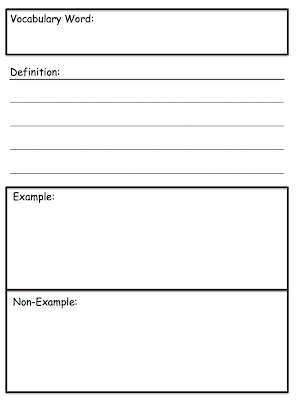
This year, my fifth graders have been recording math vocabulary in their journals. They write the word, their own definition, and an example (in pictures or numbers) as well as a non-example of the term.

The word "quotient" might show a problem with the quotient highlighted for the example and the dividend or divisor highlighted for the non-example. I recently made a little vocab record sheet to help with organization. I uploaded it to Google docs if you want to grab your own freebie.

Thank you for leaving a comment!

Monday, October 28, 2013

Math Monday Blog Hop: Math Vocabulary


Welcome to Math Monday Blog Hop!!!! In this hop all links will relate to the theme: Math Vocabulary.

This week, I'd like you to consider your own school experience. Did you use many mathematical terms? How might your math experience have been richer with more vocabulary inclusion?

Personally, I remember very little terminology. Sure, we had the basics--multiplication, addition, perimeter--but it was pretty limited. When I started teaching and had Word Resource Cards to use in the context of lessons, it brought both inspiration and challenge. I've had to learn vocabulary for the first time...as a teacher. I'm so pleased to support students with vocabulary that helps them to explain their thinking, clarifying both what they know and what they still need to figure out. I turn to resources like:
I ask kids to write their own definitions for terms we're studying, explaining their ideas with pictures, text, and sketches. How do you integrate math vocabulary? Post your ideas in the blog hop below!
**************************************************************************************************************


If you want to share this collection on your blog, just grab this link:

get the InLinkz code

Friday, January 18, 2013

Free Game Teaches Parallel & Perpendicular

Have you ever played the "dot" game? My kids play it sometimes. You start with dot paper, and take turns making lines to create little boxes. For every box captured, you score a point.

Today we played a similar game from the Math Learning Center, "Dots & Lines," that gives kids opportunity to explore the terms parallel & perpendicular. Players take turns spinning either perpendicular or parallel lines to indicate the direction in which to place their rubberbands. As squares are made, they are captured with game markers. You'll find it here, under Geometry, Supplement C1 Parallel, Perpendicular & Intersecting.

By the time we were done, my student thoroughly understood parallel & perpendicular. And we had a great time in the process. Enjoy!

CCSS.Math.Content.4.G.A.1

Tuesday, October 25, 2011

Math Journals & Notebooks

This is one of the times I feel very grateful to have connections to both the public school and homeschool community. Excitement bubbles in the homeschool world over lapbooks (we do an "on-steroids" version called Portfolders), closely followed by notebooks, where students demonstrate learning through student-made folders, foldables and creative notebook pages. Some homeschoolers focus specifically on math. Recently, I've seen a lot of fabulous information on teacher blogs about using journals/notebooks in the context of math. Since we are using math notebooks this year,  I'm enjoying...

1. Designing our journal covers
I love this idea. This teacher had her students design journal covers using "Math About Me." Students used numbers, pictures, word problems, etc. to represent themselves mathematically. In an upcoming post, I'll share ours...along with some fun extensions.

2. Basic Journal Pages
I'm using blacklines from the Bridges Math Journal as pages. The bulk of the pages are centimeter grid paper which makes it helpful when we're doing math problems, drawing graphs, making diagrams, etc. The back of the journal includes visuals in a blank math glossary (designed for students to fill in) which matches the Word Resource Cards that we use. I'm going to have my student refer to the visual glossary and the Word Resource Cards whenever we add vocabulary to the journal.

3. We'll use flaps, foldables and other interactive models.
In our Portfolders, we use a lot of flips and flaps to demonstrate learning in fun, interactive ways. Dinah Zike is the Queen of Foldables and has many great resources, including Big Book of Math and Notebook Foldables. Some of these are displayed at Simply2ndResources.

So what exactly are math journals/notebooks for? We'll be using them to...
  • Write our own definitions of math vocabulary used in our daily lessons.
  • Demonstrate our understanding of math using pictures, numbers, diagrams, etc... 
  • Refer back to math concepts that we explored earlier in the year. We'll continue to add to our knowledge by revising and adding to what we've already written.
  • Provide ample opportunity to write in the context of math.
  • Explore problem solving in creative ways, often using children's books.
  • Look at math in many settings: daily life, historical, games & more
These are other places I'll be visiting!

Runde's Room

Jimmie on Math Notebooking

Math Journals Boost Real Learning

I'll be back soon with examples from our notebooks! Would you like to share yours?


Friday, September 2, 2011

Review: Math Dictionary for Kids

Whenever possible, I integrate the use of mathematical terms in daily lessons. This year, however, I intend to expand student exploration of terms through Math Notebooking. (That post will come soon!) I was happy to receive a review copy of Math Dictionary for Kids as it appears to complement my plans.

The first section of the dictionary is organized by mathematical strand:
  • Whole Number and Operations
  • Measurement
  • Algebraic Ideas
  • Geometry
  • Decimals, Fractions, Percents, and Ratios
  • Statistics and Probability
Along with textual definitions, examples are often given. I especially appreciate the colorful visuals models that are frequently used. In some instances, multiple strategies are presented. For example, in "division strategies," the reader sees examples of strategies using multiples tables with larger numbers (if you've never seen this, it's often a very efficient strategy to use as an alternative to traditional long division), repeated subtraction, and the use of manipulatives. With the increasing amount of information that people need to process, it's essential that children learn to use a variety of strategies, considering which is most efficient for the problem at hand. For adults (and children) who've never been exposed to multiple strategies, the "Quick Reference Guide," gives a brief overview.

I'm especially partial to a section of the book called "Learning with Manipulatives." Again, for students or adults new to manipulatives--or for those wanting a review--this information clearly shows a variety of uses for manipulatives in mathematics. The visual models look very familiar after using similar models in my favorite curriculum, Bridges in Mathematics. I frequently lead workshops for teachers on how to use base ten pieces and grid paper for teaching multiplication and division, which leaves me feeling like the content is very up-to-date. Since most adults didn't have the opportunity to use manipulatives in their own math education, it's not unusual to see manipulatives set aside in classrooms (both at home and at school) or used as little more than playthings. This guide would be very instructive in helping adults and kids to see the value in using such tools to solve problems. After learning strategies for multi-digit multiplication with manipulatives, I can now do many problems in my head that used to take me significantly more time on paper.

Any negatives? Not really. I found one error. (p. 139 the array shows one dimension as 22 but in the problem it shows 21.) If anything, I'd love to see a book that pushed the exploration of strategies even further, encouraging people to look beyond the standard algorithm for the methods that are truly the most efficient. But this is a very nice start.

I wouldn't hesitate to use this book with students. Or to keep it nearby as a good reference for the teacher. The cover says it's for grades 4-9, but I'd use it with 3rd graders as well.

P.S. At the moment, this book is a good deal on Amazon.


Disclaimer: I received a review copy of Math Dictionary for Kids. I received no other compensation and this review is my opinion...good, bad, or otherwise. :) If you purchase this book through my Amazon link, all commissions go toward foster care through Grace and Hope at no additional cost to you. I do not keep any money myself; I am hoping to be able to sponsor an additional child in foster care through commissions on this site.

Monday, January 3, 2011

Children's Math Book Review: Apollo

Have you read Apollo? While this cute little book was probably not written with the intent of teaching math concepts, I love it for it's ability to explore basic vocabulary with simplicity and humor.

Summary: The owner of a dachshund describes how adorable, obedient, and clever his dog is from all sides and all directions.

Basically, the narrator introduces you to Apollo, looking at his back, middle, front, sides, etc. The reader is exposed to the words: horizontally, vertically, diagonally, left, right, etc. My favorite pages explore the concept of "half" when the pictures show the front half of Apollo but then show "different halves" by showing his top half and bottom half. Great humor and concept exploration for preschool and early primary children. The same author also has a book, Counting With Apollo, that I've not yet seen.

Vertical Stuffed Moose
I handed our older digital camera to my 8yo son this afternoon so he could take photos of stuffed animals, exploring the vocabulary and concepts from the book.

This would also make a great preschool or primary math workbox.
Horizontal Stuffed Moose

1/2 of a Stuffed Dog


Thursday, November 11, 2010

More Polygon Play! (Geometry Class #4, Fall 2010)

Time for some more polygon play...wanna play along?

I made a pdf (print it, free!) to review the terms for the number of sides of various polygons.

1. Print the sheet on white cardstock, one per person.


2. Have each child take a red crayon or colored pencil. As you say (or draw) the number of sides, they lightly color the rectangle with that term. Example: "Color in the word that means a 4 sided polygon." [Color in "quadrilateral."] After you've gotten through the first 8 terms on the sheet...
3. Now do the same thing in reverse. Have each child take a blue crayon or colored pencil. As you say one of the terms from the top of the page (already colored in red), they color in the card with that number of sides using blue. Example: "Color in the number of sides on an octagon." [Color in "8 sides."] Now everything should be colored in except the last two terms.

4. Do students know what "regular" vs. "irregular" polygons are? Review. If they don't, look here. Color the regular/irregular cards green.

5. Cut out cards.

6. Mix up cards. Match corresponding red and blue cards.

Greedy Triangle (Scholastic Bookshelf)As you read the book, The Greedy Triangle, ask students to lay out the red and blue cards that match the polygon on each page.

Give children some popsicle sticks. Tell them to lay out the "triangle"  and "regular" cards. Ask them to make a polygon with those criteria. What do students notice about their polygons? Are they alike? Different?

 Ask them to lay out the "quadrilateral" and "irregular" cards. Make a polygon. Are their figures the same?

Ask students to set aside all cards except the following: triangle, quadrilateral, pentagon, hexagon, regular and irregular. Each child should select one card of each color (red and green) and lay it out in front of him. (Use the blue cards as needed if kids need reinforcement to recall how many sides are on each polygon.)
This is one awesome irregular pentagon. Dude!


Now, have kids switch places and build a polygon based on the cards at his new spot. Rotate around the table, placing cards, building, and checking polygons.

See our first Polygon Play session here. 
Look, Ma! Another irregular pentagon!

Captain, we are ready for irregular triangle takeoff!
Whoa. Irregular quadrilaterals are too cool for words.
P.S. The content in this post has been heavily influenced by Bridges lessons. Love them! :)
Related Posts with Thumbnails
Blogging tips