Showing posts with label Division. Show all posts

Sunday, January 26, 2014

Scoot: Multiply & Divide Decimals & Whole Numbers by Powers of 10

Have you played Scoot with your students? I love the game! Basically, you spread task cards around the room and each child moves from problem to problem when you call "Scoot," and enters answers on a record sheet.

I LOVE anything that involves getting up and moving! So I created a new Scoot game for my students to practice multiplying and dividing decimals and whole numbers by 10 and 100. The cards can also be used in math centers or as task cards for early finishers. Perfect for classrooms and homeschoolers!

I've designed the cards so that students must closely evaluate different combinations with similar numbers in every set of four cards. For example, cards #1-4 are as follows:

135 x 10
1.35 x 10
1.35 ÷ 10
13.5 x 10


All cards show some form of a whole number or decimal multiplied or divided by either 10 or 100. Exponents are NOT included.

32 cards, record sheet, and answer key are included.

This game was designed to support the following Common Core Standards:
  • CCSS.Math.Content.5.NBT.A.1 Recognize that in a multi-digit number, a digit in one place represents 10 times as much as it represents in the place to its right and 1/10 of what it represents in the place to its left.
  • CCSS.Math.Content.5.NBT.A.2 Explain patterns in the number of zeros of the product when multiplying a number by powers of 10, and explain patterns in the placement of the decimal point when a decimal is multiplied or divided by a power of 10.
You'll find the game on Teachers Pay Teachers and Teachers Notebook!

Credits:
Cover Background, MyCuteGraphics
Frames & Bubble Border: Mr. Magician
Cartoon Characters: Monster Wrangler Mike

Friday, January 24, 2014

Powers of Ten: Powerful Teaching Resources

News Alert!
Check out my just-released SCOOT game that supports students as they practice multiplying and dividing fractions and decimals by 10 and 100. You'll find it on Teachers Pay Teachers and Teachers Notebook!

To commence our decimal unit, we looked at the powers of ten and more specifically:
  • CCSS.Math.Content.5.NBT.A.1 Recognize that in a multi-digit number, a digit in one place represents 10 times as much as it represents in the place to its right and 1/10 of what it represents in the place to its left.
  • CCSS.Math.Content.5.NBT.A.2 Explain patterns in the number of zeros of the product when multiplying a number by powers of 10, and explain patterns in the placement of the decimal point when a decimal is multiplied or divided by a power of 10. Use whole-number exponents to denote powers of 10.
Early on, we examined The Great Wall of Base Ten (from a lesson in The Math Learning Center's Bridges Curriculum):


On the far right of the picture, you see a unit (1cm x 1cm). What you can't see (and what the kids had to envision and then make) is what happens to the right of the unit. They cut out a tenth and a hundredth and discussed what happens to the number when you move each direction across The Great Wall of Base Ten.

Whenever possible, I like to share books and videos that reinforce or expound on our studies. Here are several favorites. (If you're in my class, watch the videos below!!) :)

Books: Powers of Ten

 http://www.amazon.com/exec/obidos/ASIN/076145070X/ref%3Dnosim/candle-20/
Ten Times Better by Richard Michelson - an excellent introduction to the topic, this book illustrates 10 times the numbers 1-10.


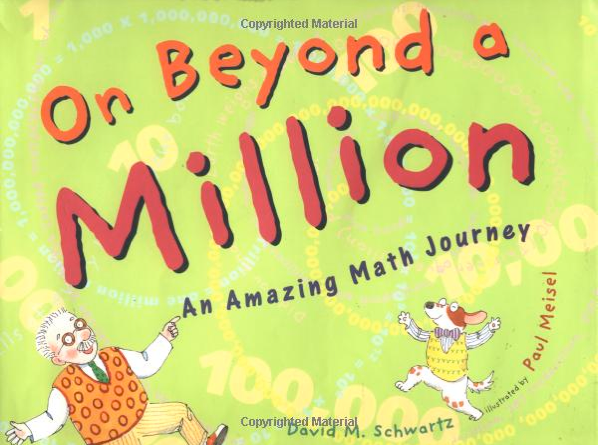
 http://www.amazon.com/exec/obidos/ASIN/0440411777/ref%3Dnosim/candle-20/ On Beyond a Million by David Schwartz - illustrates the powers of ten.


 http://www.amazon.com/exec/obidos/ASIN/0761312803/ref%3Dnosim/candle-20/ Big Numbers and Pictures That Show Just How Big They Are by Edward Packard - look for this out-of-print book at your library that also illustrates the powers of ten.


 http://www.amazon.com/exec/obidos/ASIN/0807510610/ref%3Dnosim/candle-20/ Can You Count to a Googol? by Robert E. Wells - Before we even began reading, my students connected the name "Googol" with the search engine. After we finished reading--and they learned the definition of "googol"--they had a pretty good guess about why it was given that name! (Also illustrates the powers of ten...all the way to a googol!)


Videos: Powers of Ten

Secret Worlds: The Universe Within
- From the site: "View the Milky Way at 10 million light years from the Earth. Then move through space towards the Earth in successive orders of magnitude until you reach a tall oak tree just outside the buildings of the National High Magnetic Field Laboratory in Tallahassee, Florida. After that, begin to move from the actual size of a leaf into a microscopic world that reveals leaf cell walls, the cell nucleus, chromatin, DNA and finally, into the subatomic universe of electrons and protons." After watching the presentation, you can manually zoom in and out, watching the powers of ten increase & decrease.

Powers of Ten - From YouTube: "Powers of Ten takes us on an adventure in magnitudes. Starting at a picnic by the lakeside in Chicago, this famous film transports us to the outer edges of the universe. Every ten seconds we view the starting point from ten times farther out until our own galaxy is visible only a s a speck of light among many others. Returning to Earth with breathtaking speed, we move inward- into the hand of the sleeping picnicker- with ten times more magnification every ten seconds. Our journey ends inside a proton of a carbon atom within a DNA molecule in a white blood cell. POWERS OF TEN © 1977 EAMES OFFICE LLC (Available at www.eamesoffice.com)"

Saturday, February 19, 2011

Coupon! Math in the Moment

I love the way Dan Meyer does such a wonderful job of recognizing math problems in the moment. So I tried to catch a moment myself today. During lunch when I was looking through the local grocery ads, ds8 saw a coupon for candy bars, 5 for $2. He remarked, "That's not a good deal! You can get a candy bar for like $.68!" I asked him how much one candy bar would cost if they are 5 for $2 with the coupon. He didn't know. We've only done a tiny bit of basic division, and certainly not division with money, but I decided that he was probably up to this task. So I cut out the ad and told him to use pictures, words, and/or numbers to figure out how much one candy bar would cost.

I knew this would cause a bit of disequilibrium. But I also knew that the right amount of disquilibrium = a great environment for new learning. After thinking a bit, he wrote out a long problem of 10+10 until he'd written 20 tens. He then made 5 boxes and drew curved lines connecting a 10 to each box. In the middle of this he stopped and said, "I know! They cost $.40!" I asked how he knew. He said that there are 20 tens in $2. And 20 divided by 5 equals 40. (Since he seemed to be on the right track and was obviously thinking in decimals, I didn't interrupt.) Then, after a while, he grinned and said, "We should get 4 candy bars for $1.60. Then [brother] and I can each have two so it's fair."


When do you successfully use math in the moment?

Monday, November 15, 2010

Milk Cap Math: MADS Elimination


Here is another milk cap math game for basic +/-/x/division practice. My 15yo daughter thought of the name, MADS Elimination. (Thanks!)

The object?

M: multiply
A: add
D: divide
S: subtract

...in order to eliminate all milk caps on the playing field. (Before you go completely MADs!)

You'll need:
  • two sets of 10 milk caps (any color), numbered 1-10
  • two, 1-6 dice
To play the game, each player forms a line of milk caps, 1-10. Players take turns rolling the dice. When dice are rolled, the player may choose to multiply, add, divide, or subtract. So, for example:

Dice rolled: 3 and 5

I can:

M: 3 x 5 (won't work since my caps are 1-10)
A: 3 + 5 = 8
D: 5 / 3 = 2.5 (won't work)
S: 5 - 3 = 2

So I could eliminate either the 2 or the 8 cap. If the cap(s) has already been eliminated, I lose my turn. The first player to eliminate all caps, wins.

You can make this a little easier (preschool) by using 6 caps (1-6) and one die (1-6) and removing caps from the table as you roll each number.

You can make this a little harder by using bigger numbers (on the caps) or having the option of rolling multiple dice. For example, you could roll three, 1-6 dice, and make a number sentence using all three numbers. (You could also use dice with different numbers: 0-5, 4-9, etc.)

Example using 3 dice:

I roll: 1,3,4

I could do any number of combinations...I won't list them all, but for example:

3 - 1 + 4

1 x 4 - 3   (You could even talk about order of operations here.)

4 - 1 + 3

Lots and lots of possibilities for this game!

Running out of math caps yet?? ;)

This is another great math workbox game! ;)
Related Posts with Thumbnails
Blogging tips