Friday, January 25, 2013

Kids Create Subitizing Cards


My sweet kinders love to subitize. In case you're unfamiliar with subitizing, look at some of my past blog posts. Basically, we're working on developing number sense through instant recognition of quantities. I downloaded a free set of subitizing cards that have a variety of dot combinations. For example, if I flash them (just for a moment) this card:


...and ask them "how many?" they may say "7, because I saw a 4 and a 3 and that makes 7." Or they might say "I saw a 2 and a 2 and a 3 and I counted them [in my head] and that makes 7."

Today we switched things up a bit. Imagine their delight when I told them they were going to make their own subitizing cards! Here's how:

1. I gave each child a 5"x8" index card with a line penciled lightly down the center. I asked them to find the LEFT side. A student suggested that they lay a Cuisenaire Rod on that side to help them remember. 
    2. I told them that they were going to make quantities with dot stickers. (Dot markers would also have been fabulous.)

    Guidelines:
    • Use two colors.
    • Build any number from 4-7 (later I added 8.)
    They then placed dots on the left side of their index cards.
      3. Each child practiced writing his number on an individual whiteboard and showed me before writing the number on the right hand side of the card in his BEST handwriting. (This prevented a few backward numbers and a few dot miscounts.)

      4. When the cards were done, we tried flashing their cards to a grandma who came to pick up her grandson. The kids were SO PROUD when they flashed the dots on the left and Grandma was able to figure out the number, hidden on the right side of their cards! We'll continue to use the kid-produced cards, making more with higher quantities.

      This was a huge success for us! Hope you enjoy it. (I'd love to hear about how it goes with your kids!)


      Wednesday, January 23, 2013

      Abbot and Costello Math

      Enjoy! (And visit some of my other favorite math-movie connections.)

      Monday, January 21, 2013

      Math Monday Blog Hop #83 (Jan. 21, 2013)


      If you want to share this collection on your blog, just grab this link:
      get the InLinkz code


      Friday, January 18, 2013

      Free Game Teaches Parallel & Perpendicular

      Have you ever played the "dot" game? My kids play it sometimes. You start with dot paper, and take turns making lines to create little boxes. For every box captured, you score a point.

      Today we played a similar game from the Math Learning Center, "Dots & Lines," that gives kids opportunity to explore the terms parallel & perpendicular. Players take turns spinning either perpendicular or parallel lines to indicate the direction in which to place their rubberbands. As squares are made, they are captured with game markers. You'll find it here, under Geometry, Supplement C1 Parallel, Perpendicular & Intersecting.

      By the time we were done, my student thoroughly understood parallel & perpendicular. And we had a great time in the process. Enjoy!

      CCSS.Math.Content.4.G.A.1

      Wednesday, January 16, 2013

      Do You Repeat, Repeat, Repeat Yourself?

      Has this ever happened to you?
      Teacher: Turn to page 31.
      [As the last word falls from her mouth, she is interrupted by...]
      Student: What page are we supposed to be on?

      Or...

      Teacher: Put your name in the upper right hand...
      Student: Should we put our name on our paper?

      Who is working harder in your classroom? You or your students? Think about directions. Who works harder? Do you work harder to explain (repeating yourself over and over and over) or do they work harder to listen?

      If you are a classroom or homeschool teacher and find yourself repeating-repeating-repeating yourself, here's an idea that I'll call "Take 3: Ask 3 Before Me." The idea? After you've given a direction or answered a question, you do not repeat yourself until a student can prove that she has asked at least 3 other people for the information. It looks like this:

      Teacher: Take out your math books.
      Student: What are we supposed to be doing?
      Teacher: Take 3. [Alternately, the teacher puts up 3 fingers or points to a visual cue on the wall and moves on.]

      The student then finds 3 other people to ask. In order to return to the teacher with the same question, she must list the names of the 3 people she asked. Not surprisingly, this rarely happens!

      A modified version can be very effective in the homeschool setting. "Take 3" means that the student sets the timer for 3 minutes, working at a task for mom (emptying dishwasher, folding laundry), all while trying to remember what the teacher said. At the end of the 3 minutes, if the child still doesn't remember, Mom is able to repeat a direction because the child has worked to replenish the energy that Mom will use to repeat herself.

      Grab the free posters in my TPT store.  Like what you see? Some TPT feedback would make my day!

      Enjoy!

      Monday, January 14, 2013

      Math Monday Blog Hop #82 (Jan. 14, 2013)


      If you want to share this collection on your blog, just grab this link:
      get the InLinkz code


      Wednesday, January 9, 2013

      Facebook...and Snowing Angles

      I'd LOVE to have you join me on my new Facebook page.  I'll be sharing links, photos, videos...quick, fun ideas for teaching and learning.

      Today, I'm sharing a link to a fantastic follow-up on Human Angles.  We're measuring snow angles* since we still have no snow!

      If you appreciate new teaching ideas, consider "liking" my new Facebook page. Thank you!!! :)

      P.S. On my Facebook page I'll also be occasionally asking for volunteers to proof-read or test lessons in development!

      *Photo captures student working on a free worksheet from Relentlessly Fun, Deceptively Educational. 


      Tuesday, January 8, 2013

      Teaching Position (Geometry in Kinder)

      So is it weird that I think teaching position, a la CCSS:
      CCSS.Math.Content.K.G.A.1 Describe objects in the environment using names of shapes, and describe the relative positions of these objects using terms such as above, below, beside, in front of, behind, and next to.
      ...is the funnest thing ever??? I've been feeling a tad obsessed about my "position" collection. I'd love to share it as you consider ways to make this geometry concept fun!

      Student Print Resources

      Where is the Shape?
      After discussing posters depicting shapes (and cats!) in positions relative to a table, students make their own little position books. I'd love feedback on this! Please drop me a comment if you use it. :)

      Gingerbread Man Under and Over
      A cute printable considers the concept of under/over with a gingerbread man and 8 common items.

      Teddy Bear and Box Calendar Markers
      This calendar pattern set from The Math Learning Center explores positional words throughout an entire month using a box and teddy bear.

      Books to Explore Position

      All About Where (Tana Hoban)
      Like other Hoban books, this features a variety of photographed scenes.  Students can discuss where they see positional words (included) in each picture.

      Up, Down, and Around (Katherine Ayers)
      Cute illustrations with text describing where vines grow in the garden.

      Bug Dance (Stuart Murphy)
      A personal favorite (because my son loves it!) where a centipede has a hard time following dance directions in gym class.

      Left Hand, Right Hand (Janet Allison Brown)
      Explore left and right with hands.


      Online, Tech Activities (Games & More)

      Dance Moves
      Move a dancing bear to the correct position. This could be done by a single child at the computer or with an entire class watching a projection. It'd be great to have the whole class follow instructions and dance along!

      Treasure Hunt
      Follow directions to dig for treasure.

      Monday, January 7, 2013

      Math Monday Blog Hop #81 (Jan. 7, 2013)


      If you want to share this collection on your blog, just grab this link:
      get the InLinkz code


      Friday, January 4, 2013

      Changing Math Expectations: This Ain't the 50s Anymore!

      If you're a classroom teacher, you already know this. If you're a homeschooler, you'll probably want to know it. Math expectations for our kids have changed. Drastically.

      I point you to a fascinating article, "Ralphie's Math Vs. the Common Core," which compares what 9-year-old Raphie--of the movie A Christmas Story--was supposed to know vs. what current third graders must know.

      Some days, I look at Common Core Standards, my eyes glazing over, trying to figure out how to make the content user-friendly. Not long ago, this was my fourth grade bugaboo:
      CCSS.Math.Content.4.NF.B.4a Understand a fraction a/b as a multiple of 1/b. For example, use a visual fraction model to represent 5/4 as the product 5 × (1/4), recording the conclusion by the equation 5/4 = 5 × (1/4).
      Hit me with a watermelon truck in January.

      It's too embarrassing to share how many times I read that over, trying to figure out how to make it palatable to the average 10-year-old.  Palatable. Not necessarily fun. Or able to compete with the newest video game. Just palatable. How would you make that standard developmentally appropriate for a 10-year-old? I've got one. A 10-year-old, that is. Not a way to make that standard developmentally appropriate.

      Read the article.  If you're a teacher, it might make you feel better. If you're a homeschooler, it sheds some light on what your child's peers are up to.

      Wednesday, January 2, 2013

      Temperature Story: Cold Snap

      If, like me, you're a fan of Marjorie Priceman's How to Make an Apple Pie and See the World, you will love her illustrations in a new book, Cold Snap, written by Eileen Spinelli.  Feeling a bit jealous of the snowy weather reports in other parts of the country, my only alternative was to read about a week of falling temperatures in the town of Toby Mills. By Friday night in this freezing town, the cold residents are happy to gather for a time of merriment with a bonfire, hot cider, sugar-on-snow candy, and singing.

      The book would be a perfect introduction to the concepts of temperature and hot-warm-cool-cold as described in the Fahrenheit and Celsius poems, available on the Math Learning Center website as a free download.


      View additional math-related children's books.

      Disclaimer: If you use the Amazon link, Grace and Hope (foster care for kids in China) will make a few cents (at no cost to you.) Thank you!


      Monday, December 31, 2012

      Top 10 Math Posts of 2012

      The following 2012 posts received the most visits during the past year. Thank you for your support. All the best in 2013!

      10. Fun, FREE!, Hands-on Math Units

      9. Math Education: Some Must-Read Blog Posts!

      8. Calendar Pattern: Fractions & Music

      7. Free Math Strategy Posters

      6. Ordinal Numbers in Children's Literature & Technology

      5. 10 Ways to Mess Up a Child's Mathematical Mind

      4. Greater Than/Less Than - DIY Whiteboard Tool

      3. My Life in Numbers

      2. Part-Whole Math With a Plate!

      The #1 post of 2012....
      Subitizing - Making Sense of Numbers

      And the most visited page on love2learn2day: Math in Children's Literature Book List


      If you want to share this collection on your blog, just grab this link:
      get the InLinkz code

      Grab a Math Box: love2learn2day button for your own blog:

      Thursday, December 27, 2012

      Math Chapter Book: The Lemonade War

      Author Jacqueline Davies' contribution to this year's Battle of the Books, The Lemonade War, gives kids many opportunities to consider the math involved in running a business. I'm excited to discover a chapter book that makes business, economics and math exciting. But it's much more than that...
      Summary: Siblings--Evan, a 4th grader, and Jessie, his younger sister who is skipping ahead to his grade--compete to see who can generate the most money selling lemonade before the end of summer break. Evan struggles with feeling inferior to Jessie who is very smart in math. She, on the other hand, finds it hard to understand people (her symptoms read like a child with Asperger's, perhaps?), and wishes that her brother would help her navigate the scary world of entering 4th grade.
      Although the math and business content is phenomenal, perhaps more importantly, the story illuminates the very complex feelings of two siblings who deeply love one another, all while grappling with the realities of their own strengths and weaknesses. This would be a great book to read aloud and discuss.
      Recommended age: 9 & up

      Are you interested in other math-related children's books? 

      Disclaimer: If you use the Amazon link, Grace and Hope (foster care for kids in China) will make a few cents (at no cost to you.) Thank you!

      Monday, December 24, 2012

      Merry Christmas!

      Merry Christmas! I wish you an abundance of love, merriment, and time spent with friends and family. Math Monday will resume next week. Hopefully, today you'll be counting presents, naps or peanut butter balls instead. :)

      Love to all!

      Saturday, December 22, 2012

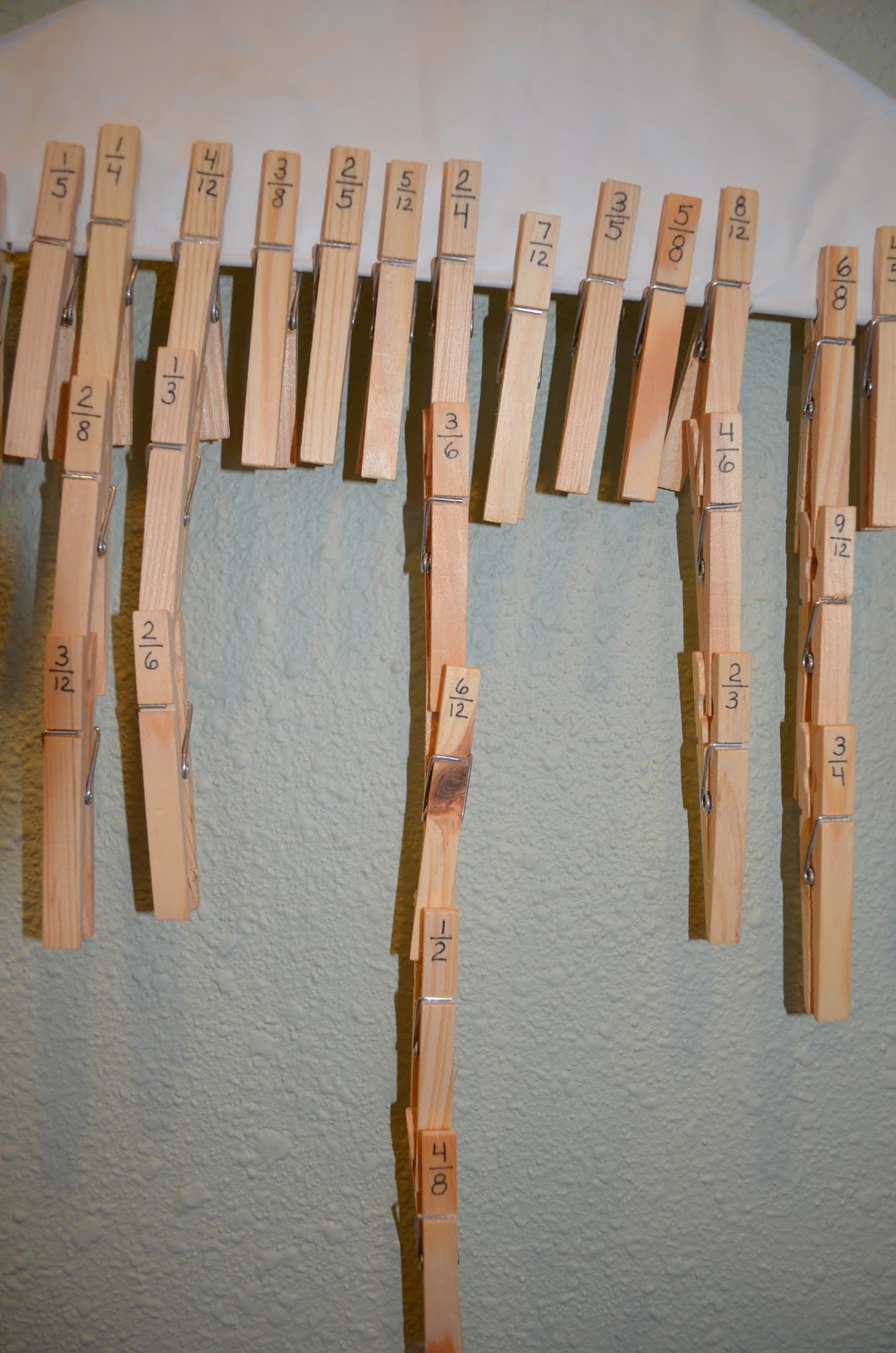
      Clothespin Fractions

      Order and compare fractions on a number line with these simple materials from the Dollar Store.

      Materials Needed:
      clothespins (pack of 36 for $1)
      hanger
      Sharpie

      Directions:
      1. Use a fine Sharpie to label clothespins with the fractions you wish to explore.
      2. Place clothespins in a Math Station or Workbox, along with a hanger.
      3. Ask kids to clip the clothespins to the hanger--the "number line"--in order. Differentiate with varying numbers of clothespins. Change the range of the number line by removing larger or smaller numbers. For example, the number line could include clothespins from 0-1 or from 0-1/2. When students find equivalent fractions, they may clip them to fractions of the same value in a vertical line.

      Additional Option: You could number or letter the back of the clothespins so that students could check their own work. (Label a set from A-Z, for example.)

      Clothespin Fractions provide a powerful model for discussion. My ten-year-old son, an eager test subject, jumped right in to order the clothespins. His dad checked answers. I wish I'd recorded the ensuing dialogue. My husband, a guy with a ton of math smarts, tried to figure out the answers using percents. Since this is something he regularly uses at work to create documents, he felt like it was an efficient method. In contrast, I relied on common denominators. My husband helped my son to make a couple order changes but finally admitted that in one case, my son's original answer was actually correct. (Talk about making a kid's day!) We then talked about how my method was easier the merits of using percents vs. common denominators. I felt a fraction wee bit smug. 

      But more importantly, we all had a fun, productive Math Talk!


      Want more ideas for teaching fractions? (One of my favorite topics to teach!) Click here! :)
      CCSS Standards in Grades 3-4: 
      CCSS.3.NF.A.3a Understand two fractions as equivalent (equal) if they are the same size, or the same point on a number line.
      CCSS.3.NF.A.3b Recognize and generate simple equivalent fractions, e.g., 1/2 = 2/4, 4/6 = 2/3). Explain why the fractions are equivalent, e.g., by using a visual fraction model.
      CCSS.4.NF.A.1 Explain why a fraction a/b is equivalent to a fraction (n × a)/(n × b) by using visual fraction models, with attention to how the number and size of the parts differ even though the two fractions themselves are the same size. Use this principle to recognize and generate equivalent fractions.
      CCSS.4.NF.A.2 Compare two fractions with different numerators and different denominators, e.g., by creating common denominators or numerators, or by comparing to a benchmark fraction such as 1/2.


      Thursday, December 20, 2012

      Angles: Learning in Degrees

      Teaching angle measurement?* Although it's tempting to put a protractor straight into the hands of students, with a little creativity, pattern blocks, and some simple movements you can build a foundation for the concept of angle measurement. This week, we've been challenged by a fun, free set of lessons by The Math Learning Center, C3 Circles & Angles.

      Our first challenge, in Activity 1, was to measure all angles in a set of pattern blocks using nothing more than this:


      My normally brilliant student looked at me like I had lost my mind. How in the world could you measure the angles of a pattern block with that??? We first talked about what we knew:

      1. Straight line = 180 degrees
      2. Perpendicular line = 90 degrees
      3. Orange square pattern block has to have 90 degree angles because it's a square. It also fits in the corner of the drawing above.


      But what about all the rest of the shapes? How could you figure their angles?


      After a time, we discovered that pattern blocks could be combined to form a straight angle of 180 degrees. In the example below, we could see that 3 triangles (or in the illustration, 1 triangle + 1 rhombus) formed a straight angle. Therefore, 180/3 = 60 degrees...or 1 green triangle has angles of 60 degrees each since it's an equilateral triangle. In a similar fashion, we made combinations of pattern blocks until we knew the angles of all the pattern blocks. Pattern blocks now became a tool for additional measurement opportunities.


      In Activity 2, we measured "Human Angles," first considering real-world connections: a sister who had to have physical therapy for a knee injury, a brother whose extreme joint mobility allows him to do circus-like feats of movement,...even a non-human connection--an owl--and it's circular head movement. But at first it wasn't easy for us to see human movement in degrees.

      We added a number of visual tools: still photos, craft sticks, and moveable paper models. The following video captures some of our thoughts as we explored angles...one step degree at a time.


      You can grab a free set of the angle lessons by looking for C3 Circles & Angles. What do you do to bring angle measurement to life?

      This lesson includes CCSS Standards:
      CCSS 4.MD.C.5 Recognize angles as geometric shapes that are formed wherever two rays share a common endpoint, and understand concepts of angle measurement
      CCSS 4.MD.C.7 Recognize angle measure as additive. When an angle is decomposed into non-overlapping parts, the angle measure of the whole is the sum of the angle measures of the parts. Solve addition and subtraction problems to find unknown angles on a diagram in real world and mathematical problems, e.g., by using an equation with a symbol for the unknown angle measure.

      Credit: Drawings from The Math Learning Center. Used by permission.

      Wednesday, December 19, 2012

      Great Song to Dance by 5s to 100!

      Looking for a get-up-and-dance song to practice counting by 5s?  Check out Counting by 5s Song by Have Fun Teaching. It's a winner!


      Math Myths to Muddle the Mind

      I'm currently reading Stephen Wilbers book, Keys to Great Writing. In it, he talks about 4 myths that limit a person's writing potential. As I read them, I thought about--what else?--MATH. Here are his myths with a little mathematical editing...

      Four Myths that Limit Your Potential (or your student's) as a Writer Mathematician:

      1. Myth #1:  Only people with natural ability can learn to write do math well.

      Reflection: I spent most of my life believing this. Without question, some people have mathematical gifts, just as others are skilled in athletics or the arts. But given the right environment, the rest of us can prosper mathematically. We would never tell someone that only people with natural ability can learn to read or walk or drive a car well. 

      2. Myth #2: People who are good in math and science reading and writing are inherently incapable of using language doing math effectively.

      Reflection: English major here. Long-time lover of children's literature. Now hugely benefitting from visual math models that I never learned as a child. Give me a good piece of math-related children's literature and scary math topics will turn on a dime.

      3. Myth #3: Achieving writing mathematical competence is a matter of learning to avoid errors.

      Reflection: Errors are often our best teachers. Ask Edison.

      4. Myth #4: Learning to write do math well is easy if you just learn the right tricks.

      Reflection: This myth causes havoc, leading us to believe, among other things, that


      When I watch finger multiplication, for instance, I'm impressed from a "boy, do you ever have a great party trick!" viewpoint. I am NOT impressed mathematically. But if I ask you what 6 x 7 is...and you explain several ways to calculate the answer...now THAT is impressive!

      Question to Ponder: Which math myths most limit your potential?

      Tuesday, December 18, 2012

      Circle Fractions & the Number Line Model

      As I've mentioned, when I was a 4th grader, fractions were a big, hairy monster in my otherwise happy little mathematical world.

      I'm still trying to heal the fractional parts of my 4th grader self. Over the last few years I've made progress:
      • Ten + years ago: fractions made me slightly nauseous, rendering me unable to think.
      • Five years ago: although no longer causing nausea and palpitations, fractions did require a rather strong antiperspirant
      • Today: while deoderant still comes in handy, a little voice in my head now does a mini "wahoo" when I hear someone utter the word "fractions."
      So whenever I see a clever lesson, one that helps fractions to make some visual sense, I take note. A free lesson from The Tutor House, Pizza Pie and the Number Line Freebie, helps kids to see the relationship between the circle "pizza" fractions we use so often and the fractions on a number line. Since the number line fraction model is such an integral part of the Common Core State Standards, this is a particularly valuable tool.


      Credit: Clip Art of the 1/2 fraction man (above) is provided by Phillip Martin. His site has GREAT, free math clip art!

      Monday, December 17, 2012

      Gingerbread Man Math: Online Activities

      Here's a timely online activity for young mathematicians. On Topmarks Maths: Gingerbread Man, students can choose from the following:
      • matching written numbers to dots
      • ordering #s of dots by quantity
      • counting
      • sequencing numbers
      • counting with one-to-one correspondence
       Enjoy!

      Math Monday Blog Hop #79 (December 17, 2012)


      If you want to share this collection on your blog, just grab this link:
      get the InLinkz code

      Grab a Math Box: love2learn2day button for your own blog:

      Sunday, December 16, 2012

      Talking About Tragedy

      As many bloggers pause to honor and remember the community of Sandy Hook Elementary, I want to suggest one article, "Helping Students Through Tragedy."

      Hugs to all.

      Saturday, December 15, 2012

      Equilibrio Competition

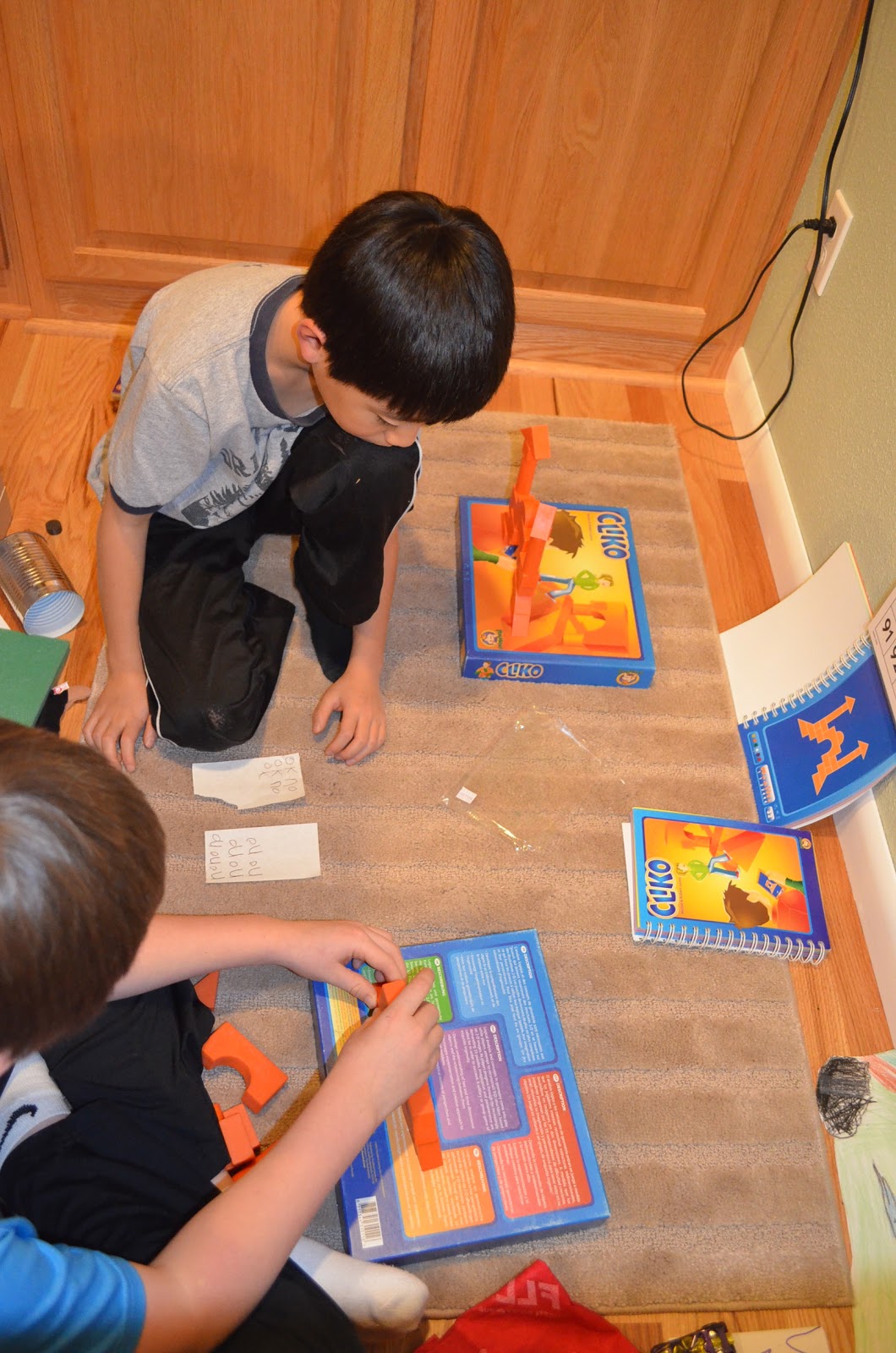
      I first wrote about Equilibrio, Architecto, and Cliko, one of my all-time favorite math purchases, several years ago. In the original blog entry you'll find a more thorough description of the product itself. Basically, it's a set of geometric blocks that are used to build structures that require balance or an eye for 3-D (depending on which book you're using.) My kids began using the series at ages 4 and 7. Now ages 6 and 10, I'm amazed at how the activities continue to challenge them.

      Having recently purchased another set of blocks, a friend's visit inspired an "Equilibrio Competition." They opened the book so both could see the structure and then raced to see who could successfully build it first. When one finished, he helped the other to figure it out.

      This would make such a good addition to geometry, whether at home or school, providing immense opportunity for differentiation. It screams "Math Station!"

      Disclaimer: I bought my own set--two sets of blocks and all 3 books--and have no contact with the company that produces it. If you use the Amazon link to buy your own, Grace and Hope (foster care for kids in China) will make a few cents (at no cost to you.)

      Friday, December 14, 2012

      So Sad...

      No words can describe the sadness I feel for the events that transpired today in Connecticut. My thoughts and prayers are with everyone. Hugs to all.

      New TPT Freebie - Math, Lit, and Doubling


      I'm thrilled to share my first, FREE, TPT product with you!

      Math & Literature: Explore Doubling, uses two books, One Grain of Rice and The King's Chessboard, depicting a rich royalty figure who, feeling indebted to a commoner (a poor village girl, a wiseman), agrees to pay the "paltry sum" of a single grain of rice...to be doubled each day for a period of days (a month, the squares on a chessboard.) These "paired books" could be compared and contrasted to consider any number of concepts--character, setting, plot...and, yes, math!

      The free download includes a template for a comparison flapbook as well as a problem solving worksheet in which students consider which is the better deal: one dollar, or a penny doubled each day for one week.


      Please grab a copy! And thank you for looking!

      Referenced Common Core State Standards: CCSS 4.OA.C.5, 4.MD.A, 4.NBT

      Monday, December 10, 2012

      Math Monday Blog Hop #78 (Dec. 10, 2012)


      If you want to share this collection on your blog, just grab this link:
      get the InLinkz code

      Grab a Math Box: love2learn2day button for your own blog:

      Saturday, December 8, 2012

      Dividing with Fractions: Great Videos!

      A math friend recently sent me a link to some wonderful videos that walk through visual models on dividing with fractions. If you are an adult who memorized the rule for dividing fractions--invert and multiply--but had absolutely no idea of the reason behind the rule -OR- if you are a teacher (homeschool or public!) and are trying to help your kiddos understand this concept, you'll love these videos.

      Thursday, December 6, 2012

      Math in the Movies!

      Republishing one of my favorite posts...  It's a good time of year to cozy up with a cup of hot chocolate and a good movie (with math!) :)

      A couple years ago I began using video clips in my continuing education classes for teachers. Why?  Short movie excerpts have the powerful ability to:
      • illustrate a point
      • incite discussion
      • provide a humorous "jumping off point" for a particular concept
      • pose "real life" problem solving
      • capture students' attention
      • address a variety of student learning styles
      • present a wide variety of mathematical strands
      • help students to consider what they know and what they have yet to learn
      Many, many movies contain mathematical clips. Some are best used with advanced math students while others are perfect for younger children.

      Consider this clip from the movie, Father of the Bride. Mr. Banks is frustrated by the fact that hotdog buns come in packs of 12 while hotdogs come in packs of 8. Pose the question to students:
      How many packs of each would he need to buy to make the hotdogs and buns come out even?


      Here's a clip from Ma and Pa Kettle. I love this clip because it illustrates how important it is for students to explain not only WHAT the answer is but also HOW they got an answer. Can your student explain where Ma/Pa went wrong in each proof?


      I also enjoy math problems from game shows. Students of all ages like to feel smarter than television competition. (Why else are game shows so successful?)  Here's an excerpt from Who Wants to Be a Millionaire in which actress Patricia Heaton struggles to answer the following question:
      If a Euro is $1.50, five Euros is worth what?

      A. Thirty quarters
      B. Fifty dimes
      C. Seventy nickels
      D. Ninety pennies 

      Many more online resources are available on math in the movies:

      Math and the Movies: Two teachers list many movie excerpts and provide free pdf lessons to go with each.

      Mathematics in Movies: A Harvard professor has collected an extensive collection of movie titles. He includes the movie clips in a library on his site.

      Simpsons Math: Math lessons using episodes from The Simpsons.

      The Math in the Movies page: guide to major motion pictures with math scenes.

      PBS Teachers Mathline: math movie activities.

      Math at the Movies: examples, photos, exercises.

      Countdown: using technology of Quicktime to develop math skills.

      LivingMathForum: Julie compiled a list of recommended math video learning materials from the Living Math Forum Yahoo group.

      Mathematics Goes to the Movies: titles and short descriptions of over 500 movies and TV episodes that contain mathematics. (Thanks, Sue, for alerting me to this site!)

      Math in the Movies: more favorites

      And, of course, any of the Cyberchase episodes. (My kids have learned an incredible amount of math from watching this PBS series. You can also play on-line games and see some excerpts at the PBS kids website.)

      Lastly, on YouTube you can see Norton Juster's The Dot and the Line... Enjoy! :)

      Wednesday, December 5, 2012

      Free Math Practice Books!

      You can print FREE full size math practice books for grades K-5. Seriously...

      Bridges Practice Books
      Using the above link, click on "Practice Books" for the grade level you desire. The consumable books are available for purchase, but you can download the FULL set of blacklines (pdf files) for FREE.
      Written to  address the NCTM Focal Points, Bridges Practice Books provide activities  and worksheets for additional skill review, informal paper-and-pencil  assessment, preparation for standardized testing, and differentiated  instruction. These books may be used with any math program  to provide practice with skills targeted for mastery at each grade  level.
      The blacklines include the answer keys. Also, each book is indexed by skill so it's easy to find multi-digit addition & subtraction, fractions, decimals, problem solving, etc...

      Grade K Skills:  Numbers to 30, comparing and ordering sets, skip  counting, early addition and subtraction, story problems.

      Grade 1 Skills:  Numbers to 100 and beyond, number patterns, place  value, facts to 10, money, time, graphing, and problem solving.

      Grade 2 Skills:  Numbers to 1,000, skip counting and number patterns,  facts to 18, place value, double-digit computation, money, time, and  problem solving.

      Grade 3 Skills:  Numbers to 10,000, multi-digit addition and  subtraction, multiplication and division concepts, fractions, equations,  perimeter, time, money, and problem solving.

      Grade 4 Skills:  Multiplication and division facts, multi-digit  addition, subtraction and multiplication, fractions and decimals,  patterns and equations, area and perimeter, data analysis, and problem  solving.

      Grade 5 Skills:  Multiplication and division facts, multi-digit  addition, subtraction and multiplication, fractions and decimals,  patterns and equations, area and perimeter, data analysis, and problem  solving.

      Tuesday, December 4, 2012

      Monday, December 3, 2012

      Math Monday Blog Hop #77 (Dec. 3, 2012)


      If you want to share this collection on your blog, just grab this link:
      get the InLinkz code

      Grab a Math Box: love2learn2day button for your own blog:

      Related Posts with Thumbnails
      Blogging tips