I'm in love.
With subitizing. Rhymes with oobitizing. (I always thought it rhymed with rub-itizing.)
Know what it is? If you're teaching, it's a great tool to add to your toolbox!
Ever since I read about it in Teaching Children Mathematics, I've been on a mission to learn more. Basically, it's the ability to instantly recognize a quantity. An example that frequently comes up: dice. Most adults see a number on a die and immediately recognize the number, without counting. We define two different types of subitizing:
Perceptual Subitizing - a number is instantly recognized, usually with quantities of 5 or less.
Conceptual Subitizing - recognizing small quantities within a number and combining to find a total. For example, you might see 7 dots as a combination of 3 dots and 4 dots.
You can see how the ability to subitize leads to all kinds of math skills. If you can instantly recognize a quantity, you can count faster, add/subtract/multiply/divide more easily and efficiently...the list goes on. It's a no-brainer that we want our kids to master this.
So I've been trying.
I started by placing objects on a peg board, showing a quick glance, and having the child replicate it on his own board. I also tried flashing quantities on a DIY counting rope.
More recently, I've been flashing quantities on a five frame. We used ducks after our lesson with Little Quack's Hide and Seek.
I've only done subitizing a handful of times (probably less than 5) this year. My little student showed a good grasp of numbers up to 5, but anything beyond that was pushing it. I thought. Shows how much I know.
Yesterday, I printed off some subitizing cards. (Went to a TON of effort. Smirk.) Googled "subitizing cards" and printed out cards from the first Google link. (Apparently, they go to a private school site, but I found the same ones linked here titled "subitizingcards.pdf.") They are FANTASTIC. Mostly because I didn't have to make them. But also because they fit neatly into a cardboard flap. I literally grabbed a piece of cardboard out of the recycling box and had a flap made in seconds. You'll see how it allows you to flash the dot pattern and then reveal the number after the child states an answer.
I apologize that the child's volume isn't more clear. I need to invest in an external mic. Listen carefully, however, and you'll hear the reasoning that went into his answers. You might think about when he used conceptual subitizing...or when he was able to instantly see smaller quantities within the number and add them together to get a total.
Although you certainly don't need to ask a child how he arrived at an answer, I found it very helpful to help assess my student's abilities. I was surprised that he knew so many number combinations. Formal addition is going to be an easy next step.
Now...go subitize! Here are some more links/resources to assist you:
Math Four
A terrific blog entry, Why Learning to Subitize is Important. (Thanks, to Tricia for the suggestion!)
Staff development with 1st grade teachers
In this YouTube Video, the facilitator guides teachers through steps that children might take in gaining number sense. It's 20 minutes but really gives you an education.
Math Coach's Corner
Donna has several posts about subitizing. She writes that subitizing is "foundational to the development of number sense." She links blacklines from John VanDeWalle's book with lots of subitizing cards. I'm printing these next. Also read her post describing different ways that kindergarten students saw a dot pattern.
Dr. Nicki's Guided Math Blog
Love Dr. Nicki's resources. She has several posts on using subitizing in the guided math setting.
Freebie! - Number Rack
Read about Math Learning Center's new free app, Number Rack. It could be easily used for subitizing, both online and on an iPad/iTouch. The entry also links you to a free activity/lesson book.
PDFs - Use with Subitizing
This site has a whole list of pdfs to print for subitizing with kids.
Saturday, April 21, 2012
Monday, April 16, 2012
Math Monday Blog Hop #53 (April 16, 2012)
If you want to share this collection on your blog, just grab this link:
get the InLinkz code
Grab a Math Monday button for your own blog:
Labels:
Math Monday Blog Hop,
Workboxes: Math
Wednesday, April 11, 2012
Little Quack's Hide and Seek (book & lesson ideas)
Here's a simple storytelling activity to go with the book, Little Quack's Hide and Seek.
Momma Duck has five little ducklings. One by one they hide so Momma can come find them. Little Quack doesn't have enough time to find a hiding spot, so he hides right behind Momma, following her as she goes to find the other ducklings. As each duckling hides, you see a subtraction sentence at the bottom of the page using pictures of ducklings. (See below.)
I used a cookie cutter to make a duck template and cut 5 ducklings from felt. My DIY "felt board" is a piece of flannel sewn onto cardboard.
During the story, as each duckling hid, I hid a felt duckling behind the ? as shown above and asked the kids how many ducklings were hiding and how many were left. As Momma finds her ducklings, I added ducklings back to the felt board and we counted how many had been located and figured out how many were still hiding. I noticed that kids were subitizing (instantly recognizing quantities.) I placed the last duckling (who followed Momma when he couldn't find a hiding place) in the book, behind each picture of Momma duck. The kids thought this was absolutely hilarious!
This is a great book to get kids excited about telling their own math stories. Don't forget to sing Rubber Duckie and Six Little Ducks!
The activities involve several Kindergarten Common Core Standards:
K.CC.4. Understand the relationship between numbers and quantities; connect counting to cardinality.
K.OA.1. Represent addition and subtraction with objects, fingers, mental images, drawings1, sounds (e.g., claps), acting out situations, verbal explanations, expressions, or equations.
K.OA.5. Fluently add and subtract within 5.
Disclosure: If you purchase books through my Amazon links, all commissions go toward foster care through Grace and Hope at no additional cost to you. I do not keep any money myself; I am hoping to be able to sponsor an additional child in foster care through commissions on this site. Thank you!
Labels:
Addition,
Children's Books-Math,
Common Core: K,
Counting,
Subitizing,
Subtraction
Tuesday, April 10, 2012
Plastic Eggs - Counting/Number Recognition Game
Don't put away your plastic eggs yet! Here's a super easy, fun, counting/number recognition game...
1. For each child, use a Sharpie to label an egg carton and a dozen plastic eggs with the numbers 1-12. (See example at right. When game is played, children will place eggs in the correct slot.)
2. Gather all the eggs into a big container and scatter them over a wide area like a yard, field, or gym. Give each child an egg carton to keep at a designated "base" such as a line on the gym or playground or a back porch at home.
3. When you say "go," each child must run out to the scattered eggs, pick up ONE egg, and bring it back to his/her egg carton, placing the egg in the hole with the corresponding number. When the egg has been placed, the child races back to the grass for another egg.
4. If a child picks up an egg that he already has (i.e. he brought a "5" back to his egg carton but he already has a "5"), he must return the extra egg to the playing field and get another one.
This could be a competition, but you could also say that friends could help one another if they fill their egg carton. My preKers (ages 4-6) played this today and loved it. They were TIRED by the time they finished.
Labels:
Counting
Monday, April 9, 2012
Math Monday Blog Hop #52 (April 9, 2012)
If you want to share this collection on your blog, just grab this link:
get the InLinkz code
Grab a Math Monday button for your own blog:
Labels:
Math Monday Blog Hop,
Workboxes: Math
Friday, April 6, 2012
The Lion's Share - fractions and doubling
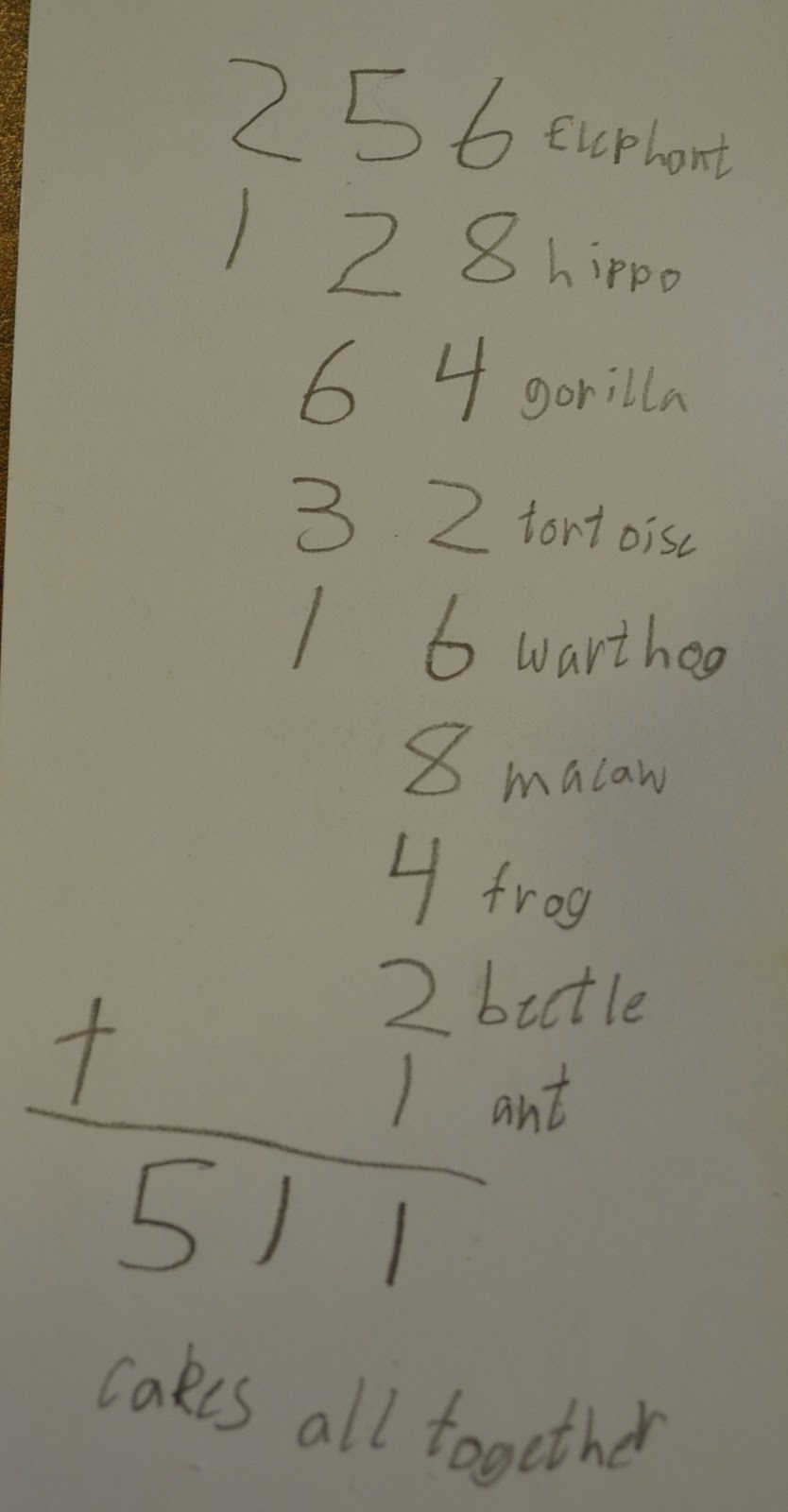
We enjoyed a great little exploration with fractions and doubling that you may want to do with your students. We used Matthew McElligott's book, The Lion's Share: A Tale of Halving Cake and Eating It, Too (2009.) In the story, an ant is invited to the lion king's dinner party. At the party, the other animals demonstrate horrendous manners. When the king passes the cake, each animal takes half of the cake he is passed. So, the elephant take half of the original cake and passes on a half. The hippo takes half of that piece (a quarter) and passes the remains to the gorilla who takes another half (an eighth of the original), passing the remainder on to each animal until a mere morsel is given to the ant. The tiny creature, embarrassed because he doesn't have enough to share, tells the king that he'll return the next day with a special cake for the king. Each animal, wanting to outdo the next, agrees to bring double the amount of cakes to the king. So the ant will bring one, the beetle two, the frog four, and so on.
I read about half the book, stopping at the point where the ant was left with a crumb. (Warning: the insides of the front and back covers show some of the fractional pieces of cake so you may want to cover them up.) I gave each student a square piece of paper and made a list of all the animals on the board. I asked, "How much would each animal get?" and challenged them to show the fractional pieces of cake with the paper. In the midst of cutting "cake" a student laughed and said, "This is going to go all the way up to 1/128. I figured it out." He soon discovered it got even smaller! (1/512)
After figuring out the fractional pieces of cake, I finished the story and asked, "If each animal doubles the number of cakes he is bringing to the king, how many cakes will the king receive?" (Work shown at right. 511 cakes.)
So, now a final question for you all...
Do you see a relationship between the two results? (1/512 and 511) Explain.
Spoiler alert: see chart at the bottom of the page...
Disclosure: If you purchase books through my Amazon links, all commissions go toward foster care through Grace and Hope at no additional cost to you. I do not keep any money myself; I am hoping to be able to sponsor an additional child in foster care through commissions on this site. Thank you!
Labels:
Children's Books-Math,
Doubling,
Fractions
Monday, April 2, 2012
Math Monday Blog Hop #51 (April 2, 2012) - Pinterest!
If you want to share this collection on your blog, just grab this link:
get the InLinkz code
Grab a Math Monday button for your own blog:
Labels:
Math Monday Blog Hop
Wednesday, March 28, 2012
Press Here - A Book to Impress!
Have you read Press Here by Herve Tullet? It presses my funny bone!
It's a ridiculously simple concept... You just do what the book says. For instance:
You see a yellow dot. The text says, "PRESS HERE and turn the page." When you turn the page you see two yellow dots. Now it reads, "Great! Now press the yellow dot again." Next page: "Perfect. Rub the dot on the left... gently."
The book continues to tell you exactly what to do on each page. The picture on the next page changes, just as if the book did what you said. It will tell you to tap a dot five times...and lo and behold there are five dots on the next page. It might say to tip the book to the left. On the next page, all the dots are clustered on one side as if your actions made the dots move.
We have read this book OVER and OVER and OVER and OVER.
My 5-year-old (without prompting) even made his own version of the book. It's a natural, humorous way to teach things like basic counting, direction/position (left and right), colors and more. My 9-year-old enjoyed it every big as much as my 5-year-old. Oh, who am I kidding? I probably liked it the most. (And I'm not telling my age!)
This is a must-read. Use it as a model for kids to write their own books. Or just enjoy it. Over and over again.
P.S. The Amazon page has a lot more information, including 100 customer reviews (impressive!...for a book that came out 6 months ago!!) and a video trailer. See to believe!
Labels:
Children's Books-Math
Tuesday, March 27, 2012
Extreme Makeover: Schoolroom Edition!
A while back I asked for some schoolroom advice. I wish I'd taken an even earlier photo, because this room had old carpeting in it, but you can still see the basic change:
We removed the warped, twisted beams that were bolted to the ceiling. Updated the lighting and popcorn ceiling. Painted.
I was stumped over how to handle the brick. I liked it better once the room had been updated, but I still needed shelving and storage in this longish/narrow room. So we added built in bookshelves/cabinets with drawers under what used to be a free standing hearth.
Here's a little room tour...
The wall to the immediate left (behind the recliner) holds the clocks. We have one clock for each of the places in which our kids were born. This is great for calculating elapsed time! We often talk about what's currently happening in Korea and China while looking at the clocks. [Clocks are from Ikea. Labels were ordered through Office Depot.]
Directly beneath the window you'll see a magazine rack that holds some of our library books. [I purchased the rack, used, at a secondhand store that was going out of business.] To the left of the rack is a Large Magic Wall (magnetic) from The Math Learning Center.
Looking straight at the fireplace, you'll see our reading couch on the left with a map above it. We agonized over what to get to hang things on the walls. After painting, my husband insisted, "NO MORE BLUE TACKY STUFF!!!" I couldn't blame him. We had teeny pieces of the stuff stuck all over the walls from years and years of hanging papers. We finally decided on map/tack strips (can't remember the name or where we got them) and the wire for artwork from Ikea. This picture gives you the idea.
The train table is used for rotating toys/projects/themes. I like to swap out Legos, Playmobil, etc.
Now the newest addition...
If you sneak a peek behind the couch, you'll see our schoolwork. I first saw the plan here. We decided to get two of these Expedit Shelves because I could separate them if I ever decide to rearrange. Two Itso Bins from Target (Clear Qtr Bin Itso See-Through) fit perfectly on each shelf. I put a throw rug back there to make a cozy reading corner. It's been there since yesterday and so far it's been the source of constant bickering. I pointed out that it has lines; it can be divided in HALF. They don't seem to be particularly interested in fractions when it comes to sharing space.
On the right wall you'll see all the usual classroom items: 100s grid, pocket charts (mostly garage sale finds!), whiteboard (Costco), more of the map racks and art wire, a DIY cookie sheet/magnetic board, and a Calendar Grid Pocket Chart on the far right. I bought the table/chairs years ago from a preschool that was closing. When I use the space for larger classes, I often clear the area and have kids sit on the floor.
Oh, and btw... We spend a lot of our day in this room. But it isn't unusual to find us sitting at the kitchen table either. This certainly isn't necessary. But it does make it SO. MUCH. EASIER. TO. FIND. THINGS. It didn't used to be so hard to lay my hands on what I needed. Life is a bit busier these days. Hopefully this organization will save me some time.
I hope you've enjoyed this little tour. I LOVE peeking in on other learning spaces! :)
Homeschool room, Homeschool classroom
Labels:
Homeschool Organization,
Organization Tips
Monday, March 26, 2012
Math Monday Blog Hop #50 (March 26, 2012)
If you want to share this collection on your blog, just grab this link:
get the InLinkz code
Grab a Math Monday button for your own blog:
Labels:
Math Monday Blog Hop,
Workboxes: Math
Friday, March 23, 2012
Teaching Fractions Through Music
While probably not a surprise to any of you, you'll likely appreciate this article from Science Daily: Getting in Rhythm Helps Children Grasp Fractions, Study Finds.
In his piano lesson this week my son is learning a clapping pattern emphasizing note values. Even as we were doing it, he reflected on the connection to fractions.
I love the idea of equating fraction bars to musical notes. (See the article for a picture.) Fraction bars are a pretty common tool...but this is a innovative way to think about them. This article says:
"Academic Music: Music Instruction to Engage Third Grade Students in Learning Basic Fraction Concepts" has been accepted for press in the journal Educational Studies in Mathematics and will be published online next week.Looking forward to it!
Thursday, March 22, 2012
One is a Snail Ten is a Crab
If you're feeling a little sluggish about teaching odd and even numbers, consider using the book One is a Snail Ten is a Crab
. It's a "counting by feet" book in which even numbers are counted using creatures with even numbers of feet: humans, dogs, insects, spiders, etc... Odd numbers are counted with an even-footed creature, plus a snail. So...
1 is a snail.
2 is a person.
3 is a person and a snail.
4 is a dog.
5 is a dog and a snail. Etc.
The book continues in that fashion up to 10. After that, the text starts counting by 10s using a variety of animal feet.
P.S. Yes, that is my foot. It's the price for making this a "pin-able" post.
1 is a snail.
2 is a person.
3 is a person and a snail.
4 is a dog.
5 is a dog and a snail. Etc.
The book continues in that fashion up to 10. After that, the text starts counting by 10s using a variety of animal feet.
P.S. Yes, that is my foot. It's the price for making this a "pin-able" post.
Labels:
Children's Books-Math,
Counting,
Odd/Even,
Patterns
Wednesday, March 21, 2012
Math in Children's Literature List - Updated!
Latest Update: March 21, 2012
I try to update my list of Math Books on a regular basis. You can always access it from the link at the top of the home page.
Enjoy!
I try to update my list of Math Books on a regular basis. You can always access it from the link at the top of the home page.
Enjoy!
Monday, March 19, 2012
Math Monday Blog Hop #49 (March 19, 2012)
If you want to share this collection on your blog, just grab this link:
get the InLinkz code
Grab a Math Monday button for your own blog:
Labels:
Math Monday Blog Hop,
Workboxes: Math
Math Myth: Borrowing is the Only Way
Subtitle: How I "Borrowed" Trouble and Have "Carried" It With Me...
I recently wrote an entry that included a link to a piece of research on "The Harmful Effects of Carrying and Borrowing." This has been on my mind a lot this past year. Here's why...
The math curriculum I use, Bridges in Mathematics, does a tremendous job at having kids explore various ways to solve problems. The way the lessons are set up, kids develop their own strategies, share their thinking with others, and refine their ideas as they become and more and more efficient at math. I was NOT taught this way and it's been amazing to watch my students develop strategies that are far superior (meaningful, more efficient, etc) than the algorithms I was forced to memorize.
This year I've been working with a 9-year-old. He's been able to use a variety of strategies to solve multi-digit addition and subtraction problems. Here's an example of one way that he solved a multi-digit subtraction problem. (Taken from a Bridges Grade 3 assessment.)
1349-675
1300-600 = 700
700+49 = 749
749-75 = 674
I asked him how he did the last step. He said:
750-75 = 675
675-1 = 674
The strategy shows number sense and comfort with place value. As a child I was told that the correct way to do this problem was by borrowing. It made no sense. No one bothered to familiarize me with place value and number sense to give the problem any context. I had no options except to follow the rules. So why, then, would I mess up this child's system by giving him rules?
I did, you know. Here's what happened...
After being exposed to a wide variety of strategies and showing marvelous strength in his own knowledge, I introduced the standard algorithm. Why? Standards specify that kids must know how to do the standard algorithm along with other strategies. So we did it.
It seriously messed him up. The harder I tried to teach him the standard algorithm, the less he maintained a grasp on the meaning he'd constructed for himself. I taught the standard algorithm using both manipulatives and numbers, so it wasn't like I taught it completely out of context. We looked at how the numbers had to be broken apart (carrying/borrowing) with the manipulatives.
But it made no sense to him.
So I abandoned the standard algorithm. Actually abandoned all multi-digit addition and subtraction for awhile because he seemed so defeated. I seriously thought I'd ruined the kid. When we came back to it, we did a lot of work with manipulatives and I let him do it HIS WAY. Lo and behold, it came back to him. Stronger now than before.
I do still occasionally show him the standard algorithm. But only after extensive time with the exploration of other strategies. And only after he seems very, very comfortable in his own methods. I have abandoned telling him to "do it this way."
Cause "this way" may not be "his way." And "this way" may actually do more harm than good.
I'd love to hear about your experiences.
Labels:
Addition,
Subtraction,
Teaching Math
Saturday, March 17, 2012
Math Education: Some Must-Read Blog Posts!
If you're involved in Math Education (or perhaps even if you're not!) you have probably read about the controversies surrounding Khan Academy. Even if you could care less about Khan, I strongly recommend this series at the Generation YES Blog, Khan Academy Posts: Implications for Math Education.
If you teach math--whether in the classroom or as a homeschooler--this series will challenge you to examine your own beliefs about teaching and learning. If you don't have time to read it now, bookmark and come back later. I'm sure glad I did. :)
I especially recommend part 1, Khan Academy and the Mythical Math Cure, which talks about "how we believe certain things about math that are not true, but we keep doing them anyway." A major myth: "Learning math is about acquiring a sequential set of skills (and we know the sequence.)"
This myth resonated with me because I recently heard something similar while attending a math conference where Jo Boaler spoke. (Highly recommend her book, What's Math Got to Do With It? How Parents and Teachers Can Help Children Learn to Love Their Least Favorite Subject.) She talked about how low achievers do very different math than those who excel. One hurdle? Low achievers see math as a series of rules...rules that are equally important. Kids who struggle in math are less flexible in their mathematical thinking...which makes them emphasize rules even more. And what happens when kids struggle? They are likely to be exposed (by the teacher) to more drill/skill, which leads them to a stronger belief (misconception) that procedure is what counts in learning mathematics.
And think about math education. If kids are ever encouraged to think flexibly about math, it's when they're young. (Unfortunately, for some, the drill/skill emphasis begins immediately.) But the older they get, the more the emphasis is on procedures, mostly through memorization. As Alfie Kohn writes, it's no wonder that U.S. kids do worse and worse on internationally normed tests as they get older.
Thoughts? Love to hear them!
P.S. While you're at it, read a fascinating piece of research: "The Harmful Effects of 'Carrying' and 'Borrowing' in Grades 1-4" by Constance Kamii and Ann Dominick. The research is from 1998. And what are we still doing in most schools (and homes?) Teaching carrying and borrowing!
Labels:
Teaching Math
Thursday, March 15, 2012
Kitty, Nine Lives, Ordinal Numbers, Bookmaking, and More...
Post flea-bath photo.
We're sad. Our kitty passed her ninth life last week. It might actually have been her thirteenth. Or thirtieth. This cat gave me gray hairs. If we cracked the outside door, she'd streak in (sometimes so fast I didn't notice) and go hide in the house. Somewhere. A couple of us are allergic, so we'd begin an all-hands-on-deck call to find her. Usually under the bed.
She made me the craziest when I'd try to leave home. She'd zip into the garage door just as it was about to close. I sometimes pushed the button repeatedly as she waltzed in, then out, then in, then out. We recently came home after being gone for hours to find the garage door standing open. She must have done that in-out thing one time after I quit looking.
But the ultimate curious cat moments came when she'd run into the garage as I was backing out, jump on the hood, leap to the van roof, and take a final hop to the backside of the garage door. Yep. Up. Way up. While in the open position. If I continued backing out, she was stuck up there and I couldn't leave because the garage door was open; if I shut the door she'd be squashed. But when I pulled back into the garage, she'd go further onto the garage door where it was impossible to reach her.
Only a year ago I wrote about her when she got sprayed by a skunk. She was CURIOUS.
She made me crazy.
But we loved her.
So in tribute, we're making cat books. While learning math. And doing a little art. Go figure.
We started by reading picture books about the nine lives of cats:
My Nine Lives by Clio, by Marjorie Priceman
Comet's Nine Lives, by Jan Brett
We also read Cookie's Week. The cat, Cookie, encounters one misadventure each day of the week ("On Monday...Cookie fell in the toilet.") until she finally rests on Sunday. It's a great book to look at the days of the week in sequence.
We wrote stories--and included ordinal numbers--about the misadventures of a cat. Each tale was unique and written at the child's developmental level. Here are pages from the 6-year-old's:
On the first day, Cuddles fell into the toilet.
On the second day, Cuddles fell into a pot of mud.
On the third day, Cuddles got into the washing machine and it spun him around.
On the fourth day, Cuddles knocked the clothes off the clothesline. They got all dirty again.
And a few pages from the 9-year-old's:
On Tiger's first life at the farm he chased a bird to the top of the barn and fell off. Oops, life number one flying away.
On Tiger's seventh life he went down to the pond and tried to catch a duck. He pounced, but fell in, KER-SPLASH. Life number seven flying away.
On Tiger's eighth life he snuck up on the dog he saw through a thorn bush. He attacked and got stuck in the bush. Life number eight bounding away with tufts of fur missing.
We made books, pop-up style.
The 9-year-old will also add page numbers using Roman Numerals after reading Fun With Roman Numerals and Roman Numerals I to MM. Although Roman Numerals seem to be on the way out, standards-wise, it's something I want my students to learn. Roman Numerals aren't uncommon in dates (think movies!) and chapter titles. Just today we read A Giraffe Goes to Paris which included information about King Charles X of France.
It's been very healing for all of us to remember kitty's antics. I hope she made you smile.
Disclosure: If you purchase books through my Amazon links, all commissions go toward foster care through Grace and Hope at no additional cost to you. I do not keep any money myself; I am hoping to be able to sponsor an additional child in foster care through commissions on this site. Thank you!
Wednesday, March 14, 2012
Video: How to Make Math Meaningful
Interesting video from UC Berkeley professor about "how to increase students' understanding of math."
Happy Pi Day, all! :)
Labels:
Videos-Math
Monday, March 12, 2012
Math Monday Blog Hop #48 (March 12, 2012)
If you want to share this collection on your blog, just grab this link:
get the InLinkz code
Grab a Math Monday button for your own blog:
Labels:
Math Monday Blog Hop,
Workboxes: Math
Wednesday, March 7, 2012
Ordinal Numbers in Children's Literature & Technology!
Always felt a bit third-rate at teaching ordinal numbers? Share these books and activities and you're sure to come in first!
Books:
On the Stairs - mice count their way up the stairs with ordinal numbers.
Ten Little Caterpillars - count caterpillars with ordinal numbers in this gorgeous new book by Bill Martin Jr., illustrated by Lois Ehlert.
Online Games & Activities:
Wash Line 1 - hang shirts on the line using the correct ordinal number order. (Scroll down for the activity.)
Alien Competition - put aliens in 1st, 2nd, and 3rd place using different characteristics: most eyes, most legs, most arms, etc. Also try Alien Racing and Alien Teleport. Designed for whole group instruction with a projector or IWB. Also see Alien Flower Show for ordinals to 5th place.
For more books, resources and activities, see the Bridges Kindergarten Resource Links.
Clip Art courtesy of Phillip Martin. The work by Phillip Martin is licensed under a Creative Commons Attribution-NonCommercial-NoDerivs 3.0 Unported License. Thank you!
Disclosure: If you purchase books through my Amazon links, all commissions go toward foster care through Grace and Hope at no additional cost to you. I do not keep any money myself; I am hoping to be able to sponsor an additional child in foster care through commissions on this site. Thank you!
Labels:
Common Core: K,
Ordinal Numbers
Monday, March 5, 2012
Math Monday Blog Hop #47 (March 5, 2012)
If you want to share this collection on your blog, just grab this link:
get the InLinkz code
Grab a Math Monday button for your own blog:
Labels:
Math Monday Blog Hop,
Workboxes: Math
Thursday, March 1, 2012
Book Review: Have You Filled a Bucket Today?
I have a new favorite book. (Not that I don't have many favorites, but this certainly makes my list.) Have You Filled a Bucket Today?: A Guide to Daily Happiness for Kids explains how each of us carries an invisible bucket. We fill our bucket with good feelings...when people say something nice to us, smile at us, or help us. If we are kind, we can help to fill the buckets of others. Some people are bucket dippers and take the goodness from other people's buckets.
I first read about this book on a teacher's blog (have no idea where!); the book was being used to help kids practice kindness.
In our family we read the book and started talking about what fills our buckets and what empties them. This is a book that should be read at least weekly around here. :) I'm thinking about making physical buckets for my two youngest. I'd like to have them put something in the other person's bucket so they notice times that they're being kind.
My bucket filler for you today...you are an awesome group of educators. I'm learning so much from visiting your blogs and reading your comments. Thank you for what you do!!!
Now go and fill a bucket!
Labels:
Children's Books-Other
Monday, February 27, 2012
Math Monday Blog Hop #46 (February 27, 2012)
If you want to share this collection on your blog, just grab this link:
get the InLinkz code
Grab a Math Monday button for your own blog:
Labels:
Math Monday Blog Hop,
Workboxes: Math
Wednesday, February 22, 2012
Exciting Freebie - Number Rack!
The Math Learning Center has an amazing new set of freebies. The Number Rack App can by downloaded from the iApp Store in iTunes -OR- used as a free Web application.
The moveable beads work with counting as well as addition and subtraction strategies. You can also download a free activity/lesson book to use along with it. I'm interested in trying it with subitizing.
This could be used at home or in the classroom with individual children or with a large group lesson. Read more about it here.
Labels:
Addition,
Apps,
Counting,
Free Stuff,
Subtraction
Monday, February 20, 2012
Math Monday Blog Hop #45 (February 20, 2012)
If you want to share this collection on your blog, just grab this link:
get the InLinkz code
Grab a Math Monday button for your own blog:
Labels:
Math Monday Blog Hop,
Workboxes: Math
Monday, February 13, 2012
Math Monday Blog Hop #44 (February 13, 2012)
If you want to share this collection on your blog, just grab this link:
get the InLinkz code
Grab a Math Monday button for your own blog:
Labels:
Math Monday Blog Hop,
Workboxes: Math
Wednesday, February 8, 2012
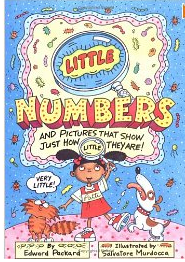
Little Numbers and Pictures That Show Just How Little They Are
I frequently facilitate grade 3-5 math workshops for teachers. Whenever we discuss decimals I always mention the book Little Numbers and Pictures That Show Just How Little They Are! I think it's a nice book to use with 3rd-5th grade students because:
1. The "unit" is a dinosaur. Specifically, a seismosaurus. Kids need to understand that a "unit" can be flexible. In this book, everything is measured in terms of a dinosaur unit.
2. The book depicts increasingly smaller measurements. If a dinosaur is worth 1, then a dinosaur shrunk to 1/10 will fit in the front yard. It talks about various other tenths, like a dime being a tenth of a dollar. It shows both decimals and the fraction equivalent.
3. The numbers creatively get smaller, each time decreasing by powers of ten. For example... 1/10,000 is an ant. 1/1,000,000 is an amoeba. Some kids will be very intrigued by the exponents, which are also included.
4. The book is big (13 x 8") and good with crowds.
If you teach decimals or fractions, I recommend it!
Labels:
Children's Books-Math,
Decimals,
Fractions
Monday, February 6, 2012
Math Monday Blog Hop #43 (February 6, 2012)
If you want to share this collection on your blog, just grab this link:
get the InLinkz code
Visit past Math Monday Blog Hops.
Grab a Math Monday button for your own blog:
Labels:
Math Monday Blog Hop,
Workboxes: Math
Friday, February 3, 2012
Fun, FREE!, Hands-on Math Units
Two of my favorite units from The Math Learning Center are now FREE!! They include:
Hands-On Math: Measurement with Marbles (click to free pdf)
Hands-On Math: Geometry with Geoblocks (click to free pdf)

I've repeatedly used the lessons with math groups. You can find my reflections on the geometry lessons here. And the marble roll lessons here and here.
Hands-On Math: Measurement with Marbles (click to free pdf)
I've repeatedly used the lessons with math groups. You can find my reflections on the geometry lessons here. And the marble roll lessons here and here.
Wednesday, February 1, 2012
Greater Than/Less Than - DIY Whiteboard Tool
On Mrs. T's First Grade Class blog, I first saw some very cool greater than/less than/equal to tools for kids to use on desktops with manipulatives. LOVED THEM! And wanted something like it to use on my whiteboard.
I cut one square of black posterboard and two strips of white posterboard. You could use any brad, but I happened to have tiny ones for scrapbooking, so I used those to anchor the white strips to the black background. (I just poked a tiny hole all the way through the two layers of paper and then shoved the brad through.) I then put a piece of packing tape on the back of the brads so they wouldn't scratch my whiteboard. I grabbed an advertising magnet off my fridge (you know,...the kind you get in the mail), cut it in half, and glued one strip to each side of the back of the black posterboard. And voila...a greater than/less than/equal to tool to use on my whiteboard.
You could use it with any magnet...including regular magnetic math manipulatives. The above photo shows a problem before it's solved, using base ten pieces. Then all the child needs to do is pivot the white strips to show greater than, less than, or equal to.
Subscribe to:
Posts (Atom)