Saturday, April 29, 2017

Fractured Fairy Tales...my Favorite Unit EVER!!


**UPDATE: I'm working hard to make more pieces of this unit available. In the meantime, enjoy my favorite unit and one of love2learn2day's most popular posts!

Over the next 3 months, I will be teaching my FAVORITE UNIT EVER!!!  I first wrote and taught this unit back in the days before internet...before Common Core...before man discovered fire...

Just kidding. About the discovery of fire. But close.

Anyway, I'd like to share the unit as it unfolds.  I am teaching a group of 4th-6th graders in a 3 hour block, once a week. I originally taught the unit in 6th-8th grade language arts. The unit can be comfortably modified up or down to fit grades 3-8 in a classroom or homeschool setting.


Session 1
Focus: What Every Good Story Must Include/Parts of a Story

Opener
As students enter, I ask them to list every fairy tale title they can name.

Getting to Know You: Fairy Tales
We begin with a quick introduction in which students say their name, followed by their favorite fairy tale. They then repeat all the previous names/favorite tales in the class. This becomes a quick assessment tool as students offer up titles that are not actually fairy tales. In my class, one child named a book and said that the title is a fairy tale because it is fiction. I do not correct students as we will be learning more about what makes a fairy tale in the coming weeks.

Round Robin Fairy Telling
As a class, we retell the story of the Three Little Pigs, popcorn-style. I start the story and keep it going, randomly pointing to a student to have him/her fill in parts. I want them to recognize how much they DO already know. Later in the morning I can use this as an example for certain words/topics..."do you remember the DIALOGUE in the Three Little Pigs," etc.

http://www.amazon.com/exec/obidos/ASIN/1404853421/ref%3Dnosim/candle-20/
What Makes a Good Story?
Next, a read aloud: Show Me a Story: Writing Your Own Picture Book. Here, we talk about the tools that authors use to create good stories.

Fairy Tale Bibliography
I hand out a blank bibliography so students can add each book that we read. We will be doing a LOT of fairy tale reading, and I want them to use this as a reference.


This sheet is now available here!
Parts of a Story
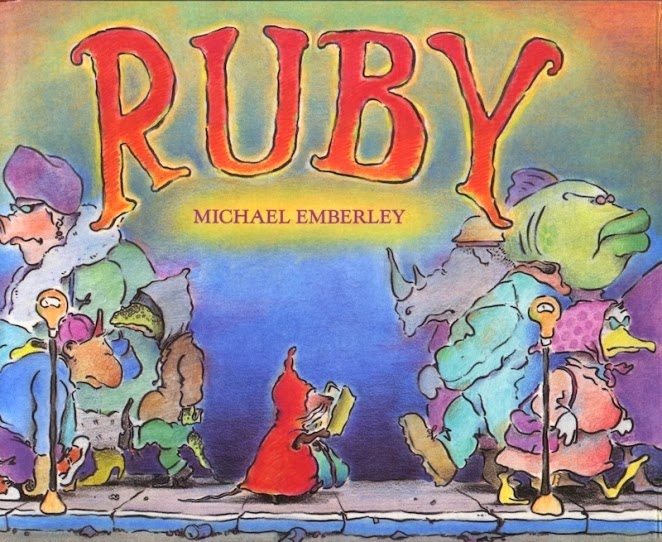
I read aloud a traditional Red Riding Hood tale. Then, together, we list fairy tale events and plot them on an excitement scale to show rising action, climax/turning point, and falling action. We talk about how these elements are in every good story...and how the stories that they write will also include these elements. I follow with a reading of  Ruby by Michael Emberley. This is a "fractured" version of Red Riding Hood. We track events and plot an excitement scale again, showing that even as the story changes, the general shape of the excitement scale remains the same.
http://www.amazon.com/exec/obidos/ASIN/0316236608/ref%3Dnosim/candle-20/

http://www.amazon.com/exec/obidos/ASIN/0916260313/ref%3Dnosim/candle-20/
Drama
A big portion of this unit includes drama. Today we did an introductory pantomime activity from Theatre Games for Young Performers.

Comparison/Contrast
First, I read a traditional Cinderella Story. Together, we build a chart to look at various elements of the story. I record on the bulletin board as students record on their own individual charts. Then, I give each student a "fractured" version or a version from another culture to read. They each add this book to their own charts, then present what they discover so that we can add to the class chart (and individual charts.)


It is eye opening to discover just how many versions of Cinderella there are...and how the elements stay consistent throughout the tales. It's those consistent elements that make fairy tales what they are...so we're beginning to uncover how fairy tales differ from other types of fiction.

Think Sheets are now available here!
Writing Assignment: Fractured Fairy Tales

We'll be doing a lot of writing this term. To kick off the year, I read the traditional Three Little Pigs, then ask each student to use a  "Fractured Fairy Tale Think Sheet" to brainstorm how they might fracture the story. I suggest that they change one or two elements of the story--perhaps the setting, character, point-of-view of the story, etc...  But not all elements. Just a few changes allow students to start experimenting with fairy tale writing. I also mention a few additional guidelines. Their stories will likely include:
  • 3 little somethings
  • a "big bad" something
  • 3 "houses" of some type
  • dialogue between little somethings and big bad somethings
  • the phrase, "Once Upon a Time"
Before class begins next week, students will complete their own fractured fairy tales. Next week, we'll meet in authors' circles to revise our writing.

For additional support, students might also use this site from ReadWriteThink.

Fairy Tale Notebooks
We're compiling all our work into 3-ring binders with page protectors. At the conclusion of the unit, the page protectors will be taken out of the binders and made into permanent reference books.

Once Upon a Time there was a teacher who LOVED teaching fractured fairy tales...

Read more about our adventures here and here. And now you can also read about writing and producing the play portion, here.

**Update**

I am gradually adding items from this fairytale unit to TPT. Currently available:

Fairy Tale, Folktale Characteristics Poster

Short Story: Plot Diagram for Fairy Tales and More!

Character Studies: Folk, Fairy Tale, and Short Stories

Fairy Tale Think Sheets: Story Analysis & Pre-Writing Organizer (New! 4/29/17)

Fairy Tale Maps: Exploring Setting(New! 5/5/17)

Fairy Tale Bibliography Record Sheets(New! 5/12/17)

Fairy Tale Character Wanted Posters(New! 5/17/17)

Folk & Fairy Tale Compare & Contrast Story Chart(New! 5/19/17)

The entire collection is also available in a bundle:
Folk, Fairy Tale, & Short Story Series Bundle (Now complete! Over 100 pages!)


Friday, April 28, 2017

Averaging with Unifix Cubes

Unifix cubes are one of my favorite math manipulatives. I especially love to use them when averaging.

In the "old days," when I was an elementary student, I was told that to average, you add up all the numbers and divide by the number of groups to get the average. Not surprisingly,

I HAD NO IDEA WHAT THAT MEANT!

OR WHAT IT HAD TO DO WITH AVERAGING!

I first used unifix cubes to average when I taught "Measurement with Marbles," one of my FAVORITE math units that's now FREE from the Math Learning Center. I hope you enjoy that unit and my little videos on Averaging with Unifix Cubes.

Note: Due to video time limitations I could not show multiple ways to level the towers. When you work with children, however, I encourage you to help kids understand the idea of averaging by giving them 2 stacks, and then 3 stacks of cubes, and asking them to devise methods to level the towers. If we just TELL them what to do rather than allowing them to devise their own strategies, we're really just giving them a different version of my childhood experience (where I had no idea WHY I was doing what I was doing.) Give them some cubes and a little time for productive struggle! :)


Part 1:


Part 2:


Saturday, April 8, 2017

Group Fraction Activity for Warm-Ups, Transitions, or Anytime!


As a math coach I'm able to see a lot of teachers and students in action. On a recent visit to a third grade classroom, I saw a fantastic activity that I can't wait to share! (Homeschool adaptations included below.)

In this particular class, student desks were configured in groups of 4 or 5. As students arrived at their desks in the morning, they immediately began working on a group task: "What fraction of your group are boys? What fraction are girls?" In the early stages of the activity, before everyone arrived, a group might have results like 1/3 girls and 2/3 boys. But as more students arrived, the results changed. A group might then have 2/5 boys and 3/5 girls. But the group next to them might have 1/4 girls and 3/4 boys. The answer entirely depended on when kids arrived and who was in attendance.

When the starting bell rang, the teacher focused the class and began asking groups to share. Each group shared the fraction of boys/girls in each group. As she questioned individual groups, she stopped and asked students to consider how one group compared to another. If one group had 2/5 girls and another had 3/5 girls, which group had a greater fraction of girls?

The activity also lent itself to thinking about fraction addition or subtraction. If a group had 2 boys and 3 girls, then:

2/5 + 3/5 = 5/5 = 1 (whole group)
5/5 of a group - 2/5 boys = 3/5 girls.

Students could also consider equivalent fractions. "If a group has 2/4 boys and 2/4 girls, is there another way we can think about the fraction of boys and girls?" (1/2 boys and 1/2 girls.)


This is a wonderful, quick activity that helps students to figure parts of a group with fractions. As they consider the answer, they're continually thinking about which number is used in the numerator and which is used in the denominator and why.

After observing the activity, I made a set of 75+ Math Task Cards that could be used with small groups (3-6), medium groups (6-12) or large groups (12-entire class.) Many cards encourage students to consider questions that help them to know one another better. Depending on teacher emphasis, the cards could be used in grades 3, 4, or 5.

If you are interested in the Task Cards, they are available on TPT as a new product at an introductory sale (deep discount!) price.

If you use this activity--with or without the Task Cards--I'd love to hear about your experience!

p.s. Homeschoolers could make up a similar activity with items around the house: "What fraction of my stuffed animals include animals with teeth? No teeth?"  Years ago I gathered Teeny Beanie Babies just for the purpose of sorting and fraction activities like this.

Saturday, February 11, 2017

Math-y Valentine's Day Cards - FREE!

"Parallel lines have so much in common...it's a shame that they'll never meet."

Print these humorous parallel lines cards for Valentine's Day or hand them out as mini-posters at any time of the year!

I add candy sticks or pencils to the parallel lines to make a fun, math-y Valentine's Day card!

Pick yours up (free!) here:

Teachers Notebook
Teachers Pay Teachers

Enjoy! (And thank you in advance for taking the time to rate this free product!)

P.S. Speaking of LOVE...and MATH...do not miss this article on how love and math intersect.

Thursday, December 29, 2016

Math Games for Grades 4-6 (Free Online)

I recommended this collection of math games when I was teaching fifth grade. It's a great assortment for students in 4th-6th grades.

Content includes:
  • Ratios
  • Multiples
  • Factors
  • Prime/Composite
  • Multi-Digit Multiplication
  • Products/Factors
If you have other games to add to the list, drop me a comment and let me know!
Ratio Blaster - In this free online game, view a ratio (example: 3 to 6) and click to shoot at the invading spaceship that shows an equivalent ratio, written as a fraction (example: 1/2).
Table Numbers - Choose a factor from 2-9, then click on one of three numbers that represents a multiple of the chosen factor.
Prime/Composite Applet - this is a great follow-up to an exploration of prime/composite numbers and reading of You Can Count on Monsters. See if you can figure out how the picture of each number relates to prime/composite.
The Amoeba Multiplication Game - practice multi-digit multiplication by splitting numbers; use partial products to solve.

MathTappers: Multiples - add this app to your mobile device to explore multiplication and division using visual models. If your student is struggling with fluency in multiplication, this is highly recommended.
Times Square - find factors as you race to get four products in a row.
Factor Dazzle- Click on the factors of target numbers set by an opponent. Use Guest Pass or register to play against students online.

Factor Game - Click on the factors of target numbers set by an opponent. Play against the computer or a friend.

Wednesday, December 28, 2016

Math & Literature: Time (& Related Activities!)

I'm on a holiday vacation cleaning frenzy. (Any other crazies out there?) In the process, I've made progress purging my office bookshelves, rediscovering all my kid lit/math books. It's time to revamp my Math Book List to reflect all the additions I've made in the last couple years. With the coming New Year, "TIME" seems like an appropriate place to begin. Here's the updated list for this concept. And, as always, the complete math/lit booklist can be found here.

Time  New! (12/2016)
All About Time, Jeunesse & Verdet
All in a Day, Mitsumasa Anno, et al
Bats Around the Clock, Kathi Appelt
Chimp Math, Nagda & Bickel
Clocks and More Clocks, Pat Hutchins
Cluck O'Clock, Kes Gray 
Four Season Make a Year, Anne Rockwell
Henry's Important Date, Robert Quackenbush (only linked mini-version is currently in print)
How to Tell Time (older Little Golden Book)
It's About Time, Jesse Bear, Nancy White Carlstrom
Just a Minute!, Teddy Slater (Hello Math)
Maxie, Mildred Kantrowitz
My First Book of Time, Claire Llewellyn
On the Same Day in March, Marilyn Singer
Pigs on a Blanket, Amy Axelrod
Scaredy Squirrel, Melanie Watt (Review & Activity)
Telling Time, Jules Older
Telling Time with Big Mama Cat, Dan Harper
Time To..., Bruce McMillan
The Warlord's Alarm, Virginia Walton Pilegard
What Time Is It? A Book of Math Riddles, Sheila Keenan
What Time Is It Mr. Crocodile?, Judy Sierra
When This Box Is Full, Patricia Lillie

My blog also has several other activity/book entries about time:


Tuesday, December 6, 2016

"Presents" with Factors and Multiples!

It's time to repost this favorite from a few years ago. These little factor/multiple "presents"--and the games that follow--are great math activities to do around the holidays!

Although factors and multiples are a 4th grade focus*, they are definitely something that we fifth grade teachers like LOVE to review.

To keep my students' skills sharp during holiday break, I created factor and multiple flap books. These little "presents" require students to write the definition of "factor" and "multiple" and list 5 multiples for 2-10 and all the factors for 6,7,8,9,10,12,18, 24, 36. Blank versions are also included for teachers or students who want to use their own numbers. When these little homework assignments return from break (!), they will be added to our math notebooks.


You'll find Presenting Multiples & Factors at:

Teachers Notebook
Teachers Pay Teachers

*factors & multiples are in CCSS.Math.Content.4.OA.B.4

Looking for more factor and multiple practice over break? Below, you'll find links to some of my favorite related games:

Table Numbers - Choose a factor from 2-9, then click on one of three numbers that represents a multiple of the chosen factor.


Times Square - find factors as you race to get four products in a row. Use Guest Pass or register to play against students online.
Factor Dazzle- Click on the factors of target numbers set by an opponent. Use Guest Pass or register to play against students online.

Factor Game - Click on the factors of target numbers set by an opponent. Play against the computer or a friend.

Thursday, September 8, 2016

Elementary Content Specialists: Is it Time?

Over the last 10+ years, I've had the privilege of working with hundreds of K-5 teachers in math professional development. The longer I work, the more frequently a question comes to mind:

Is it time that elementary teachers specialize in subject content?

Why?

Sheer Amount of Content
New standards change and increase the amount of math and language arts standards that each grade level teacher must know. With new standards comes new curricula, hopefully of high quality (check yours on EdReports) and hopefully with plenty of supportive PD.

For some, new curricula (or good curricula!) is not purchased and teachers piece together their own. (For a recent statement on this trend, read a reflection by NCTM President, Matt Larson.) If one is to learn even one new set of content area standards--and a new, related curricula--it takes time to develop proficiency. Add in another major content area (or 2, 3, 4...) and you have a recipe for overwhelmed teachers.

Depth of Content
Over the last 10+ years, I watched many standards appear to come down a grade level (example: what was in 4th is now in 3rd.) Then it seemed to happen again. Much of what we learned when we were kids is now taught 1-2 grade levels earlier. I routinely work with 4th and 5th grade teachers to learn how to teach math content that they first encountered when they were in middle school. 

Please Note: I fully believe teachers capable of learning the mathematics. (See Jo Boaler's work.) But they don't always have the TIME to learn it.

Advantages
If K-5 elementary teachers specialized, they could focus, teaching one subject (or a major content subject and related subjects) twice a day. For example, a language arts specialist might team up with a math content specialist, sharing a class that rotates between two locations. Each could add related subjects like social studies or science, or another specialist could take a third area. Teachers could focus professional development time, standards, and curricula on a single subject.

Students would benefit from teachers who not only understand the content, but know how to teach it well. Teachers would be trained in developmental stages in a given content area, allowing them to deeply reflect on current student understanding and what individuals need in order to advance.

Disadvantages
Completely self-contained classrooms and all the related advantages would disappear. However, if paired well, teachers could work together to establish common expectations and similar classroom climates. Students would still only see two teachers per day. And with today's emphasis on constant change of focus (thinking of video games and t.v....always quickly changing), perhaps it would even help to keep student attention?

What do you think? Are you or your teachers overwhelmed? How can we help teachers to learn all they must know to be successful?

Friday, July 22, 2016

Tears to Cheers! (Perseverance!)


If you were a fly on the wall in my house this morning, you would have heard this coming from my 10yo during math...

[sniff, sniff]

[sniff, sniff]

[sniff, sniff]

Background: At the beginning of the summer, I noticed that my son struggled to solve multi-digit subtraction problems. So, for the last several weeks, we've been adding strategies to his toolbox. He's caught on fast. Yesterday, as we discussed one strategy he grinned and said that this made sense!

Fast forward to today.

He's working on a problem. I ask him to call me over when he's ready to talk about it. When he does, my heart sinks. (More on that later!) I immediately see that he attempted to apply the strategy from yesterday. But it didn't work. Basically, he tried to make the strategy into a series of rules. He tried to follow "the rules." He forgot "the rules." And when it didn't work, he just accepted whatever answer came from the procedure. He forgot that math MAKES SENSE.

My gut reaction? I wanted to immediately jump in and show him where he went wrong. I sorta did. That was sorta terrible on my part. Luckily, it was short-lived and he went back to working on the problem on his own. He struggled. And struggled. And struggled.

[sniff, sniff]

Then he got it. Sorta.

At this point, you might say his knowledge was shaky. He did figure out the problem. He did use his strategy. But it was very unclear as to whether he really "got it."

So he continued to the next problem. Wherein my heart sank again. (Yeah, yeah. More on that later...) He used the same strategy in the same, wrong way. This time, I asked him to talk me through what he'd done on his visual model. His words made sense, but he couldn't show it on the visual model. I repeated what he'd said, but explained that I couldn't see that on his model. He looked at the model, obviously perplexed. He KNEW that it didn't match what he was saying. It was dawning on him that this DIDN'T MAKE SENSE! I asked if he could revise his model to represent what he said and told him to call me back when he was ready.

[sniff, sniff]

[sniff, sniff]

Now here, folks, is where I'd usually jump in with two never-let-my-child-suffer feet. I mean the kid is CRYING! (Or at least sniffling!) Who wants to see their kid in agony?

I wanted to intervene. I wanted to get-him-back-on-the-happy-track. Maybe ask a good (pointed!) question. Or suggest an avenue that might lead him to discover where he'd gone wrong. I wanted bunnies. Pink ponies. And rainbows.

But today, with every-ounce-of-my-being, I kept my mouth shut.

Guys, it was SO HARD!

Time passed. It felt like FOREVER. I think it must have been at least, what, TEN MINUTES! An eternity!

[sniff, sniff]

[sniff, sniff]  

But then, tentatively, he calls me over. He talks me through his visual. He explains why it makes sense. And it DOES! It REALLY DOES!

So here's what I said to him: "You know what was cool today? You persevered. Do you know what persevere means? [no] It means you kept going. You stuck with it. And look what you did! You kept going until it MADE SENSE." I cheered!


Herein, the child grins. Tears falling, while grinning.

Guys, he GOT IT! And I ALMOST, with my Momma-doesn't-want-to-see-you-suffer-mentality, TOOK THAT AWAY FROM HIM!

So back to my heart sinking...

When I see a child make a mistake, my natural reaction is to cringe. It's in me. I admit it. I want to FIX IT! But we know that mistakes grow the brain. We have to let kids make mistakes. Toss, turn, and roll in their mistakes. Until they discover that MATH MAKES SENSE.

You know what would have happened if I'd intervened today: a few less tears and a whole lot less learning.

Obviously, I don't want math to hurt. Shoot, no one wants to see kids in pain. But sometimes there is a little pain in perseverance. And if we never let them persevere? Well you know what would happen then... (Eeesh.)

Our job? We must also persevere...by letting them struggle. We must allow them to bask in moments of disequilibrium. For it's in those moments, those oh-how-I-want-to-save-my-child-moments that real learning happens.

Persevere!

Update p.s.
The first week of school this child came home and related an assessment he'd just taken in math. "I used that strategy, Mom! It worked!"
Related Posts with Thumbnails
Blogging tips