Friday, March 23, 2012

Teaching Fractions Through Music

While probably not a surprise to any of you, you'll likely appreciate this article from Science Daily: Getting in Rhythm Helps Children Grasp Fractions, Study Finds.

In his piano lesson this week my son is learning a clapping pattern emphasizing note values. Even as we were doing it, he reflected on the connection to fractions.

I love the idea of equating fraction bars to musical notes. (See the article for a picture.) Fraction bars are a pretty common tool...but this is a innovative way to think about them. This article says:
"Academic Music: Music Instruction to Engage Third Grade Students in Learning Basic Fraction Concepts" has been accepted for press in the journal Educational Studies in Mathematics and will be published online next week.
Looking forward to it! 


Thursday, March 22, 2012

One is a Snail Ten is a Crab

If you're feeling a little sluggish about teaching odd and even numbers, consider using the book One is a Snail Ten is a Crab. It's a "counting by feet" book in which even numbers are counted using creatures with even numbers of feet: humans, dogs, insects, spiders, etc...  Odd numbers are counted with an even-footed creature, plus a snail. So...

1 is a snail.
2 is a person.
3 is a person and a snail.
4 is a dog.
5 is a dog and a snail. Etc.

The book continues in that fashion up to 10. After that, the text starts counting by 10s using a variety of animal feet.

P.S. Yes, that is my foot. It's the price for making this a "pin-able" post.

Wednesday, March 21, 2012

Math in Children's Literature List - Updated!

Latest Update: March 21, 2012

I try to update my list of Math Books on a regular basis. You can always access it from the link at the top of the home page.

Enjoy!

Monday, March 19, 2012

Math Monday Blog Hop #49 (March 19, 2012)


If you want to share this collection on your blog, just grab this link:
get the InLinkz code

Grab a Math Monday button for your own blog:

Math Myth: Borrowing is the Only Way


Subtitle: How I "Borrowed" Trouble and Have "Carried" It With Me...

I recently wrote an entry that included a link to a piece of research on "The Harmful Effects of Carrying and Borrowing." This has been on my mind a lot this past year. Here's why...

The math curriculum I use, Bridges in Mathematics, does a tremendous job at having kids explore various ways to solve problems. The way the lessons are set up, kids develop their own strategies, share their thinking with others, and refine their ideas as they become and more and more efficient at math. I was NOT taught this way and it's been amazing to watch my students develop strategies that are far superior (meaningful, more efficient, etc) than the algorithms I was forced to memorize.

This year I've been working with a 9-year-old. He's been able to use a variety of strategies to solve multi-digit addition and subtraction problems. Here's an example of one way that he solved a multi-digit subtraction problem. (Taken from a Bridges Grade 3 assessment.)

1349-675

1300-600 = 700
700+49 = 749
749-75 = 674

I asked him how he did the last step. He said:

750-75 = 675
675-1 = 674

The strategy shows number sense and comfort with place value. As a child I was told that the correct way to do this problem was by borrowing. It made no sense. No one bothered to familiarize me with place value and number sense to give the problem any context. I had no options except to follow the rules. So why, then, would I mess up this child's system by giving him rules?

I did, you know. Here's what happened...

After being exposed to a wide variety of strategies and showing marvelous strength in his own knowledge, I introduced the standard algorithm. Why? Standards specify that kids must know how to do the standard algorithm along with other strategies. So we did it.

It seriously messed him up. The harder I tried to teach him the standard algorithm, the less he maintained a grasp on the meaning he'd constructed for himself. I taught the standard algorithm using both manipulatives and numbers, so it wasn't like I taught it completely out of context. We looked at how the numbers had to be broken apart (carrying/borrowing) with the manipulatives.

But it made no sense to him.

So I abandoned the standard algorithm. Actually abandoned all multi-digit addition and subtraction for awhile because he seemed so defeated. I seriously thought I'd ruined the kid. When we came back to it, we did a lot of work with manipulatives and I let him do it HIS WAY. Lo and behold, it came back to him. Stronger now than before.

I do still occasionally show him the standard algorithm. But only after extensive time with the exploration of other strategies. And only after he seems very, very comfortable in his own methods. I have abandoned telling him to "do it this way." 

Cause "this way" may not be "his way." And "this way" may actually do more harm than good.

I'd love to hear about your experiences.

Saturday, March 17, 2012

Math Education: Some Must-Read Blog Posts!

If you're involved in Math Education (or perhaps even if you're not!) you have probably read about the controversies surrounding Khan Academy. Even if you could care less about Khan, I strongly recommend this series at the Generation YES Blog, Khan Academy Posts: Implications for Math Education.

If you teach math--whether in the classroom or as a homeschooler--this series will challenge you to examine your own beliefs about teaching and learning. If you don't have time to read it now, bookmark and come back later. I'm sure glad I did. :)

I especially recommend part 1, Khan Academy and the Mythical Math Cure, which talks about "how we believe certain things about math that are not true, but we keep doing them anyway." A major myth: "Learning math is about acquiring a sequential set of skills (and we know the sequence.)"

This myth resonated with me because I recently heard something similar while attending a math conference where Jo Boaler spoke. (Highly recommend her book, What's Math Got to Do With It? How Parents and Teachers Can Help Children Learn to Love Their Least Favorite Subject.) She talked about how low achievers do very different math than those who excel. One hurdle? Low achievers see math as a series of rules...rules that are equally important. Kids who struggle in math are less flexible in their mathematical thinking...which makes them emphasize rules even more. And what happens when kids struggle? They are likely to be exposed (by the teacher) to more drill/skill, which leads them to a stronger belief (misconception) that procedure is what counts in learning mathematics.

And think about math education. If kids are ever encouraged to think flexibly about math, it's when they're young. (Unfortunately, for some, the drill/skill emphasis begins immediately.) But the older they get, the more the emphasis is on procedures, mostly through memorization. As Alfie Kohn writes, it's no wonder that U.S. kids do worse and worse on internationally normed tests as they get older.

Thoughts? Love to hear them!

P.S. While you're at it, read a fascinating piece of research: "The Harmful Effects of 'Carrying' and 'Borrowing' in Grades 1-4" by Constance Kamii and Ann Dominick. The research is from 1998. And what are we still doing in most schools (and homes?) Teaching carrying and borrowing!

Thursday, March 15, 2012

Kitty, Nine Lives, Ordinal Numbers, Bookmaking, and More...

Post flea-bath photo.

We're sad. Our kitty passed her ninth life last week. It might actually have been her thirteenth. Or thirtieth. This cat gave me gray hairs. If we cracked the outside door, she'd streak in (sometimes so fast I didn't notice) and go hide in the house. Somewhere. A couple of us are allergic, so we'd begin an all-hands-on-deck call to find her. Usually under the bed.

She made me the craziest when I'd try to leave home. She'd zip into the garage door just as it was about to close. I sometimes pushed the button repeatedly as she waltzed in, then out, then in, then out. We recently came home after being gone for hours to find the garage door standing open. She must have done that in-out thing one time after I quit looking.

But the ultimate curious cat moments came when she'd run into the garage as I was backing out, jump on the hood, leap to the van roof, and take a final hop to the backside of the garage door. Yep. Up. Way up. While in the open position. If I continued backing out, she was stuck up there and I couldn't leave because the garage door was open; if I shut the door she'd be squashed. But when I pulled back into the garage, she'd go further onto the garage door where it was impossible to reach her.

Only a year ago I wrote about her when she got sprayed by a skunk. She was CURIOUS.

She made me crazy.

But we loved her.

So in tribute, we're making cat books. While learning math. And doing a little art. Go figure.

We started by reading picture books about the nine lives of cats:

My Nine Lives by Clio, by Marjorie Priceman
Comet's Nine Lives, by Jan Brett

We also read Cookie's Week. The cat, Cookie, encounters one misadventure each day of the week ("On Monday...Cookie fell in the toilet.") until she finally rests on Sunday. It's a great book to look at the days of the week in sequence.

We wrote stories--and included ordinal numbers--about the misadventures of a cat. Each tale was unique and written at the child's developmental level. Here are pages from the 6-year-old's:
On the first day, Cuddles fell into the toilet.
On the second day, Cuddles fell into a pot of mud.
On the third day, Cuddles got into the washing machine and it spun him around.
On the fourth day, Cuddles knocked the clothes off the clothesline. They got all dirty again.

And a few pages from the 9-year-old's:
On Tiger's first life at the farm he chased a bird to the top of the barn and fell off. Oops, life number one flying away.

On Tiger's seventh life he went down to the pond and tried to catch a duck. He pounced, but fell in, KER-SPLASH. Life number seven flying away.

On Tiger's eighth life he snuck up on the dog he saw through a thorn bush. He attacked and got stuck in the bush. Life number eight bounding away with tufts of fur missing.


We made books, pop-up style.

The 9-year-old will also add page numbers using Roman Numerals after reading Fun With Roman Numerals and Roman Numerals I to MM. Although Roman Numerals seem to be on the way out, standards-wise, it's something I want my students to learn. Roman Numerals aren't uncommon in dates (think movies!) and chapter titles. Just today we read A Giraffe Goes to Paris which included information about King Charles X of France.

It's been very healing for all of us to remember kitty's antics. I hope she made you smile. 


Disclosure: If you purchase books through my Amazon links, all commissions go toward foster care through Grace and Hope at no additional cost to you. I do not keep any money myself; I am hoping to be able to sponsor an additional child in foster care through commissions on this site. Thank you!

Wednesday, March 14, 2012

Video: How to Make Math Meaningful

Interesting video from UC Berkeley professor about "how to increase students' understanding of math."

Happy Pi Day, all! :)

Monday, March 12, 2012

Math Monday Blog Hop #48 (March 12, 2012)


If you want to share this collection on your blog, just grab this link:
get the InLinkz code

Grab a Math Monday button for your own blog:

Wednesday, March 7, 2012

Ordinal Numbers in Children's Literature & Technology!

Always felt a bit third-rate at teaching ordinal numbers? Share these books and activities and you're sure to come in first!

Books:

On the Stairs - mice count their way up the stairs with ordinal numbers.

Ten Little Caterpillars - count caterpillars with ordinal numbers in this gorgeous new book by Bill Martin Jr., illustrated by Lois Ehlert.


Online Games & Activities:

Wash Line 1 - hang shirts on the line using the correct ordinal number order. (Scroll down for the activity.)

Alien Competition - put aliens in 1st, 2nd, and 3rd place using different characteristics: most eyes, most legs, most arms, etc. Also try Alien Racing and Alien Teleport. Designed for whole group instruction with a projector or IWB. Also see Alien Flower Show for ordinals to 5th place. 


For more books, resources and activities, see the Bridges Kindergarten Resource Links.

Clip Art courtesy of Phillip Martin. The work by Phillip Martin is licensed under a Creative Commons Attribution-NonCommercial-NoDerivs 3.0 Unported License. Thank you!

Disclosure: If you purchase books through my Amazon links, all commissions go toward foster care through Grace and Hope at no additional cost to you. I do not keep any money myself; I am hoping to be able to sponsor an additional child in foster care through commissions on this site. Thank you!  

Monday, March 5, 2012

Math Monday Blog Hop #47 (March 5, 2012)


If you want to share this collection on your blog, just grab this link:
get the InLinkz code

Grab a Math Monday button for your own blog:

Thursday, March 1, 2012

Book Review: Have You Filled a Bucket Today?

I have a new favorite book. (Not that I don't have many favorites, but this certainly makes my list.) Have You Filled a Bucket Today?: A Guide to Daily Happiness for Kids explains how each of us carries an invisible bucket. We fill our bucket with good feelings...when people say something nice to us, smile at us, or help us. If we are kind, we can help to fill the buckets of others. Some people are bucket dippers and take the goodness from other people's buckets.

I first read about this book on a teacher's blog (have no idea where!); the book was being used to help kids practice kindness.

In our family we read the book and started talking about what fills our buckets and what empties them. This is a book that should be read at least weekly around here. :) I'm thinking about making physical buckets for my two youngest. I'd like to have them put something in the other person's bucket so they notice times that they're being kind.

My bucket filler for you today...you are an awesome group of educators. I'm learning so much from visiting your blogs and reading your comments. Thank you for what you do!!!

Now go and fill a bucket!

Monday, February 27, 2012

Math Monday Blog Hop #46 (February 27, 2012)


If you want to share this collection on your blog, just grab this link:
get the InLinkz code

Grab a Math Monday button for your own blog:

Wednesday, February 22, 2012

Exciting Freebie - Number Rack!


The Math Learning Center has an amazing new set of freebies. The Number Rack App can by downloaded from the iApp Store in iTunes -OR- used as a free Web application.

The moveable beads work with counting as well as addition and subtraction strategies. You can also download a free activity/lesson book to use along with it. I'm interested in trying it with subitizing.

This could be used at home or in the classroom with individual children or with a large group lesson. Read more about it here.

Monday, February 20, 2012

Math Monday Blog Hop #45 (February 20, 2012)


If you want to share this collection on your blog, just grab this link:
get the InLinkz code

Grab a Math Monday button for your own blog:

Monday, February 13, 2012

Math Monday Blog Hop #44 (February 13, 2012)


If you want to share this collection on your blog, just grab this link:
get the InLinkz code

Grab a Math Monday button for your own blog:

Wednesday, February 8, 2012

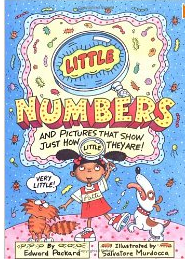
Little Numbers and Pictures That Show Just How Little They Are

I frequently facilitate grade 3-5 math workshops for teachers. Whenever we discuss decimals I always mention the book Little Numbers and Pictures That Show Just How Little They Are! I think it's a nice book to use with 3rd-5th grade students because:

1. The "unit" is a dinosaur. Specifically, a seismosaurus. Kids need to understand that a "unit" can be flexible. In this book, everything is measured in terms of a dinosaur unit.

2. The book depicts increasingly smaller measurements. If a dinosaur is worth 1, then a dinosaur shrunk to 1/10 will fit in the front yard. It talks about various other tenths, like a dime being a tenth of a dollar. It shows both decimals and the fraction equivalent.

3. The numbers creatively get smaller, each time decreasing by powers of ten. For example... 1/10,000 is an ant. 1/1,000,000 is an amoeba. Some kids will be very intrigued by the exponents, which are also included.

4. The book is big (13 x 8") and good with crowds.

If you teach decimals or fractions, I recommend it!

Monday, February 6, 2012

Math Monday Blog Hop #43 (February 6, 2012)


If you want to share this collection on your blog, just grab this link:
get the InLinkz code

Visit past Math Monday Blog Hops.

Grab a Math Monday button for your own blog:

Friday, February 3, 2012

Fun, FREE!, Hands-on Math Units

Two of my favorite units from The Math Learning Center are now FREE!! They include:

Hands-On Math: Measurement with Marbles (click to free pdf)

Hands-On Math: Geometry with Geoblocks (click to free pdf)


I've repeatedly used the lessons with math groups. You can find my reflections on the geometry lessons here. And the marble roll lessons here and here.

Wednesday, February 1, 2012

Greater Than/Less Than - DIY Whiteboard Tool

On Mrs. T's First Grade Class blog, I first saw some very cool greater than/less than/equal to tools for kids to use on desktops with manipulatives. LOVED THEM! And wanted something like it to use on my whiteboard.

I cut one square of black posterboard and two strips of white posterboard. You could use any brad, but I happened to have tiny ones for scrapbooking, so I used those to anchor the white strips to the black background. (I just poked a tiny hole all the way through the two layers of paper and then shoved the brad through.) I then put a piece of packing tape on the back of the brads so they wouldn't scratch my whiteboard. I grabbed an advertising magnet off my fridge (you know,...the kind you get in the mail), cut it in half, and glued one strip to each side of the back of the black posterboard. And voila...a greater than/less than/equal to tool to use on my whiteboard. 

You could use it with any magnet...including regular magnetic math manipulatives. The above photo shows a problem before it's solved, using base ten pieces. Then all the child needs to do is pivot the white strips to show greater than, less than, or equal to.

Monday, January 30, 2012

Math Monday Blog Hop #42 (January 30, 2012)


If you want to share this collection on your blog, just grab this link:
get the InLinkz code

Visit past Math Monday Blog Hops.

Grab a Math Monday button for your own blog:

Friday, January 27, 2012

Happy New Year! (Dragons!)

Celebrating Lunar New Year? This art project  (and this!) provided us with great fun as we  commemorate the Year of the Dragon. Here's our monster:


The dragon's scaly skin is formed by painting with bubble wrap. Fun medium!!

We've also been reading. Two of our favorite books this week...

  • The Knight and the Dragon (by a beloved author/illustrator, Tomie DePaola...this is also a great story to act out)
  • The Paper Dragon (with a beautiful moral...the strongest thing in the world is not dragons, but LOVE!)


I've also learned (by much trial and error) that the single most effective way to get children to draw is to sit down and draw with them. We got out the Prismacolor pencils yesterday. Here's a 9-year-old's dragon (right.)

I'm also thinking about a math lesson...  How about a survey where students interview people of all ages to find out which animal under the Chinese calendar they were born? It'd be a great Facebook survey to do at home.

Happy New Year from someone born under the Chinese Calendar animal...

wait for it...

MONKEY! :)


(Photo taken at a garden in China.)


Linking up at stART.

Tuesday, January 24, 2012

Pinterest Site for Math Education (+Tessellations!)

Follow Me on Pinterest

I've succumbed. Pinterest has grabbed me. Almost my entire Pinterest site is dedicated to math. Feel free to follow along. The goodie I found this morning? An unbelievable site showing origami masks and tessellations...incredible 3D artwork "sculptures" each entirely created from 1 piece of paper. It'd be great to show students as you explore tessellation lessons. The sample below comes from one of my lessons; I had each student in my class decorate a fish to make into a tessellated poster.


Monday, January 23, 2012

Math Monday Blog Hop #41 (January 23, 2012)


If you want to share this collection on your blog, just grab this link:
get the InLinkz code

Visit past Math Monday Blog Hops.

Grab a Math Monday button for your own blog:

Wednesday, January 18, 2012

Part-Whole Math With a Plate!

At a conference last fall, I heard Kim Sutton mention something about using Zoo Pal Paper Plates to show parts and whole in math. She briefly described putting the parts in the ears and then showing the whole in the larger plate area. I'm not exactly sure how she uses the plates. But I wanted to experiment with the idea...

I couldn't find the zoo plates locally (Amazon link is below), but decided to try it with a plastic plate from a local one buck store. (My plate is sorta like this divided plastic picnic plate.) I've used this a couple different ways to explore the part-whole relationship in addition with my 5yo...

With Dice:
He tossed one die into each of the smaller compartments and put that many items (I used centimeter cubes) in each dish. He wrote down the two dice numbers in an addition number sentence. So if he rolled "2" and "3," he put 2 cubes in one small slot, 3 in the other small slot and wrote "2 + 3." He then moved all the cubes to the bigger area (the whole) to count the total and finish the number sentence (= 5.)


With Pre-Written Number Sentences & Penguin Pieces: 
I wrote several number sentences. (Photo above models 2+2.) If the sentence was 2 + 4, he counted out 2 marble penguins into the first small compartment and 4 marble penguins into the second small compartment. He then moved all the penguins into the larger compartment, counted the total and finished his number sentence.

This could easily be replicated at home or school. And could be used with subtraction, multiplication, division, fractions, decimals and more. Enjoy!

Disclaimer: If you order from Amazon links on love2learn2day, all commissions go toward foster care through Grace and Hope at no additional cost to you. THANK YOU!  

Monday, January 16, 2012

Math Monday Blog Hop #40 (January 16, 2012)


If you want to share this collection on your blog, just grab this link:
get the InLinkz code

Visit past Math Monday Blog Hops.

Grab a Math Monday button for your own blog:

Monday, January 9, 2012

Math Monday Blog Hop #39 (January 9, 2012)


If you want to share this collection on your blog, just grab this link:
get the InLinkz code

Visit past Math Monday Blog Hops.

Grab a Math Monday button for your own blog:

Saturday, January 7, 2012

Cure for Bored Kids (Rube Goldberg-esque machine)

Are your children bored? If you don't mind pin holes in your walls, challenge them with this video:


It reminds me of making marble rolls. And of our Frigits marble roll.  But, Wow!

Tuesday, January 3, 2012

Math Monday Blog Hop #38 (January 2, 2012)


If you want to share this collection on your blog, just grab this link:
get the InLinkz code

Visit past Math Monday Blog Hops.

Grab a Math Monday button for your own blog:

Sunday, January 1, 2012

Teaching Dimensions - Great YouTube Movie

My 3rd grader asked, "What's a dimension?" I think he was reflecting on the 3D shapes we've been considering in math. We had a brief conversation about it, but this movie really helped...and thoroughly intrigued both of us.


Happy New Year!!

Saturday, December 31, 2011

One, Two, Skip a Few!

Recently ran across a math-related book I've never read. (Crazy, I know!) :)  One, Two, Skip a Few! contains number rhymes perfect for the preK-Kindergarten set. But I could also see it used as a model for writing math-related poetry in the upper grades.

It contains a few familiar poems such as "One, two, three, four, five, Once I caught a fish alive..." but it also includes many poems new to me. Some include vocabulary for ordinal numbers: first, second, third, etc. Others include examples of concepts like multiplication...

"Twice one are two,
Violets white and blue.
Twice two are four,
Sunflowers at the door."
(continues up to twice twelve...)

Great book to add to a math-related children's library! And inexpensively out-of-print, to boot! Looking for more math-related children's titles? The gigantic booklist has been updated!

Monday, December 26, 2011

Math Monday Blog Hop Break

Let's take a week off from the Math Monday Blog Hop to enjoy restful time with friends and family. In the meantime, if you are antsy to think about math, visit the list of 100s of math-related children's books or enjoy some of the many marvelous lessons in Math Monday Blog Hops from this past year.

Merry Christmas, Happy Holidays and have a great last couple days in 2011!!

Monday, December 19, 2011

Math Monday Blog Hop #37 (December 19, 2011)


If you want to share this collection on your blog, just grab this link:
get the InLinkz code

Visit past Math Monday Blog Hops.

Grab a Math Monday button for your own blog:

Monday, December 12, 2011

Math Monday Blog Hop #36 (December 12, 2011)


If you want to share this collection on your blog, just grab this link:
get the InLinkz code

Visit past Math Monday Blog Hops.

Grab a Math Monday button for your own blog:

Saturday, December 10, 2011

Math App...Improves Fraction Test Scores

Last year I bought my first math app ever, Motion Math, and reviewed it in a blog entry. A friend just sent me an article, "Proof in Study: Math App Inproves Test Scores (And Engagement)", talking about an independent study in which Motion Math "showed that fifth graders' fractions test scores improved an average of over 15% after playing Motion Math for 20 minutes daily over a five-day period, a significant increase compared to the control group." It also showed an increase in their overall liking of fractions. Although I think my son does show a natural affinity toward fractions, we seem to be cruising through our fraction curriculum at breakneck speed... Maybe his exposure to Motion Math helped?

I find this all very interesting. I wonder where apps in education are headed...? Do you use math apps in the classroom or with your homeschool student?

(And I don't work for Motion Math or get any kickbacks, btw. I even had to plunk down the .99 for my own game! :)

Friday, December 9, 2011

The Rabbit Problem (linking math and lit)

The Rabbit Problem is not a book about math. It says so on the cover. But you can't always judge a book by it's cover. ;)

According to the back cover, "This book is based on a problem that was solved in the 13th Century by the Mathematician Fibonacci, but it is NOT (I repeat NOT) a book about math. It is a book about rabbits... Lots of rabbits!"

And it's adorable. In a rabbit-infestation sort of way. Every 2-page section depicts a calendar spread from a month in the year. In January, we have one rabbit. On the calendar, you see an invitation "to be my friend." In February, rabbit has a friend rabbit and the population grows to 2 (one pair). By March, the population reaches 4 (two pairs) and the reader finds a rabbit baby book to flip through. Throughout the year, the population grows and grows. Pages often include flips and flaps for readers to open. Oh, and don't overlook the rabbit chew holes! Humorous notations are on many calendar dates. The final page pops-up to show rabbits galore. 288, perhaps? (And, no, I'm not counting them to check!)

Not about math. Yeah, right. ;)

Here's a bit more rabbit, Fibonacci-style, to chew on.

P.S. At the moment I wrote this blog entry, I noticed the book was advertised for a pretty good discount.

P.P.S. And check out the gargantuan book list for more math-lit connections!

Disclaimer: If you order from Amazon links on love2learn2day, all commissions go toward foster care through Grace and Hope at no additional cost to you. THANK YOU!  

Wednesday, December 7, 2011

Fraction Visuals (...do you have fraction anxiety??)

Here are a couple visuals to share from our current unit on fractions. (Bridges, Grade 3) I love this stuff...and wish someone had taught me fractions this way. To this day, I still harbor feelings of anxiety about fractions due to the way I was taught. (Or NOT taught.) Do you have fraction anxiety? How do you teach fractions?

Sharing licorice with different numbers of friends...lots of fractions! During this lesson my student said, "This is easy! It's just like multiplication!"

We made quilt blocks and looked at many different fractions as we cut pieces and formed the squares.

Tuesday, December 6, 2011

Learning Basic Skills Through Music (preK/K hit!!)

Although don't consider myself a preK/K specialist, lately I'm finding myself more and more immersed in that world as I teach a little co-op group. We are having such fun. Today I used a CD by Hap Palmer, Learning Basic Skills Through Music Vol. 2, that my kiddos couldn't get enough of!!

On the CD, Palmer asks kids to follow directions to learn a wide variety of basic skills. We did two songs today. The first song, "Parade of Colors," asks kids to march around, sit when the bell rings, and then stand/sit when a color is mentioned. Our mini-unit today was about "mittens" so I gave each child a paper mitten in a different color. They absolutely glowed when their color was called! They asked to do the song four times...wanted to do it a fifth, but I convinced them it was time to stop for snack. :)

The other song we tried, "Let's Dance," asked kids to move forward, backward, left and right. Since our theme was mittens, I had them all put a mitten on their right hand only...so we'd know which side was right. I planned to follow this with a reading of Tana Hoban's book, All About Where, but we ran short on time. Like most of Hoban's books, this one contains beautiful photographs and includes the words: above, on, behind, under, out, against, across, between, in, through, beside, among, below, over, around. Children can then discuss how the words apply to objects in the photos.

The CD I have contains several math-related songs to work on identifying shapes or numbers. Children move toward certain numbers or shapes or try to match one posted in the room.

Both resources are excellent in preK/K for any sort of a group, whether at home or at school. Wish I would have know about the CDs a long time ago. I'm eager to check out Volume 1 of the same set after reading the reviews on Amazon. (You can hear samples of Vol. 1 on the Amazon page...Vol. 1 is the black cover below...Vol. 2 that I own is the red cover.)

Disclaimer: If you order from Amazon, all commissions go toward foster care through Grace and Hope at no additional cost to you. THANK YOU! 

Monday, December 5, 2011

Math Monday Blog Hop #35 (December 5, 2011)


If you want to share this collection on your blog, just grab this link:
get the InLinkz code

Visit past Math Monday Blog Hops.

Grab a Math Monday button for your own blog:

Saturday, December 3, 2011

Math Advent Calendars - new ones!

The NRICH site has two new math calendars for this Advent season. You'll find a primary and secondary version containing math activities to do each day until Christmas Eve. Enjoy!

Friday, December 2, 2011

Game Review: Cartoon It!

Cartoon It! is totally unlike any game we've ever played.

The game begins as each player is given 30 seconds to memorize the features of a cartoon character on a card. When time ends, the player turns the card over and uses the "Features Board" to assist him in recalling all the parts of the cartoon. He draws the cartoon with as much accuracy as possible. Points are awarded for number of correct features; a bonus point is given to the player who finishes first.

We played this for the first time over Thanksgiving break with a mixed group, ages 5-adult. One adult was always done first, so we quickly decided to forego giving a bonus point for finishing first. If we allowed players the time they needed, all players got full points every time. (It's slightly embarrassing to admit that the 5yo often remembered as well as the adults. I shouldn't be surprised considering the fact that my kids regularly beat me at Memory.) Since everyone was successful, it became less a competitive game and more of an opportunity to work on drawing and memorization. We experienced amusement, merriment, and occasional awe as we viewed all the drawings. When the rest of us quit, my almost-6yo kept drawing on his own, using the cards and the features board. I could see it inspiring some children to draw more often.

I think this is the perfect game for the right person/group. It's a great little tool for children to practice memorization and drawing skills. I like the visual/spatial qualities. I could see a group of slightly older children having an uproariously good time, comparing their cartoons to the originals. The game fills a unique niche in the market and could be a fun group activity for holiday play. It would also make a fun classroom game for early finishers...especially those who like to draw.

Disclaimer: I received a review copy and no other compensation. This is my personal opinion. If you order from Amazon, all commissions go toward foster care through Grace and Hope at no additional cost to you. THANK YOU! 
 

Thursday, December 1, 2011

Game Review: Speed! Multiplication/Skip Counting


Speed! is a "two-person game that uses skip counting to teach multiplication." (from the game directions)

The game comes with 8 decks of cards for skip counting 2s-9s. The photo (above) is from the 2s deck which contains 4 sets of identical cards numbered: 2,4,6,8,10,12,14,16,18,20. A visual representation of "beads" matches the card number.

To play, each person is given half the deck. Several cards are placed on the playing surface; each player then races to discard from a line-up of four cards in front of him/her. Players may lay cards one skip count higher or lower than the cards in the center. So, for example, you could lay either a 4 or an 8 on a 6. YouTube shows the game in play.

Game Strengths:
* My 9yo son enjoyed the game. (He does already know his times tables, but I think he would have enjoyed it equally, even if he didn't know them.) When I asked him for a comment on the game, he said, "It's FUN!" Why? "Because it's like multiplication!"
* I like the idea of practicing skip counting through a game. Skip counting is a foundational step toward developing understanding of multiplication. I think that alone makes it worthwhile.
* Sturdy box and colorful cards. Sturdy game boxes make me happy. :)

Additional Thoughts:
*Both my son and I felt like it was a little difficult to read the numbers on the card corners. While I was glad that a visual representation was included (beads), they were quite small and in the larger numbers got rather muddled as the beads spiraled due to the large number count.
*I think skip counting is a very important skill and foundational in learning multiplication (and this provides practice), but I'm not quite sold on the idea that this will "teach multiplication." The directions do suggest trying multiplication after the child is familiar with the increments in a deck by asking questions like, "What is the 1st (or 6th, etc.) number in Two Speed?" I suppose if you were really diligent about this, it could result in learning multiplication, but it's not how I'd approach it.
*We often finished the game in a tie because neither of us could lay the remaining few cards in our hand. While I don't think that all games need to end with one winner (probably best for those of us who have issues with competition!) I think it would be more fun to race to a certain conclusion. After we played awhile, we decided that the person with the least number of cards left was the winner. I'm tempted to alter our cards so that half of each deck is marked for one person and then play it more like one of our favorite games, Dutch Blitz. In that game, you play until the first person gets rid of his/her blitz pile of 10 cards...and the person with the most cards placed on the table would then win. (If anyone wants this alternative play strategy explained in more depth, holler.)

Bottom Line: If your kids (in the classroom or at home) are learning skip counting, you'll find this useful. With 8 decks, you could have up to 16 kids playing at once, all at their own level. While I personally wouldn't rely on it to teach multiplication, it does provide practice toward foundational understanding.

Disclaimer: I received a review copy and no other compensation. This is my personal opinion. If you order from Amazon, all commissions go toward foster care through Grace and Hope at no additional cost to you. THANK YOU! 


Tuesday, November 29, 2011

Math Monday Blog Hop #34 (November 28, 2011)

Sorry I'm a day late. Busy, busy, busy around here! A late Happy Thanksgiving to all! :)


If you want to share this collection on your blog, just grab this link:
get the InLinkz code

Visit past Math Monday Blog Hops.

Grab a Math Monday button for your own blog:

Related Posts with Thumbnails
Blogging tips